Watch your verbs and the grade tends to follow. A middling paper reports that shoppers are influenced by price, by packaging, by peers. A strong one gives the shopper something to do and names the mechanism doing it: buyers compare this price against the last one they paid, so an increase reads as unfair before it reads as expensive. Seminar in Consumer Behavior is worth 3 semester credits, and it asks why people buy what they buy, what they expect afterwards, and how a business should act on both.
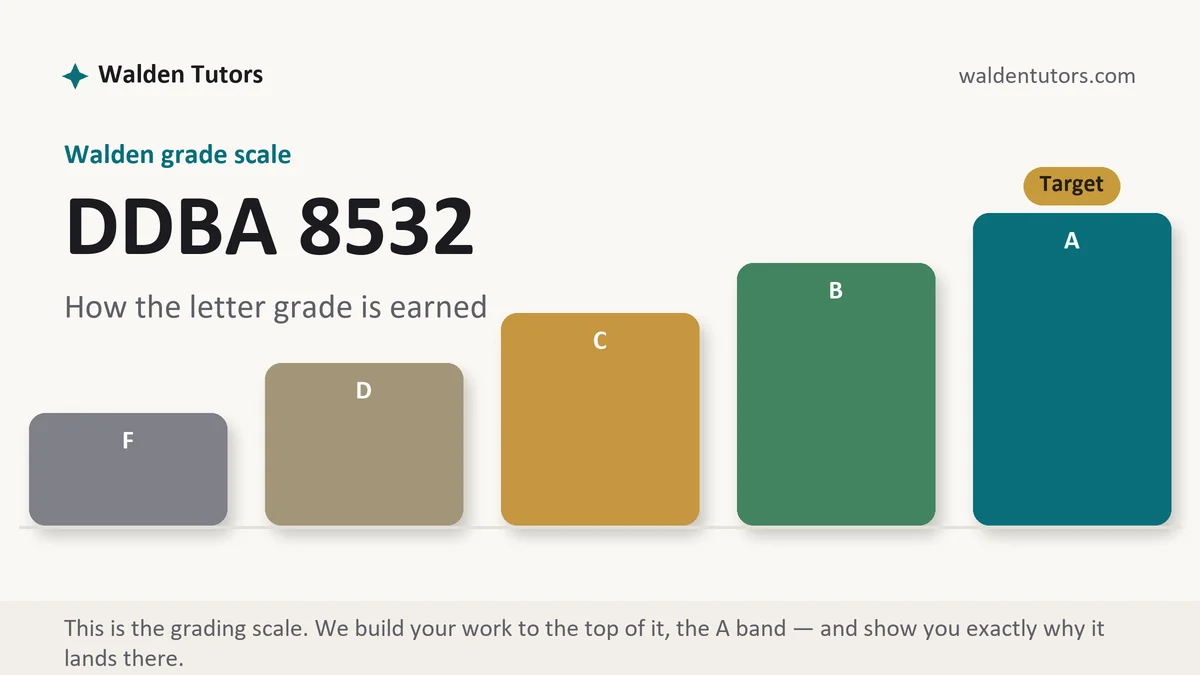
What DDBA 8532 actually grades
Walden frames the seminar around the buyer decision process and the consequences it carries for how, where and when a product is marketed. Inside that frame the reading covers individual behavior and the psychology of choice, what motivates a purchase, what satisfaction looks like once the money has moved, and how culture and subculture change the meaning of the same object in different hands. The work is expected to run on established models and the original literature behind them rather than on summaries.
Marks divide roughly into three. There is accuracy: constructs used the way their authors defined them, not stretched to cover anything convenient. There is application: the construct actually explaining a purchase pattern rather than being introduced and abandoned. And there is the managerial turn the description keeps returning to, which is what a firm should do about the behavior once it is understood, from first attraction through a relationship both sides want to keep.
The failure mode is comfortable and hard to spot from inside. Consumer behavior feels intuitive because everyone shops, so drafts fill with confident statements nobody has tested. A doctoral reader will accept your intuition only where a study stands behind it, and will notice the moment one stops standing there.
How we help in this course
Work in 8532 is usually an analysis of a purchase pattern, a research-based discussion contribution, or a longer case synthesis. Tutoring reviews your draft against the live scoring guide and returns a short row map so you can see how the argument fits the criteria and where it still needs revision. You remain the author and verify every source and claim.
Criterion-mapped feedback can come back inside 24 to 48 hours. One review checks your argument against the live rows, and a second checks APA, source use, and originality. Name the category or brand used in your own analysis so the feedback remains specific. You decide what to adopt, verify every claim, and submit only work you can defend.
Weekly manuals for this course
We put up a manual for a week of 8532 once that week has been checked against the live classroom, and not one day earlier. Walden hands syllabi to enrolled students rather than publishing them, so any outside page that prints this seminar's deliverables in order is filling gaps with guesswork.
Treat the calendar as answered. Walden does run the DBA on quarters as well as on semesters, but the quarter build numbers its courses DBAX and this one is numbered DDBA, which puts your pacing inside a semester. Read the term dates in your student portal rather than a figure from a page like this one. The nightly deadline is stable across both patterns, 10:59 p.m. in Central time and 11:59 p.m. for anyone on Eastern. No manual for the week you are in? Say so in chat and you will have scope and pricing before the day is out.
Facing an 8532 analysis this week?
Send the prompt, the scoring guide and the product category you care about. First premium draft free, back in two days.
How to actually write DDBA 8532: give the buyer a verb
Take the scoring guide apart before you write anything. Each row becomes a heading in a blank file, with its share of the marks noted beside it, and that skeleton is what you fill. It sounds mechanical because it is, and it is the fastest protection against a paper that is interesting in the wrong proportions.
Then cut the topic down until it has edges. Consumer behavior in retail is not a paper. One decision, made by one identifiable group of buyers, in one category, over a defined stretch of time is a paper: households switching from branded to store-label staples during a squeeze on incomes, first-time buyers of a durable they expect to keep a decade, subscribers deciding in month three whether to cancel. Write your case in a sentence and pin it above the draft.
Say which stage of the decision you are working in, because the constructs differ by stage and mixing them is what makes drafts feel muddled. Before the purchase, you are dealing with problem recognition, how much searching people are willing to do, and the rules they use to compare options. At the moment of purchase you are dealing with the setting, the framing of the price and whatever interrupts the plan. Afterwards you are dealing with satisfaction, regret, complaint and repeat. A paper that announces its stage in the opening paragraph reads twice as clearly as one that wanders between all three.
Now the verb work, which is where the grade is actually made. Search your draft for phrases like "is influenced by", "plays a role in", "is impacted by" and "is affected by". Every one of them hides the mechanism the seminar wants you to name. The repair is to ask what the buyer is doing when the alleged influence happens, then write that. Not "the shopper is influenced by the reference price" but "the shopper judges the shelf price against what they paid last time, and treats the gap as unfairness rather than as cost." Not "brand loyalty impacts repurchase" but "the buyer stops evaluating alternatives once the brand has performed twice, which makes the third purchase automatic." The second version in each pair states a testable claim you can then support with published work, and testable claims are what fill the top of a rubric row.
Handle culture with care and precision. The seminar asks you to analyze behavior through cultural and subcultural lenses, which is not permission to describe groups of people as though they shared a temperament. Keep the analysis at the level of shared meaning and practice: what an object signifies inside a group, who is expected to make the decision, which occasions carry obligation to spend, how a household divides that choice. Cite studies rather than impressions, and state plainly that differences within any group run wider than the differences between groups. A doctoral reader is watching for exactly this discipline, and its absence is expensive.
Finish where the description finishes, on the relationship. Satisfaction is not a mood; it is a comparison between what was expected and what arrived, which means a firm can raise satisfaction by managing either side of that comparison, and both moves have consequences. Follow the purchase forward into regret, complaint behavior and repeat buying, and say what the company should do at each of those points. Then close with the measure: what would show, within a period you specify, that the recommendation worked.
For sourcing, go through the Walden Library instead of a general search, since the consumer research and psychology journals a doctoral reader expects sit inside subscription databases. When you cite an experiment, carry its boundaries with it, because an effect found among undergraduates in a laboratory does not automatically hold for procurement in a recession, and pretending otherwise is the quickest way to lose an evidence row. Under APA 7, put author and year in the clause that makes the claim, keep heading levels consistent from the first page to the last, and make sure nothing sits in the reference list unmentioned in the text. Walden's Writing Center holds the formatting guidance your grader is using, and matching it is far cheaper than arguing about it afterwards.
| Section | What it does | Common failure |
|---|---|---|
| Case and buyer group | Fixes one decision, one identifiable set of buyers, one category and one period. | A paper about shoppers in general, so no claim in it can be checked. |
| Stage of the decision | Declares whether the analysis sits before, during or after the purchase. | Constructs from all three stages mixed together until the argument loses its thread. |
| Motivation and choice | Names the mechanism driving the behavior and cites the work that established it. | Vague influence language standing in for a mechanism nobody ever names. |
| Cultural and subcultural reading | Explains what the product means inside a group and who is expected to decide. | Group traits asserted, turning a cultural analysis into a set of stereotypes. |
| Post-purchase and relationship | Follows satisfaction, regret, complaint and repurchase into what the firm should do. | The paper stopping at the till, with the relationship half of the brief untouched. |
| Managerial recommendation | States the action, who it targets, and the measure that would prove it worked. | Advice written so broadly that any company in any category could receive it. |
Threads where everyone has a shopping story
This is the seminar where discussion boards fill with anecdote, because every person in the room is also a consumer and the material invites recognition. Recognition is not analysis. Use a story if it helps, then immediately name the construct it illustrates and cite the study that supports it, so the post moves from something you noticed to something the field has examined.
The participation expectation at Walden is substantive contribution, delivered on schedule, and the grading policy advises spreading your posts over at least two to four different days instead of dropping everything in one sitting. Walden is clear that these expectations move from one course to the next and from one week to the next, so read the brief in your own classroom before assuming anything. In replies, aim at the mechanism: ask which stage of the decision your classmate is describing, ask what evidence separates their explanation from an obvious rival one, ask what a firm would do differently if they were right.
The mistakes that cost points in DDBA 8532
- Influence verbs standing in for mechanisms, so nothing in the paragraph can be tested or argued with.
- Personal shopping habits generalized to a population, with no study anywhere behind the claim.
- Constructs borrowed loosely, so motivation, attitude and preference end up doing each other's work.
- Cultural analysis written as group traits rather than as shared meaning and practice.
- Laboratory effects transplanted to a real market without a word about boundary conditions.
- The paper ending at the purchase, leaving satisfaction and repeat behavior unexamined.
- Recommendations general enough to send to any firm, which is the same as sending them to none.
DDBA 8532 questions students actually ask
May I use myself as the example shopper?
Sparingly, and never as proof. A short personal illustration can make an abstract construct land, and doctoral readers accept that when it is clearly framed as illustration. What sinks a paper is generalizing outward from one life, because a sample of one has no boundary conditions and no variance. If your own experience is what got you interested in the question, say so in a sentence, then go and find the published work that tested the same idea on a population.
How do I write about culture without stereotyping?
Write about shared meaning rather than about people. A cultural group does not have a shopping personality, but a group can share what an object signifies, who is expected to decide, and which occasions call for spending. Anchor every cultural claim in a study rather than in impression, keep the unit at the level of practice and meaning, and say out loud that variation inside any group is larger than the gap between groups. That single sentence protects most of what follows.
Do I have to collect data, or is this a literature paper?
Your prompt and scoring guide decide, and in this seminar the work is normally argued from published research rather than from a study you run. Where an assignment asks for original formulation, that usually means proposing a question and a defensible design, not fielding a survey inside a single term. Read the guide for the word it uses. Propose, examine and analyze point at different amounts of work, and writing beyond the verb earns you nothing extra.