Half a minute into your submission, before a full paragraph has been read, a DDBA 8570 grader has formed a view from the title, the headings and the opening line. What they are testing in that glance is whether the paper is genuinely about a portfolio or about one project wearing a portfolio label. Walden lists this seminar as Seminar in Program and Portfolio Management at 3 semester credits inside the DBA project management concentration, and the graded work is written throughout.
What DDBA 8570 actually grades
The catalog builds this seminar around program and portfolio management as a field of practice, and around the competencies a doctoral practitioner needs when initiatives run across time zones, business units and contract boundaries. Four themes carry most of the graded weight. Tying the shape of a portfolio to the strategy and the value an organization claims to want. Judging why portfolio management held together in one setting and came apart in another. Putting defensible numbers against portfolio performance. Asking what a portfolio structure does to an organization's appetite for trying new things. Your own scoring guide fixes the rows for each assignment, so read it before you assume, but those four subjects keep resurfacing.
Everything graded arrives as writing: seminar papers, applied analyses of a named organization's project spending, and threads where you defend a position against colleagues who manage portfolios themselves. The line between bands is almost never reading volume. It is the unit of analysis. Scholars who run projects for a living write beautifully about one initiative and file it as portfolio work, and the alignment rows catch that every time. What the rows want are decisions taken across a set: what got funded, what got starved, what the trade was, and whose signature settled it.
So spend disproportionate care on the three artifacts a reader meets first. Put the portfolio in your title rather than the project. Make your first heading a decision, not a background section. Let the opening sentence say what the organization was trying to buy with its project money. Those thirty seconds set the frame every later page is read inside, and a frame set wrongly is expensive to recover from.
How we help in this course
Hand over the assignment file and its scoring guide and you get an original draft written against those specific rows, plus a short map showing which passage answers which row. For portfolio work we also want anything you can share about the organization you chose, because an argument assembled from sector generalities reads thin at doctoral level and editing does not repair it afterwards.
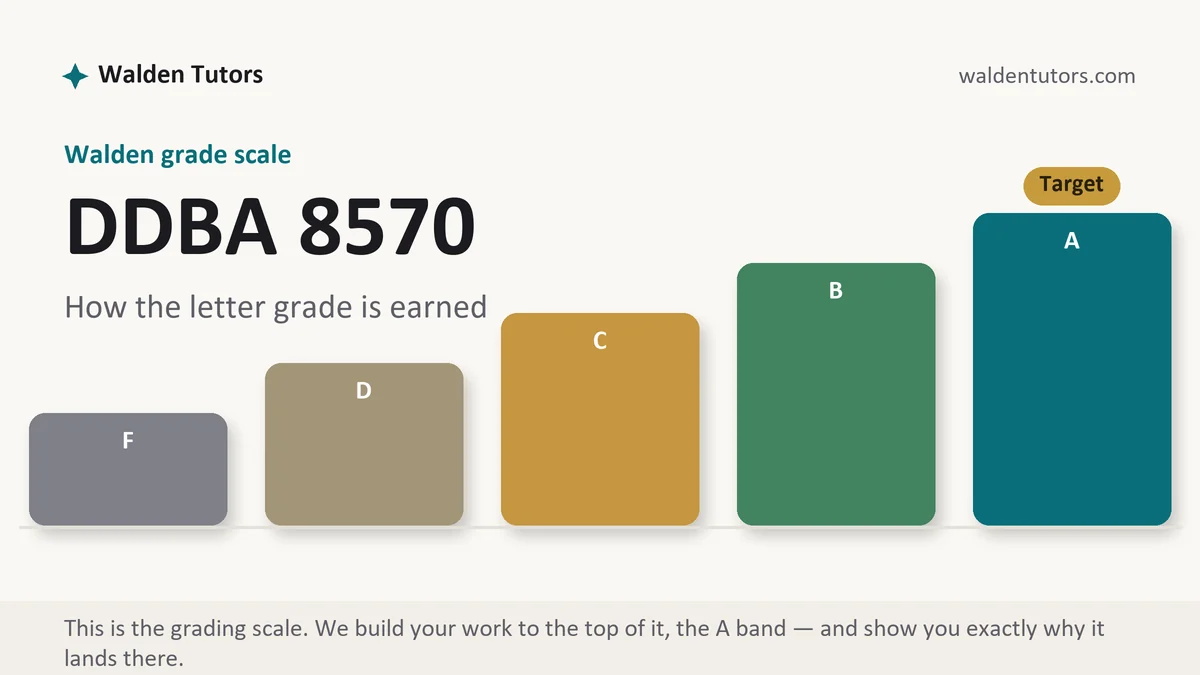
The commercial terms are the ones running across this whole site. Drafts return inside 24 to 48 hours. On a course-based rubric the target is an A. Two reviewers read the piece independently before it reaches you, one marking it the way your instructor would and one auditing citations and originality. Revision costs nothing and continues until you are satisfied. Attach something you wrote earlier and the register comes back near enough to your own that personalizing it takes an evening rather than a weekend.
Weekly manuals for this course
Nothing goes up for an individual 8570 week until that week has been checked against Walden's own materials. Walden holds its syllabi behind the classroom login, which means any confident deliverable table for this seminar sitting on the open web was assembled by guesswork rather than by reading. Two practical notes about timing belong here. The academic calendar governing your term is the semester one, given that Walden numbers that build DDBA and its quarter build DBAX, so your student portal and not this page is what settles the dates you plan around. Submissions are timestamped against a 10:59 p.m. Central cutoff, which on an Eastern clock reads as 11:59. Nothing published yet for the week you are sitting in? Ask in chat and scope comes back the same day.
Stuck on an 8570 portfolio paper?
Send the prompt with its scoring guide attached. Your first premium sample is free and lands inside two days.
How to actually write DDBA 8570: fix the unit of analysis first
Before any prose exists, write a single sentence naming the organization, the set of initiatives you are treating as the portfolio, and the window of time under examination. Two or three years is usually plenty; a decade turns the paper into a history essay. That sentence is the boundary, and everything you later delete will be deleted because it sat outside it. Then open the scoring guide, list its rows down a blank page, and turn each one into a heading with its point weight written beside it. That weight is a word budget. Doctoral drafts fail on proportion far more often than on substance, and the row carrying the heaviest weight is very often the one written last, at midnight, in two thin paragraphs.
Choose the organization for its evidence rather than your affection for it. You need project spending you can describe with something other than adjectives: how many initiatives are live, roughly how the money splits, which stated objective the spending is meant to serve, and at least one thing that was stopped, deferred or quietly starved. If you work there, that inventory comes out of memory and old meeting notes, and it is worth writing down before you go reading, because reading first has a way of editing what you thought you remembered. If you do not work there, annual reports, capital expenditure disclosures, investor day decks and trade coverage give you portfolio-shaped material you can cite instead of assert.
Now the thesis, and it has to be a claim you could turn out to be wrong about. Portfolio papers drift toward description because description is safe, and safe produces sentences like this one: the organization manages a number of projects across several business units. Nobody can argue with that, which is precisely what makes it worthless to a grader. A thesis that scores commits to a mismatch or a fit. This portfolio is weighted toward one kind of value while the published strategy calls for another, and the reason sits in a named feature of how initiatives get selected. Every clause in a sentence like that hands you a section to write and hands your reader a row to fill in.
Synthesis is where careful readers still lose marks. Three paragraphs describing three articles is not synthesis, however accurate each paragraph happens to be. The rows want the sources arguing with one another. Portfolio scholarship disagrees usefully: one tradition treats selection as an optimization problem answered with scoring models and financial ranking, while another treats it as a political and behavioral process where the ranking gets negotiated and the model is filled in afterwards to justify the result. Run both readings across your organization, declare which one explains what you observed, and name what the other one failed to see. Only someone who read both could write that paragraph, and the synthesis row exists to find it.
Measurement deserves separate discipline, because a performance section written in project vocabulary bleeds points quietly. On time and on budget are project measures. Portfolio questions are different in kind: what share of spend sits behind the priority the board actually named, how long an approved initiative waits before anyone starts it, how many things were killed and how quickly, whether benefits were ever tracked after the closing meeting. Say where each figure would come from. Then admit which ones your organization does not collect at all. Naming a hole in the data is a doctoral move that graders reward; pretending the number exists is the one that ends badly.
Pull your sources through the Walden Library instead of a general web search. The business and management databases there carry peer reviewed work whose provenance survives a committee's questioning, and a subject librarian will put together a proper search strategy far quicker than trial and error manages. Each reference ought to be doing one identifiable job, and you should be able to name that job in a short phrase before you cite it. APA 7 then gets marked twice over, as formatting and as habit: author and year belong inside the clause carrying the claim, heading levels stay consistent from first page to last, and the reference list gets walked against the body text before anything is uploaded. Practitioner standards and consultancy benchmarks belong in this paper as evidence of what firms actually do, with the conceptual claims resting on scholarship.
| Section | What it does | Common failure |
|---|---|---|
| Portfolio and boundary | Names the organization, the initiatives being treated as the portfolio, and the period covered. | A company profile that never says which projects are inside the set under examination. |
| Strategic alignment | Connects what the portfolio contains to a stated objective and the value the firm says it wants. | Strategy lifted from the annual report and never compared against where the money went. |
| Selection and governance | Explains how initiatives enter, get funded, get reprioritised and get stopped. | A governance diagram reproduced with no account of who really settles the funding call. |
| Performance measurement | Proposes measures that operate at portfolio level and says where the data would come from. | Project measures relabelled, so schedule variance gets offered as portfolio performance. |
| Success and failure | Reads one case that worked and one that did not, then explains what separated them. | Only the flattering case, which quietly turns the analysis into advocacy. |
| Innovation capacity | Asks what this portfolio structure does to the firm's willingness to try unproven things. | Innovation asserted as a benefit with no mechanism, no cost and no evidence. |
| Recommendation and risk | States the change, sequences it, names its owner, and says what failure would look like. | Advantages listed without ownership, without order and without any signal of trouble. |
Threads where a portfolio argument gets tested
A doctoral thread in this seminar is a compact argument carrying sources, not a compressed essay. Open on the position. Support it with one source you have genuinely appraised rather than three you can merely name. Add the sentence only somebody who has sat through a funding meeting could produce. Then stop. Length is not the currency in these rows; commitment is, and knowing when to stop is part of what gets marked.
Walden's grading policy asks that participation be substantive, regular and on time, and the guidance names a floor of two to four separate posting days, which rules out packing the week into one evening. The university also states plainly that what a thread demands varies from course to course and sometimes between weeks, which leaves the brief inside your own classroom as the only guide worth trusting. Replies carry a row of their own, so agreement earns nothing at all. Do something to the post in front of you: run your colleague's selection model against a portfolio whose internal politics would break it, supply the measurement problem their recommendation walks past, or isolate the assumption holding their argument upright and ask whether it survives outside their industry. Name the person, quote the line you are answering, and allow yourself to disagree in writing.
The mistakes that cost points in DDBA 8570
- Writing a single project case study and filing it as portfolio management, which the alignment rows detect on the first page.
- Quoting the published strategy statement and never once testing it against where the funding actually landed.
- Performance sections assembled from schedule and cost variance, measures that describe projects rather than portfolios.
- Choosing only the initiatives that succeeded, so the paper ends up arguing a case instead of examining one.
- Governance described the way the org chart claims it works, with nothing about the informal route real decisions take.
- Recommendations generic enough that any firm running projects could adopt them unchanged.
- Program and portfolio used as synonyms, which tells a grader the framing was never settled.
DDBA 8570 questions students actually ask
Can I write this paper about my employer's portfolio if I only see part of it?
Yes, and a bounded slice usually reads better than a whole-enterprise sweep assembled from hearsay. State early what sits inside your view and what does not: one division's capital projects, one funding cycle, one category of spend. Then hold every claim inside that boundary. A limitation declared openly earns more credit than a modest scope costs you. The submissions that suffer are the ones quietly writing about an entire organization on evidence drawn from a single corner of it.
How is program management different from portfolio management here?
A program is a set of related efforts chasing one benefit together, so the argument turns on coordination, dependencies and shared outcomes. A portfolio is everything competing for the same money, so the argument turns on selection, priority and what gets stopped. This seminar covers both levels, and using the two words interchangeably is the quickest way to forfeit the framing row. Decide which level your assignment wants, define it in your own words on the first page, and stay there.
Do I need real financial figures for the performance section?
Not always, but you do have to be straight about what you hold. Where figures are public, use them and cite the filing they came from. Where they are confidential, name the measure, explain what it would reveal, and note that the value is not disclosed. Where the organization tracks nothing of the kind, say that too, since an unmeasured portfolio is itself a finding worth several paragraphs. Inventing plausible numbers is the only choice here with real consequences, and invented precision is easy for a doctoral reader to spot.