Walden's catalog lists this one as The New HR: The Savvy Strategic Partner, 3 semester credits, in the DBA. Within the first half minute a reader is looking for one specific thing on your opening page: an actual decision. Which HR service, which sourcing option, whose money. Papers that put a live make, buy or partner question in front of the reader hold their marks. Papers that argue human resources deserves a seat at the table are answering a question nobody in a doctoral seminar is still asking.
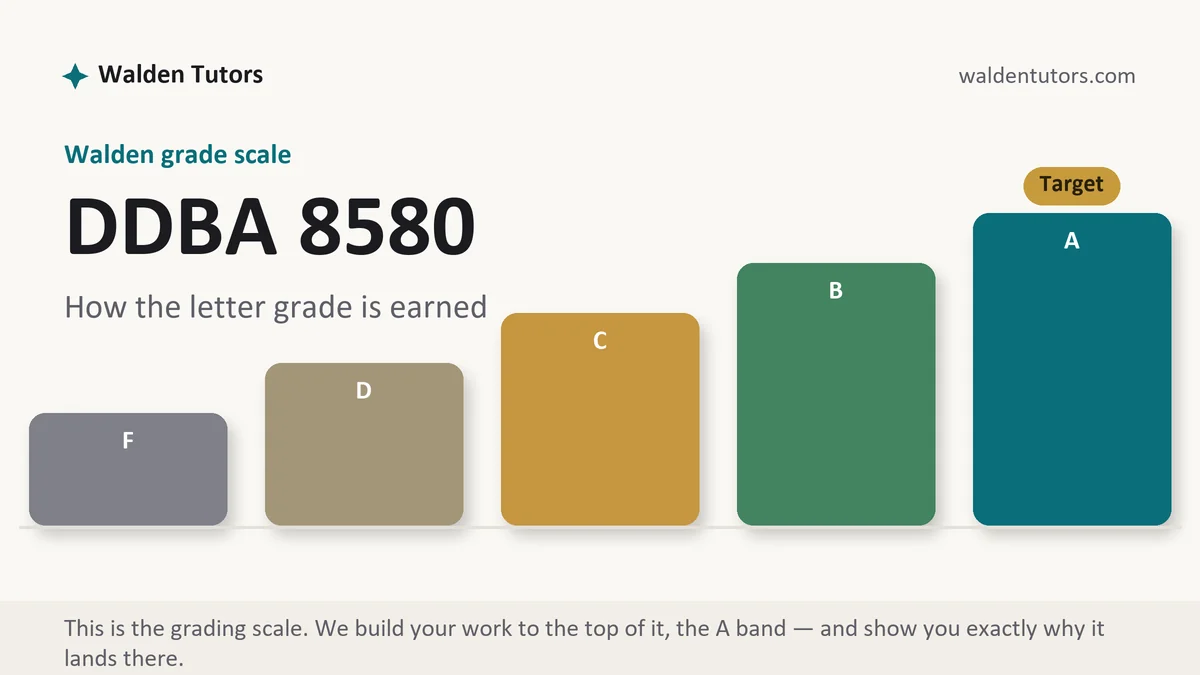
What DDBA 8580 actually grades
The course description sets up HR as a partner whose new functions are supposed to help an organization run as a high performing and cost aware operation, and it then points at the decisions that come with the role. Evaluating partnership alternatives. Weighing what should be delivered internally against what could be bought. Service agreements, the negotiation that produces them, and the case where an entire function moves to a provider. Finally, and this is where the doctoral weight sits, assessing what those choices do to the quality of what gets delivered and what risk they leave behind for HR and for the wider business.
Assignments arrive as written analysis: sourcing evaluations built on a named organization, contract and service level design pieces, risk assessments, and graded threads where classmates who have run these transitions will spot a claim that has never met a vendor. Read your own scoring guide first, because the rows are set per assignment. The pattern underneath tends to hold: a decision framed clearly, options compared on the same basis, costs treated honestly, contractual mechanisms understood rather than named, and risk followed to whoever ends up carrying it.
The thirty second test is worth designing for deliberately. Your title should name the service and the choice. Your first heading should be the decision or the current state, never a definition of strategic partnership. Your opening sentence should say what the organization is trying to buy, save or protect. Get those three right and every later section is read as part of an argument rather than as an essay looking for one.
How we help in this course
Hand across the prompt and whatever rubric arrived with it. What returns is an original draft arranged around those rows, with a short map showing which passage covers each. For 8580 we also ask what you can share about the function you are writing about, in particular how the work is currently split and roughly how many people touch it, because a sourcing argument without a current-state picture will read as generic no matter how careful the later analysis is.
The terms are unchanged from the rest of the site. Drafts arrive within 24 to 48 hours. On course-based rubrics we aim at an A. Two reviewers see the work separately before you do, one marking it against the rows and one checking APA and originality, and revisions stay free until you are satisfied with it. Attach something you wrote previously and the voice comes back near enough to your own that the personalizing pass is short.
Weekly manuals for this course
A week of 8580 gets its manual after verification, never before, and the gap does not get filled with a guessed grid. Course outlines are distributed through the classroom rather than published openly, so the deliverable list for a DBA elective is not something an outside site can print honestly. On dates, the course code is exactly what tells you the calendar, because Walden gives the semester build of this doctorate DDBA numbers and the quarter build DBAX numbers, so treat the student portal as the record that decides your own start and finish. Regardless of which one applies, submissions are due by 10:59 p.m. Central, or 11:59 p.m. if your clock is set to Eastern. If your week is not covered yet, drop it into chat and the drafting work starts anyway.
Working on an 8580 sourcing analysis?
Send the assignment and its scoring guide. First premium sample free, returned inside two days.
How to actually write DDBA 8580: put a sourcing decision on the table
Write the decision sentence before anything else. One line naming the organization, the specific HR service under examination, the options genuinely available, and who signs the outcome. Payroll processing for eleven hundred employees across two countries, currently run by four people internally, with shared services, co-sourcing and a full transfer to a provider on the table. That sentence is worth more than any amount of introduction, because it makes every subsequent section either relevant or removable. Then take the scoring guide, copy its rows onto a blank page, convert each into a heading and write the point weight next to it. Weight is your word allowance, and proportion failures cost more doctoral marks than reasoning failures do.
Map the current state next, in units a reader can check. How many people are involved and at what grade. What volume passes through in a month. Which systems the work sits on and who licenses them. Where errors currently happen and what they cost when they do. Managers who live inside the function tend to skip this because it feels obvious, and then the comparison section has nothing to compare against. If you cannot obtain real figures, build the picture from what you can defend and label the assumptions plainly. Stated assumptions are acceptable at doctoral level. Numbers presented as fact when they were estimates are not.
Now compare the options on identical terms, which is where most drafts quietly cheat. The in-house option gets costed at salaries while the outsourced option gets costed at the vendor's quoted fee, and the comparison is decided before any analysis happens. A defensible model prices both sides fully: transition and one-time separation costs, the retained team that manages the relationship afterwards, the contract governance nobody budgets for, the systems that stay behind, and the cost of getting out again in a few years. Then run the two numbers you are least sure about up and down, and say whether the recommendation survives. A conclusion shown to hold across a range of assumptions is worth considerably more than one balanced on a single spreadsheet.
Give the service agreement a section that explains mechanisms rather than listing clause titles. Four provisions usually carry the argument. What is inside scope and what is billed as extra, because the boundary is where disputes are born. What the service levels actually measure, and whether they measure the thing the business cares about or the thing that is easy to count. What remedy applies when a level is missed, and whether that remedy is proportionate to the harm or merely a small credit against next quarter's invoice. And what happens at the end, including whether the provider is obliged to help you leave. An exit clause is where the real negotiating power sits, and papers that treat it as an afterthought are missing the most examinable thing in the whole contract.
Then follow the risk to whoever ends up holding it. Outsourcing moves execution; it rarely moves accountability. If a payroll provider mishandles data, the regulator and the employees still arrive at your door. Write about the quality of what gets delivered, about compliance exposure, about the knowledge that walks out of the building and cannot easily be bought back, and about dependency, which is the risk that grows quietly as your remaining team loses the ability to do the work themselves. Each one wants a control attached: a measure, an audit right, a retained capability, or a contractual term. Risks listed without controls read as a worry list rather than an analysis.
Synthesis is the row that rewards reading properly. Put the traditions into contact instead of summarizing them in turn. Transaction cost reasoning says buy what is standard and frequent, keep what is specific to you, and watch the cost of writing and policing the contract. A resource-based reading says never outsource what makes you different, whatever the price comparison shows. The literature on the HR business partner model adds a third voice, some of it enthusiastic and some of it arguing that splitting the function into service delivery and advice hollowed out the advice. Run all three at your own case, say which explains the situation best, and name what the others fail to see. Pull the sources through the Walden Library, where the business and HR databases give you material with provenance a committee will accept, and where a librarian will build the search faster than guessing at terms. APA 7 wants author and year inside the clause carrying the claim, heading levels held steady, and the reference list reconciled against the citations before you upload. Vendor case studies and industry benchmarks belong here as evidence of practice, with the conceptual argument resting on peer reviewed work.
| Section | What it does | Common failure |
|---|---|---|
| Decision framing | Names the service, the options on the table and the person who owns the outcome. | An opening essay on why human resources matters, with no decision anywhere in it. |
| Current state | Describes today's delivery in headcount, volume, systems and known failure points. | The existing arrangement assumed to be understood, leaving nothing to compare against. |
| Options compared | Prices and assesses each alternative on the same basis and the same time horizon. | Internal salaries set against a vendor fee, which decides the answer before the analysis. |
| Cost case | Includes transition, retained management, governance and eventual exit, with assumptions labeled. | A single savings percentage borrowed from a benchmark and treated as this organization's number. |
| Service agreement | Explains scope boundaries, measures, remedies and exit obligations as working mechanisms. | Clause headings reproduced from a template with no account of what any of them do. |
| Risk and control | Traces quality, compliance, knowledge and dependency risk to whoever actually carries it. | A list of risks with no owner, no control and no way of noticing one has materialised. |
| Recommendation | States the decision, sequences the transition, and names what would signal it going wrong. | Benefits summarized, with no timeline, no owner and no trigger for reversing course. |
Threads where somebody has run the transition
Assume at least one classmate has sat on the buying side of a deal like the one you are describing, and write for that reader. Open with your position, support it with a single source you have properly weighed, then contribute the detail only experience supplies: the service level that was met every month while the business got worse, the transition that ran to plan and lost the two people who knew why the process existed. Practitioner evidence presented as evidence, and cited where it can be, reads as doctoral work. Then stop, because the row is not measuring length.
Walden expects participation to be substantive, regular and delivered on time, and the recommendation is to spread contributions over a minimum of two to four days instead of one sitting. The university also states that thread requirements are not the same everywhere, varying by course and sometimes from one week to the next, so your own classroom instructions decide what counts. Replies score on a separate row, which means agreement adds nothing. Push the argument forward: ask what their cost model does when volumes fall by a fifth, point at the clause that would have prevented the outcome they described, or question whether the capability they are willing to outsource is really as undifferentiated as they assume. Name the person, quote the line, and be willing to hold a different view in writing.
The mistakes that cost points in DDBA 8580
- An advocacy essay about the value of the HR function where the assignment wanted a sourcing decision.
- Comparing internal salary cost against a vendor price without pricing transition, governance or exit.
- Service levels quoted as percentages with no explanation of what they measure or what happens when they slip.
- Treating a contract as though it transfers accountability, when it only ever transfers execution.
- Risk sections that name exposures and attach no control, no owner and no early warning to any of them.
- Benchmark savings figures imported from an industry report and applied to a firm that resembles nothing in it.
- No exit provision discussed, which leaves the paper silent on the point of maximum commercial danger.
DDBA 8580 questions students actually ask
Do I have to recommend outsourcing to score well?
No. The rows reward a defended decision, not a particular one, and keeping a service in house is a legitimate finding when the analysis supports it. What loses marks is arriving at retention by default, without ever having priced the alternative or asked why the current arrangement exists. Run the comparison properly, show the numbers and the risks, then say what you would do. A paper concluding that this service should stay where it is, for three stated reasons, reads far stronger than one recommending a transition it never costed.
What if I cannot get my employer's HR cost data?
Build the model with stated assumptions and label them as such. Headcount, salary bands and volumes are often reconstructable from what you can see, and published benchmarks give you ranges you can cite for the rest. Write the source or the assumption beside every figure, then test the conclusion by moving your two least certain numbers up and down. If the decision holds across that range, say so, because a recommendation shown to survive uncertainty is worth more than one resting on figures presented as exact. Confidential values should be described rather than guessed at.
How much contract detail belongs in an academic paper?
Enough to prove the mechanism, not enough to read as a draft agreement. Pick the three or four provisions that actually carry your argument, usually the service measures, the remedy for missing them, the route for changing scope, and the exit terms, and explain what each one is doing and what happens without it. Two paragraphs on a well chosen exit clause beat six pages of clause headings. Your reader is assessing whether you understand where risk moves and where it stays, not whether you can reproduce a template.