DDBA 9001 is the enrollment you hold while the doctoral study itself is being written. Walden's catalog fixes it at 3 semester credits per term across a minimum of five terms of continuous enrollment, and it counts two eight-week terms inside each semester, so that floor is closer to two and a half semesters than to five. You arrive here after the methodology coursework and the sequence of DDBA 8101 mentoring terms that precede it. There is no ordinary assignment list. The deliverable is one long document, released a section at a time, and it advances only when the readers who have to approve it say it does.
What DDBA 9001 actually grades
One document, plus the permissions attached to it. Walden's published account of this course names the queue a finished study has to clear: academic approval from your committee members and from the Institutional Review Board, a Form and Style Review it has to pass, approval won at the oral defense, final sign-off from the chief academic officer, and publication on ProQuest before the degree is conferred. Individual programs can route a study past further independent evaluators on top of that list, so ask your chair who else will be reading you in your specialization. Nothing written between those checkpoints scores on its own. A section either satisfies the reader holding it or comes back carrying comments.
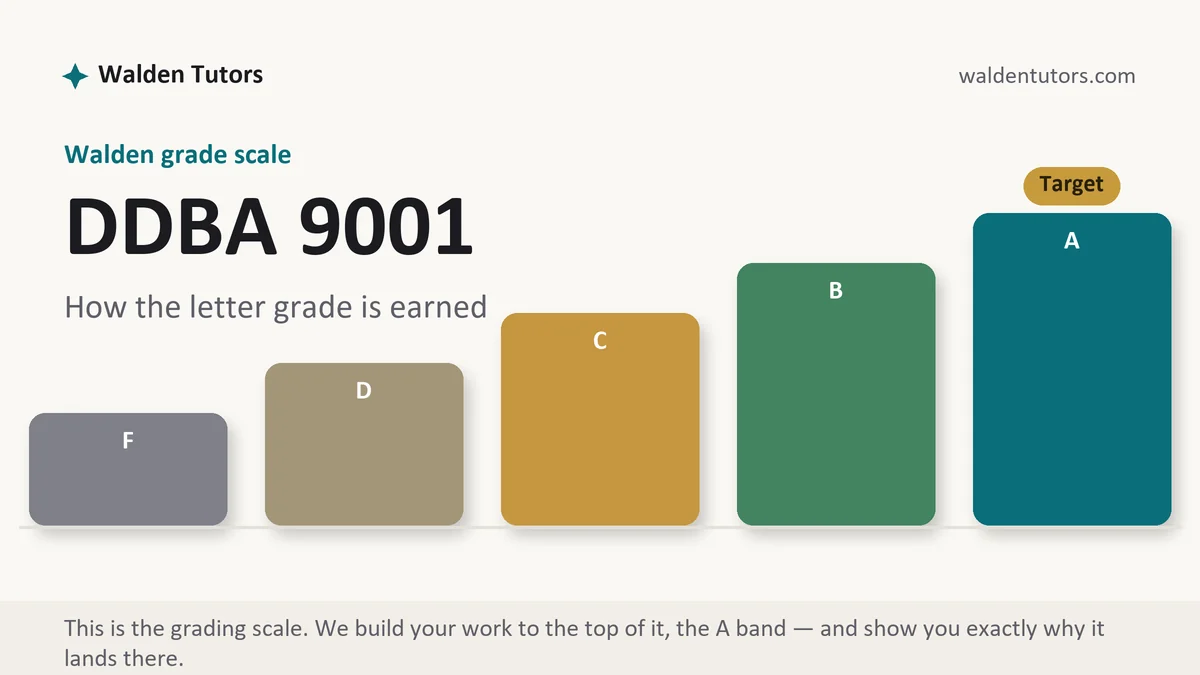
That shifts what grading means compared with the coursework behind you. Section reviews sit closer to pass or return than to partial credit, so the useful question stops being how many points a paragraph is worth and becomes whether a reader can find, inside that paragraph, the thing the standard says has to be there. Two audiences decide it: the rubric or checklist your program applies, and the chair who applies it. Write for the first, and talk to the second.
How we help in this course
We run the study as a dated section plan instead of a pile of chapters. Each piece is drafted in doctoral register, scored in-house against the standard your program uses, and tightened before your chair ever opens it, which keeps the comments you receive about substance rather than about things a checklist would have caught. When feedback lands, it goes into a revision inside days.
Terms are the ones the rest of this site runs on. Work returns inside 24 to 48 hours. A research analyst reads your program's standard before a writer opens the file, one review pass scores the draft against that standard, a second looks at nothing but APA and originality, and rewriting carries on until the section reaches its target. Pricing follows the plan in stages, so you are never paying ahead of a section that is not moving.
Weekly manuals for this course
This course does not run on a published weekly grid, and nothing on this page will invent one. Per-section manuals go up as each is verified against Walden's own materials. Where the piece in front of you is not covered yet, raise it in chat and somebody reading current committee feedback will tell you what that requirement looks like now. Drafting support never waits for a manual to exist.
How your enrollment maps onto the calendar is a question for your student portal. The catalog counts this course in terms rather than in weeks, and the DDBA numbering puts those terms inside the semester build of the doctorate, the quarter build completing its capstone under a DBAX code, so the schedule printed in your own portal is the authority on when anything is due, not a pattern remembered from an earlier course.
Stuck on a DDBA 9001 section?
Send the section, the rubric or checklist, and your chair's last set of comments. One premium sample is written free of charge before anything gets invoiced.
The approval queue sets your pace
Most people who stall in this course are not slow writers. They are waiting. A section goes to a chair, the chair reads it when the chair can, comments return, a revision goes back out, and somewhere inside that loop a month disappears that nobody spent writing. The queue described above is not paperwork bolted onto the end of the project. It is the real schedule, and every gate in it belongs to somebody whose calendar you do not control.
Which leaves one pacing rule worth keeping: nothing should sit idle while something else is under review. Draft the next section while the current one is being read, and revise a returned section while a newer one waits its turn. Put dates against the remaining sections at the start and mark the review windows you expect, and the empty stretches appear on paper before they appear in your life. Ask your chair early what turnaround to plan around, and ask what the Institutional Review Board usually wants from a design shaped like yours, because those two answers reshape a schedule far more than your typing speed ever will.
Keep a decision log beside the document. Each time something gets settled about the problem, the design, the sample or the analysis, record what was decided, who agreed, and when. A project this long outlives your memory of it, and at the defense you will be asked to justify a choice you made a year earlier.
How to actually write DDBA 9001: turn the rubric rows into the outline
Before you write a sentence, build the file you are going to write into. Find the sheet your program scores this section against, whether that turns out to be a rubric, a checklist or the capstone template itself, and copy its rows into an empty document as headings. What sits on your screen now is not an outline you invented. It is the reader's own list of questions, in the order the reader will ask them. From that point every paragraph you produce has an address, and anything without one is either in the wrong place or unnecessary. Discovering that at the outline stage costs you minutes; discovering it after a review costs you a term.
Then label what each row is really asking for: a claim, an evidence chain, a justification, or a plain description. Rows demanding justification need the rejected alternatives visible on the page, and those are the rows that come back most often, because writers describe what they did and never say what else they weighed. Rows demanding evidence need the citation sitting inside the sentence that makes the claim. Rows asking only for description can be written quickly, and knowing which ones those are is how you protect your best hours for the sections that need them.
Start the study itself at the problem, since everything downstream inherits whatever is wrong with it. A workable doctoral study problem is narrow enough for one researcher to address inside one collection window, and it stands on two supports at once: what recent literature reports, and what practice documents. Test yours by asking what evidence would settle it. If no method suggests itself from the sentence, what you are holding is still a topic. Once the problem holds, the rest is a chain that has to stay aligned in both directions. Purpose follows problem, question follows purpose, design follows question, data follow design, findings answer the question, and the application section returns to the problem you opened with. When a section keeps coming back, the fault usually sits one or two links upstream of the pages being returned.
Write the review of literature as an argument, not a catalog. That section exists to establish what is settled, where the field contradicts itself, and what nobody has answered, so that your study lands in a gap you have just demonstrated. Synthesis is the mechanical difference between a review that clears and one that does not. A summarizing review gives each source its own paragraph. A synthesizing review gives each idea its own paragraph and brings in the three or four authors who bear on that idea, including the ones who disagree with each other. If your paragraphs are named after authors, you have not started synthesizing yet.
| Section | What it has to do | Where it usually fails |
|---|---|---|
| Problem and background | Name the business problem, show recent literature reports it, and show practice records it. | The sentence describes an area of interest, so no method can be built from it. |
| Purpose and research question | State the study's aim and the single question it sets out to settle, both worded to echo the problem. | The question was sharpened in one draft and the purpose statement never caught up. |
| Conceptual framework | Name the lens, justify its fit for this problem, and show how it will shape the analysis. | The framework is introduced early, then abandoned the moment data arrives. |
| Review of literature | Build the case that the gap is real and that this study is the thing that addresses it. | One source per paragraph, which hands the reader a reading list instead of an argument. |
| Method and design | Population, sampling, instruments, procedures, ethics, and the reasoning behind each of them. | Decisions stated as settled fact, with no alternative weighed and no limitation admitted. |
| Findings and application | What the data showed, what it means against the framework, and what practice should change. | Results reported and never carried back to the problem that justified collecting them. |
Discussion posts and peer threads in a capstone term
A graded thread runs in some capstone terms and not in others, so open the classroom and look instead of working from what the last course did. Where you find one, it is scored on rows of its own like any Walden discussion, and it tends to ask for a progress report, a methodological problem put up for comment, or a fragment of a section offered for peer reading. The posts that earn the row name a real difficulty. Saying you are working on chapter two teaches nobody anything. Saying that your interview protocol has eleven questions and four of them keep producing the same answer, and that you cannot tell whether that is saturation or a badly written instrument, draws replies from people who have solved it, and it reads to a grader as scholarly engagement rather than attendance.
Replies are a separately scored event with a closing time the classroom sets rather than one you can infer from habit. Substantive, punctual participation is what the published grading policy wants, and the minimum spread it recommends is two to four separate days, so the thread needs you in it on more than one evening. The classroom stops accepting posts at 10:59 in the evening Central, which reads as 11:59 to anybody in your cohort on Eastern, and a post landing at 11:15 Central is late whichever clock hangs on your wall. When you answer somebody, quote the exact sentence you are responding to and say what you would change and why. Agreement adds nothing to a thread and nothing to the row.
Citations, APA 7 and the Walden Library
The doctoral study is the most format-sensitive document Walden will ever ask you for, and the template decides much of that formatting before you type. Use it exactly as issued: heading levels, seriation, table and figure treatment, reference list style. Then reconcile the reference list against the in-text citations in both directions, so nothing is cited without an entry and nothing sits in the list uncited. Form and Style is a named gate in this course, and it is the one that sends studies back for reasons that have nothing at all to do with research quality.
What counts as an acceptable source changes once you reach the capstone, and it changes in two directions at once. Programs generally want the weight of the review peer reviewed and current at the point the study finishes rather than the point it was proposed, which makes the review a section you keep returning to. Confirm the currency standard your own program applies instead of guessing. Search the Walden Library systematically and log the databases and search strings you used, because a review whose own method can be described is far easier to defend than one assembled from memory. Every source should be doing one job you could name in half a sentence, and the citation belongs inside the clause that makes the claim, so a reader meets the evidence and the argument at the same moment.
The mistakes that cost points in DDBA 9001
- A problem sentence that names a subject area, leaving a reader nothing a method could be built around.
- Alignment that drifted apart across drafts, so purpose, question and design no longer describe the same study.
- A framework named in the opening pages and never used again, so the analysis explains nothing in particular.
- Method decisions written as facts, with no rejected alternative on the page and no limitation acknowledged anywhere.
- Ethics and site access treated as end-stage paperwork, when the review board question should have shaped the design.
- Idle weeks spent waiting on one reader with nothing else in draft.
DDBA 9001 questions students actually ask
How many terms does DDBA 9001 actually take?
Walden's catalog sets a floor rather than a forecast: continuous enrollment of 3 semester credits per term, for a minimum of five terms, until the study wins final approval. Read the word term carefully, because the catalog pairs two eight-week terms inside one semester, so five of them is roughly two and a half semesters rather than five academic years' worth of anything. A floor is also not an average. What stretches a capstone is almost never drafting speed, it is the number of times a section goes out and comes back, and that number is decided by how well aligned the study was before any reader saw it. Your chair and your program can say what is realistic for a design like yours, and those figures beat anything posted in a student forum.
Can I collect data at the organization where I work?
Often yes, and it is common in a practice doctorate, but treat it as a design and ethics question before you treat it as a convenience. You will need documented permission from the site, and your Institutional Review Board submission has to address what your role there does to consent, to power dynamics, and to the confidentiality of anyone who reports to you. Raise it with your chair before the study is built around that access, because a design that only works at one employer turns fragile the moment the access changes.
What is the fastest way to shorten a review cycle?
Send work that somebody applying the same standard has already read. Most returned sections come back for reasons a careful pre-read catches: a checklist row not visibly answered, a claim carrying no citation, headings that wandered off the template. Clear those before submission and the comments you get are about the research itself, which is the conversation that moves a study forward. Ask what turnaround you should plan around, put that number in the schedule, and spend the waiting on the next section instead of on your inbox.