In an ethics course, the first thirty seconds of reading answer one question for the grader: is this person going to reason, or are they going to declare. MMPA 6405 is a 5-credit core course in Walden's Master of Public Administration, and it grades whether you can take a philosophical framework, hold it against a real problem of public service, and defend a conclusion somebody could disagree with.
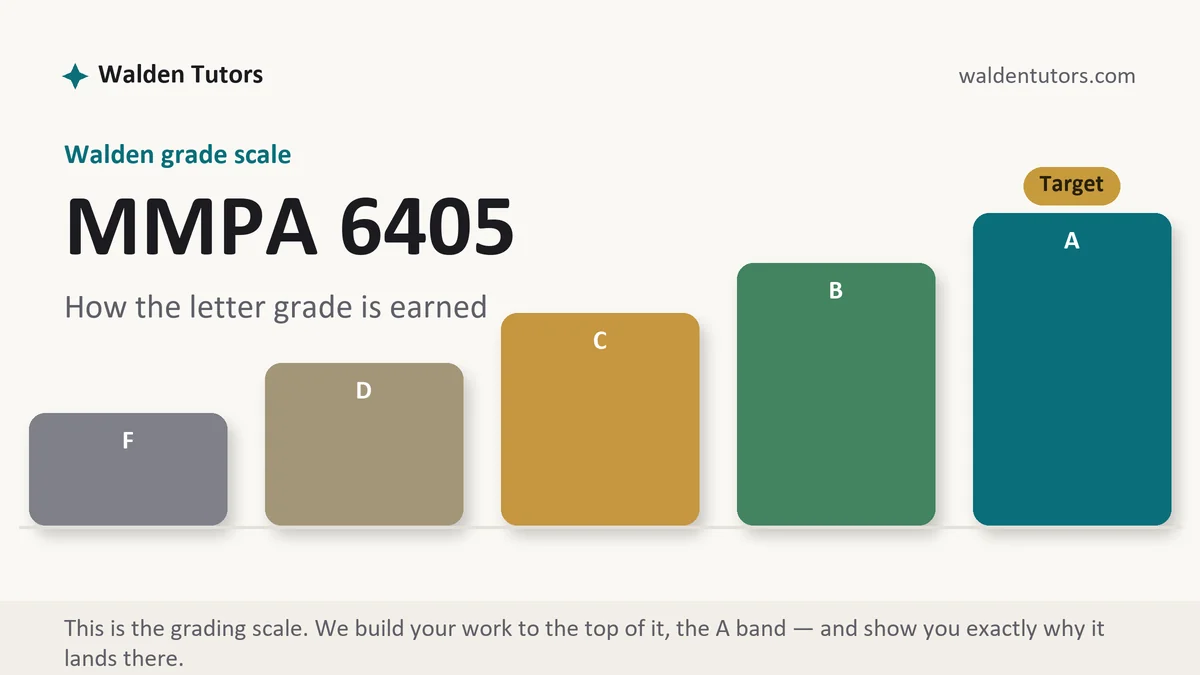
What MMPA 6405 actually grades
Walden's description sets the course on the leading philosophical bases of ethics and the social justice themes underneath public service, taught through seminal texts and case studies about the dilemmas leaders meet while serving diverse populations. The named subject matter includes economic disparity, power imbalance, social privilege, and division along lines of race or religion. Rubric rows follow from that: they want a framework named, a case examined at depth, and recommendations aimed at positive social change that somebody could actually carry out.
The distinguishing demand is reasoning that shows its steps. Most students already hold defensible ethical positions and lose points because the paper states the conclusion and then decorates it, rather than deriving it. A grader can see the difference immediately. Reasoning names its principle, applies it to specific facts, meets the strongest objection, and only then concludes. Declaring skips to the end and hopes the reader agrees.
The course runs at 5 credits and sits behind a foundations prerequisite, most commonly MMPA 6116 for MPA students. Its term is quarter or semester depending on your program, so treat the student portal as the authority on your own dates rather than a classmate's schedule. Everything is due at 10:59 p.m. Central, 11:59 p.m. Eastern.
How we help in this course
What students usually need here is feedback on whether their position is argued at the depth the rubric assumes, with the ethical framework doing visible work and the objection handled instead of avoided. Tutoring marks where your argument turns, checks the public-administration register, and asks the questions you should be able to defend in a thread afterward.
Delivery runs 24 to 48 hours. Every draft passes two separate reviews before it reaches you, one checking it against your rubric line by line and one checking sources and originality. Revisions stay free until the target lands. Send the assignment file, the rubric, and a note on which side you actually hold, so the draft argues your position rather than a convenient one.
Weekly manuals for this course
Individual week manuals for this course publish only once the week has been verified in the classroom, which is slower than guessing and considerably more honest. If yours is not up yet, drop the prompt into chat and you will get scope and pricing back the same day. Drafting is never gated on whether the manual exists.
Sitting on a 6405 ethical analysis?
Send the case, the rubric and the position you want defended. First sample free, drafts back within two days.
What the opening page tells an ethics grader
Somebody marking ethics papers develops a fast test, and it is applied before your argument has been followed at all. They check whether a framework is named on the first page or merely implied, whether the case is described with facts a reader could verify, and whether the language is analytic or hortatory. Papers that open on how important fairness is, how public servants must always act with integrity, how injustice harms communities, have told the grader everything: this will be sincere and it will not argue. Sincerity is not a rubric row.
Turning that around is a matter of the first two paragraphs. Say which ethical framework you are applying and why it suits this problem. State the case in concrete terms, a specific decision made by specific actors under specific constraints. Then pose the question as a genuine question, one where a reasonable person could land on either side. A grader who reaches your second page holding a real question in mind reads the rest as argument, and argument is what the rows are written to reward.
How to actually write MMPA 6405: where to begin
Take the rubric apart before anything else. Its rows tell you how the marks split between describing the case, applying the framework, addressing counterargument and producing recommendations, and in this course the application and counterargument rows are usually heavier than students expect. Put the rows in a blank file as headings and give each one length proportional to its weight. Ethics papers fail on budgeting more than on thinking, because writers spend two thousand words on the situation and four hundred on the reasoning that was supposed to be the point.
Choose a case with a genuine dilemma inside it. A dilemma requires two defensible options, not one obviously wrong option and one obviously right one. An administrator who embezzles funds is a crime, not an ethical problem worth five pages. An administrator deciding whether to close an underused clinic in an underserved neighborhood so the same money can serve more people elsewhere is a real dilemma, because equity and utility genuinely conflict there and thoughtful people land differently. If your case has an obvious answer, keep looking, or find the version of it where the tension is real.
Then apply the framework as a procedure rather than a label. Deontological reasoning asks what duties bind these actors and whether the action could be willed as a general rule. Consequentialist reasoning asks who is affected, how much, and over what horizon, which forces you to be specific about the distribution of outcomes rather than the total. A justice framework asks what the least advantaged party gets under each option. Virtue reasoning asks what the choice makes of the person who makes it. Run your case through the framework step by step, writing the steps out, because the steps are the analysis and skipping them leaves the rubric row unmarked.
Give the opposing position its strongest form before you answer it. This is the single move that most reliably lifts a paper in this course. Write the counterargument as an intelligent person who disagrees with you would write it, with their best evidence attached, and then answer it on the merits rather than by restating your view more firmly. A conceded point costs you nothing and buys enormous credibility. Refusing to concede anything reads as a writer who never seriously considered being wrong.
Finish with recommendations that have actors and steps in them. Walden's social change language invites vagueness, and vagueness is where these papers die. Do not recommend that the agency prioritize equity. Recommend that the agency publish disaggregated service data quarterly, name who would produce it, say what it would cost in staff time, and identify the objection you would expect from whoever currently controls that reporting. Source through the Walden Library throughout, since the philosophical texts and the empirical work on disparity both live there, and use the Writing Center for APA rather than losing mechanics marks in a course whose content you have handled well.
| Section | What it does | Where it usually fails |
|---|---|---|
| Framing | Names the ethical framework and the case, and poses the dilemma as a question with two defensible answers. | Opens with general statements about integrity in public service, which tells the grader no argument is coming. |
| Case facts | Sets out who decided what, under what constraints, with consequences that can be documented. | Facts asserted from memory or outrage, with nothing a reader could check behind them. |
| Framework application | Walks the case through the framework's actual steps, writing each step out rather than naming the theory once. | The theory appears in the introduction and never returns, so the application row has nothing to score. |
| Social justice dimension | Identifies who bears the burden of each option and cites evidence on how that burden is distributed. | General claims about marginalized communities with no data, no jurisdiction and no citation attached. |
| Counterargument | States the strongest opposing case fairly, then answers it on its own terms. | A weak version of the objection set up so it can be knocked over in two sentences. |
| Recommendations | Proposes specific actions with owners, sequence and the resistance each would meet. | Calls for greater awareness and commitment to equity, which nobody could implement on Monday morning. |
Discussion posts that actually earn the points
Ethics threads are graded deliverables with rows of their own, and they go wrong in a specific way: a room full of decent people agreeing with each other about injustice, at length, with no disagreement anywhere. That is pleasant and it scores poorly. Write the initial post as a compact argument, principle stated, applied to one concrete instance, conclusion drawn, with a citation carrying whatever you claimed as fact. Say what your position costs. Every ethical position costs somebody something, and naming that price is the fastest way to look like you have thought it through.
Post across several days rather than in one push, which is what the grading policy asks for, participation that is consistent, substantive and timely spread over two to four days at minimum, and it is also the only way to reply to anything real. Replies carry their own row. The useful reply in an ethics thread takes a classmate's principle and tests it somewhere uncomfortable: the case where their rule produces a result they would not accept, the group their framing leaves out, the practical constraint that would break their recommendation inside a real agency. Do it without hostility and quote the sentence you are answering. How many replies count, and by when, is set in your own classroom, and those requirements vary from course to course and sometimes week to week.
Citations and APA the way Walden grades them
Two kinds of source do two different jobs here and confusing them is the most common failure in ethics writing. Philosophical texts supply the framework and the vocabulary, and they should be cited from the work itself where you can manage it rather than from a textbook summarizing it. Empirical sources supply the facts about disparity, outcomes and effects, and they need to be current, peer reviewed where the claim is causal, and drawn from the Walden Library rather than from advocacy material that already agrees with you.
That last point deserves weight. Organizations with a position publish excellent research and also publish persuasive material, and the difference matters to your credibility. If a figure comes from a group with a stake in the conclusion, say so and find a second source, or attribute it plainly as that organization's finding. On mechanics, keep APA 7 as a separate final pass: title page, heading levels, in-text citations inside the sentences making the claims, and a reference list reconciled in both directions with the body. Use the document's own publication year, not the day you retrieved it.
The mistakes that cost points in MMPA 6405
- Choosing a case with an obvious answer, which removes the dilemma the assignment needed you to reason through.
- Naming an ethical theory in the opening and then arguing entirely from personal conviction.
- A counterargument section built from the weakest possible version of the other side.
- Statements about disparity that carry no data, no place and no citation, in a course that grades evidence.
- Recommendations phrased as values rather than actions, with nobody assigned to do anything.
- Emotional intensity used as a substitute for the reasoning steps, which the rubric scores and feeling does not replace.
MMPA 6405 questions students actually ask
Can I write about an ethics problem from my own workplace?
Usually yes, and it tends to produce the strongest papers, but handle it carefully. Strip anything that identifies individuals, avoid personnel matters that are confidential or still open, and describe the organization at a level that keeps you out of trouble, a mid-size county human services department rather than the one you badge into. Whatever you assert as fact still needs evidence, so lean on published policy, public reporting or the scholarly literature on that class of problem. Where the assignment names an approved case list, use it instead of improvising.
Do I have to pick one ethical theory or can I combine them?
Combining is allowed and often better, as long as the combination is deliberate rather than a hedge. The move that works is applying two frameworks in sequence and showing where they part company, since a deontological reading and a consequentialist reading of the same decision frequently point in opposite directions, and that divergence is the analysis. What loses marks is naming three theories in the introduction and then arguing from none of them. Read your prompt first, because some assignments fix the framework and a substitution costs you the row.
How do I write about race or religion without the paper becoming an opinion piece?
Anchor every claim in something checkable and keep the ethical reasoning explicit. Disparities are documented in administrative data, audits, litigation records and peer reviewed research, so cite those rather than describing what everyone supposedly knows. Then state the principle you are applying and reason from it in the open, which is what separates ethical analysis from assertion. Strong papers in this course also give the strongest opposing argument a fair hearing before answering it, because a reader who sees their objection handled honestly is far more likely to accept the conclusion.