NURS 4110 help and tutoring

NURS 4110 · 5 quarter credits · RN-to-BSN core
The short answer

Leadership and Health Policy is listed by Walden as NURS 4110, 5 quarter credits, with NURS 4151 as its stated prerequisite. The catalog names it a second time inside the entry for the BSN capstone, NURS 4300, which on the RN-to-BSN track stays closed until this course, the patient safety course and the population health course are all behind you. Arguing for a change and bringing somebody with you is the skill being graded here, and the capstone is where you spend it.

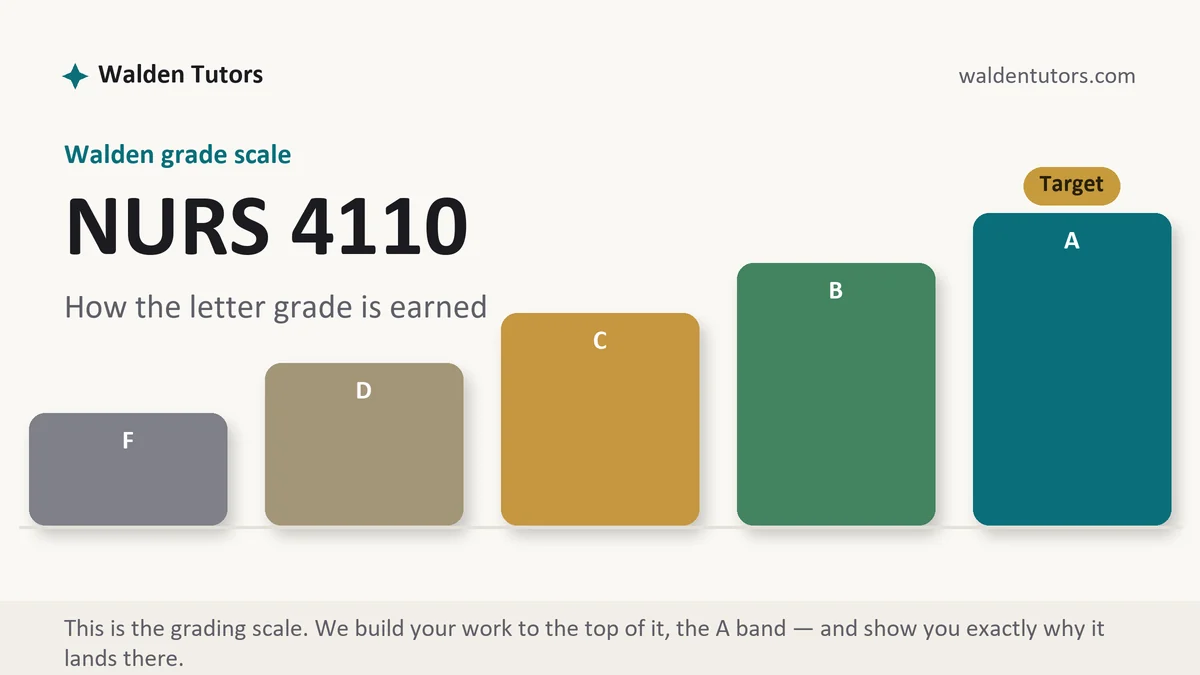
NURS 4110 grading scale at Walden, how the work is graded, from Walden Tutors
How Walden grades NURS 4110, visualized by Walden Tutors.

What NURS 4110 actually grades

The catalog frames this course around professional nursing leadership with an emphasis on policy knowledge and skills used to advance, inform and implement equitable policy that protects the health, safety and rights of patients. Translated into deliverables, that means persuasive documents rather than reports. Sections vary in what they assign, so read your own classroom, but the family of work is recognizable: analysis of a named policy, advocacy writing aimed at somebody with authority, stakeholder mapping, and reflective pieces connecting your own leadership behavior to a framework.

Scoring grids here pay for position and for audience. A row asking for analysis wants a stated recommendation, not a balanced summary that declines to choose. A row asking for advocacy wants writing shaped for the person receiving it, which means a legislator gets different sentences than a chief nursing officer. A row asking about equity wants a named group whose outcomes differ and the mechanism behind the difference, not the observation that disparities exist.

How we help in this course

Policy writing goes wrong quietly, so we start by pinning down three things before drafting: which policy, at which level of government or organization, and who the document is addressed to. From there the draft carries a real bill or regulation with its status, stakeholders identified by their interest rather than by job title alone, and a recommendation that survives the objection a reader would actually raise. Reflection pieces get built from the events you supply, since a leadership paragraph without a story behind it reads hollow to any grader.

What you get is the standard route for this desk. Turnaround sits at 24 to 48 hours, the draft aims at an A against the posted rows, two reviewers sign off separately before release, and revisions stay free until the target lands.

Weekly manuals for this course

Week-level manuals for NURS 4110 appear here as each one is confirmed, not before. Syllabi at Walden live inside the classroom and the assignment order is not identical everywhere, so publishing a grid we have not seen would only mislead you. Missing week? Say so in chat and it gets handled directly while the manual waits its turn.

In NURS 4110 right now?

Paste the policy assignment prompt and its scoring grid into chat. Your first premium sample is free and comes back in 24 to 48 hours.

How long you actually have in NURS 4110

Before you map any deadline onto a calendar, settle which version of the degree you enrolled in. Walden takes BSN students through two doors. One is course-based, with new classes opening at six-week intervals. The other is Tempo Learning, the competency-based option, and Walden prints a note excluding it from those start times altogether. What neither door supplies on its own is a week count for this course, since that figure follows your modality together with the section you were placed in. Read the syllabus in your classroom, confirm the dates showing in your student portal, and build the plan from those two documents instead of from a number a search result promised you.

Whatever length your section turns out to be, submissions close at 10:59 p.m. Central, which is 11:59 p.m. Eastern, and Walden asks every student to post or submit something graded within the opening week. Budget fifteen to twenty hours a week per Course-Based nursing course. Policy work rewards early starts more than most subjects, because the bill you want to write about has to be findable, current and small enough to describe, and discovering late that it is none of those things is expensive. Settle your policy in the first days of the term and the rest of the course becomes a writing problem instead of a search problem.

How to actually write NURS 4110: where to begin

Read the grading grid twice before you read the prompt once. Each row is a promise about what will be looked for, and turning those rows into your headings gives the grader a document that answers itself in order. Then look at the weights. Policy assignments almost always load the recommendation and the analysis rows and keep the background row light, so a paper spending three pages explaining the history of an act and half a page on what should happen next has spent its length in the wrong place.

Pick the policy before you pick the argument. The best choices for an undergraduate paper are narrow and locatable: a state bill with a number and a sponsor, a licensure or scope of practice rule, a staffing regulation, a reimbursement change, or an internal policy at your own organization. Check the assignment first, because some weeks fix the level of government for you. Once you have the policy, write down four facts and keep them in front of you: what it requires, who it binds, where it currently stands, and who benefits or pays if it moves. Papers drift when the writer never nailed down the current status and ends up arguing for something that already passed.

Build the stakeholder section around interests rather than lists. Naming nurses, physicians, administrators and patients tells a grader nothing. Saying that the hospital association opposes a ratio requirement because it fixes a cost they currently flex, while the state nurses association supports it because it removes an argument they have to have shift by shift, gives the analysis a spine. Two or three stakeholders described that way outperform a table of eight described by title. Where a group is divided internally, say so; graders read that as sophistication.

Equity is a graded idea in this course, not a decorative one. Handle it by naming a population, naming the outcome gap with a figure from a credible source, and then explaining the mechanism: what in the current arrangement produces the difference, whether that is transport, cost sharing, language access, clinic hours, broadband, or how a formula distributes money. A sentence saying that a group experiences worse outcomes is a claim. A paragraph tracing how the policy would change the mechanism behind it is the analysis your rubric is paying for.

Then commit to a recommendation and defend it against the strongest objection rather than the weakest one. Say what should happen, who should do it, and what it would take. Give the cost or the effort honestly, name the group most likely to resist, and answer them in the paper. Undergraduate policy writing loses more points to fence sitting than to any other habit, because a rubric row asking for a defended position cannot award marks to a paper that carefully never takes one. Close by connecting the argument to your own practice: the leadership skill you would need to carry it, and the specific first move you could make on your unit next month.

SectionWhat goes in itWhat earns full rubric points
Issue and policy identifiedThe named bill, rule or organizational policy, its level, and its current standing.A policy specific enough to cite by number or title, with its status verified rather than assumed.
Background and problemWhat health problem the policy addresses and how large it is.The problem sized with a figure from a credible body, kept short so the argument rows keep the space.
StakeholdersWho gains, who pays, who decides, and what each group actually wants.Interests explained rather than roles listed, including any group whose members disagree among themselves.
Equity analysisThe population affected unevenly and the mechanism producing the difference.A named group, a sourced gap, and a traced pathway from the policy to the outcome.
RecommendationWhat you argue should happen, by whom, and at what cost or effort.One clear position, the strongest counterargument answered inside the paper, feasibility addressed plainly.
Advocacy planThe audience, the channel, the message, and the ask.A message written for one named decision maker, ending in a request that person could actually grant.
Leadership reflectionThe skills the change would demand and where your own practice sits against them.Specific incidents from your work tied to a named framework, with one concrete next step attached.

Discussion posts that actually earn the points

Policy discussions invite opinion, and opinion is exactly what the grid does not pay for. Give the initial post a shape: your position in the opening line, the reason behind it, one cited source doing genuine work, and a closing sentence that hands classmates something to push against. Bringing a live example, a bill moving in your state, a rule your employer changed last quarter, lifts a post above the ones written entirely from the module readings, and it usually earns the relevance row without any extra effort.

Responses are scored on their own row and usually have their own due day, so confirm the dates inside your classroom rather than carrying over habits from an earlier course. Walden's grading policy expects participation that is substantive and timely, landing on two to four different days rather than in one long Sunday session, and the university notes that requirements differ between courses and even within one. In a policy course the reply that scores tends to do one of three jobs: it supplies the stakeholder your classmate left out, it names the funding or enforcement problem their proposal would hit, or it reports how the same policy plays out in a different state. Disagreement is welcome here provided it stays about the policy.

Citations and APA the way Walden grades them

Formatting is graded on its own row and the deductions repeat themselves: title pages built by hand instead of from the Walden template, headings styled by eye rather than set at APA levels, indents that did not survive a paste, citations in the text with no partner in the reference list. Run one comparison pass between your paragraphs and your references before submitting and most of that row comes back.

Policy writing also carries a source problem the other nursing courses do not. Much of the material you need is government or organizational rather than scholarly: bill text, agency rules, position statements, national data sets. Those are legitimate and often required, but they cite differently from journal articles, so check the format for a government report or a webpage rather than guessing. Balance them with peer-reviewed evidence pulled through the Walden Library, since a paper resting only on advocacy statements reads as one-sided to a grader. Give every source a job you could state in six words, place the citation inside the sentence carrying the claim, and check the date on anything describing a policy's status, because a two-year-old summary may describe a bill that has since died. The Writing Center settles formatting arguments faster than classmates do.

The mistakes that cost points in NURS 4110

  • A summary that reviews both sides fairly and never states which one the writer supports.
  • Stakeholders listed as job titles, with nothing said about what any of them stand to gain or lose.
  • Equity mentioned once as a value, with no population named and no gap measured anywhere in the paper.
  • A policy described from a secondary article, so its current status turns out to be wrong.
  • An advocacy letter that explains at length and never asks the reader to do a specific thing.
  • Leadership reflection written as personality description, with no incident from practice behind any claim.

NURS 4110 questions students actually ask

Can I write about a state policy instead of a federal one?

Almost always, and a state or even a facility policy is usually the stronger choice. State law is where scope of practice, staffing rules and licensure actually live, so a nurse can trace the effect on real patients without abstraction. Confirm the assignment does not name a level of government, then pick the one where you can find the bill number, the sponsor and the current status. Specific beats sweeping in every row on the grid.

How do I write about leadership without turning it into a personality quiz?

Anchor every claim to something you did. A self-assessment instrument gives you vocabulary, not evidence, so a paragraph reporting your score and stopping there has answered nothing. Name a shift, a conflict or a project, describe what you chose to do, say what happened next, and only then reach for the leadership concept that explains it. Graders reward the sequence event, action, outcome, theory, and they discount the reverse order fast.

The assignment asks for a letter to a legislator. How formal should it be?

Formal in structure and plain in language. Open with who you are and which district you vote in, state the ask in the first paragraph rather than the last, give two or three supporting points with sources named in ordinary words, and close with a specific request such as a vote, a cosponsorship or a meeting. Keep it to one page. If the rubric wants APA citations as well, add them at the end under a short reference heading and do not let them crowd the prose.

Keep going

Online now