NURS 6003 help and tutoring

NURS 6003 · 3 cr ยท MSN foundation
The short answer

NURS 6003 is Perspectives on Graduate Study for Advanced Nursing Practice, carrying three quarter credits at the front of the MSN. It grades your writing, your APA, your grasp of academic integrity, and a professional development plan built around the specialization you intend to finish in. One choice governs the whole seat: name that specialization early, because a plan written for an undecided student has nothing solid to grade.

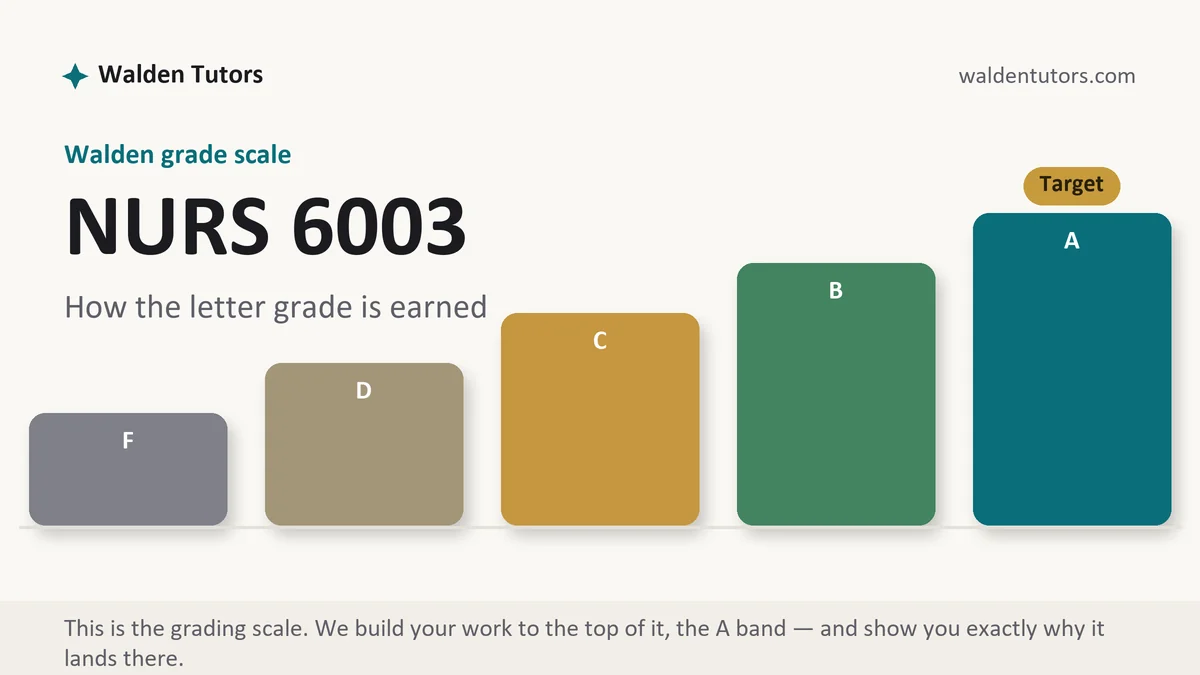
NURS 6003 grading scale at Walden, how the work is graded, from Walden Tutors
How Walden grades NURS 6003, visualized by Walden Tutors.

What NURS 6003 actually grades

Walden's own course description says the seat exists to set students up as scholar-practitioners and social change agents, and the graded work follows from that. Assignments walk you through the resources the university expects you to use, graduate-level academic writing, APA Style, academic integrity, and the building of a professional development plan tied to whichever specialization you have chosen. The practicum requirements are introduced here too, ahead of the term where they bite.

What the rows reward is specificity applied to yourself. A foundations course sounds like it should be graded gently, and the grading is fair, but it is not vague. Rubric rows ask whether your goals are stated in terms someone could check, whether your self-assessment names actual gaps instead of modest generalities, and whether your citations behave. Everything resolves into a letter grade built out of those rows, so a paper that reads pleasantly while saying nothing checkable comes back mid-band with feedback that makes the same point three different ways.

One disambiguation before you go hunting for material. Walden's catalog carries this same title a second time under the NRSE prefix, numbered NRSE 6002, and states plainly that NRSE courses are equivalent to the NURS version. If the header in your classroom shows that code instead, you are still in the right place and nothing below changes for you. The catalog prints the course at three credits, and the MSN counts its credits on the quarter system.

How we help in this course

The bottleneck in NURS 6003 is rarely effort. It is that nobody has ever asked you to write about your own career in the register a graduate rubric expects, and the first attempt usually lands either too casual or too inflated. We draft your work with the goals sharpened into something measurable, the specialization named, and the APA already correct, so what you receive reads like a graduate paper rather than a cover letter.

Nothing about the arrangement changes for this course. Turnaround sits in the 24 to 48 hour window, drafts are pitched at the highest band each scored row offers, two reviewers who work independently of each other read every one, and rework stays free of charge for as long as it takes to hold. Send an old paper of your own with the order and the draft arrives already sounding like you, which turns personalizing into a short job instead of a rewrite.

Weekly manuals for this course

Manuals for the individual NURS 6003 weeks go up one at a time, each one only after somebody has checked it against material a student actually received. Syllabi at this university sit behind the classroom login, so a published week map would be guesswork wearing the costume of information, and this page prints none. Whichever week you are staring at tonight, describe it in chat; drafting does not wait for a manual to exist.

Three timing facts are worth carrying while you plan. The quarter full term is listed on Walden's calendar under a heading that names both eleven and twelve weeks, and a six week half term also runs within the quarter, so only your classroom can tell you how many weeks your own section has. Everything is due at 10:59 p.m. Central, the same instant as 11:59 p.m. Eastern. And the university expects a graded post or submission from every student inside the opening seven days, which lands harder in a foundations seat than anywhere else, because this is where the habit either forms or does not.

In NURS 6003 right now?

Send the assignment, the rubric from your classroom, and the specialization you are heading toward. No charge for the opening premium sample, and it is with you inside forty-eight hours.

The one choice NURS 6003 will not let you postpone

Students arrive at the development plan still weighing tracks, decide to keep their options open on the page, and write goals broad enough to fit any of them. That is the single most reliable way to lose points here, because breadth is exactly what the rubric cannot reward. A goal that would suit an educator, an executive and an informaticist equally well is a goal with no content.

Commit on paper even if you are still thinking. The specialization you name changes what the plan should contain, and not by a little. Walden's MSN specializations outside the nurse practitioner tracks run to 53 quarter credits for a student entering with a BSN, but the field-experience load attached to them is nowhere near uniform: Nursing Education asks for 144 hours, Nurse Executive the same 144, Nursing Informatics 216, and Public Health Nursing 360. Those totals are published, and the spread between the lightest and the heaviest is more than double. A plan that ignores which of those numbers is coming for you is a plan the grader can see through.

So write the plan for one track. State which track. Then let the practical consequences show up in your goals: how you intend to find a site and a preceptor for the hours that track requires, which competencies the track leans on that your current job does not exercise, and what you will do in the next two quarters to close that distance. If you change your mind next term, the change costs you a conversation with your advisor and nothing on this transcript.

How to actually write NURS 6003

This is the rare graduate paper with no literature to hide behind, and that is precisely why it goes sideways. A nurse who can summarize pathophysiology without breaking a sweat will sit frozen in front of a document whose subject is her own career. So resist the urge to begin writing. Begin by putting the scored rubric on screen, lifting its rows into an empty file, and converting each row into a heading you are obliged to fill. The prompt tells you what the paper is about; the rows tell you what it is worth, and the rows are the document your grader actually completes.

Then get concrete about yourself before you write a sentence. Most of this course is self-directed writing, and self-directed writing fails when the writer has no data. Spend twenty minutes listing raw material: the units you have worked, the certifications you hold, the skills your last appraisal flagged, the tasks you avoid, the reason you enrolled this year rather than three years ago. You will not use most of it, but a plan written from that list has texture, and a plan written from memory alone reproduces the same four sentences every applicant writes.

Convert each ambition into something checkable. "Improve my leadership skills" is not a goal a rubric can score. "Complete the 144 field hours for the Nurse Executive track at my current facility by the end of the summer quarter, having secured a preceptor in the two quarters before it" is a goal with a verb, a quantity, a place and a deadline. Do this for every goal in the plan, and where you genuinely cannot attach a number, attach an observable event instead, something a third party could confirm happened.

Handle sources by making them work rather than decorate. A foundations paper does not need many citations, but the ones present should each carry an argument. When you claim a competency matters to your track, cite the professional standard that says so. When you describe the scholar-practitioner idea or the social change commitment, cite the university material that defines it rather than paraphrasing from a classmate's post. Pull everything through the Walden Library, since that is where the databases your later courses assume actually sit, and learning the search interface now costs you an hour you will otherwise spend in a panic during an evidence course.

On academic integrity, treat the material as operational instruction rather than a warning. The practical content is where paraphrase becomes patchwriting, how to quote a short passage properly, why every idea traceable to somewhere else needs an attribution even when you agree with it, and how to keep a note file that separates your sentences from theirs while you read. Students who set that file up in this course rarely have an integrity problem later.

Nothing in the table below is a Walden template. It is a structure that survives most of what this seat asks for, and you should bend it to whatever headings your own assignment names.

SectionWhat it doesThe common failure
Opening frameStates who you are professionally, the specialization you are entering, and what the paper will argue about your development.An autobiography that reaches the actual point on page two, by which time a scored row has already been decided.
Self-assessmentNames present strengths and, more valuably, present gaps, each tied to evidence from your own practice.Gaps written so diplomatically that no gap is visible, which leaves the goals with nothing to fix.
Academic goalsWhat you will do inside the program, with timing, and how it connects to the coursework ahead.Goals restating the program requirements, so the plan says only that you intend to pass your courses.
Professional goalsWhere the specialization takes you after graduation, in a role and a setting you can name.An aspiration with no route attached, so the reader cannot tell what the next two years are for.
Resources and strategiesThe specific supports you will use, from the Writing Center to your advisor to your practicum planning.A list of services copied off a page, with no indication you know what any of them do.
Integrity and scholarshipHow you will keep the work honest and what scholar-practitioner writing means for your habits.A recital of the policy in the policy's own words, which demonstrates reading rather than understanding.

Discussion craft in a foundations seat

The threads carry a scored rubric of their own, and in this seat the prompts almost always bend back toward you: what a reading means for your unit, your track, the plan you are drafting. Write the opening post as a small argument rather than a reflection. Make one claim about your own setting, bring the reading that backs it or complicates it, then say what follows. Put a citation in the post. Unsourced confidence, however well phrased, lands on an evidence row as opinion.

Get into the thread on more than one day. The university's policy on grading wants contributions that are substantive, on time and repeated, and its stated minimum is posting on two to four different days of the week. Arriving once, late, carrying everything at once, fails that test before a single sentence gets read.

Replies score separately, and nodding along scores nothing. Do something to what a classmate wrote: name a constraint their plan has not priced in, offer a resource that would move their timeline, or ask how they intend to secure the field hours their specialization demands. Two or three replies at that level finish the row. Walden is open about posting rules being inconsistent, both across the catalog and week to week within one classroom, so whatever the last term trained you to do is overruled by the instructions sitting in this one.

The mistakes that cost points in NURS 6003

  • Leaving the specialization unnamed or listed as one of two options, which strips every downstream goal of its specificity.
  • Goals phrased as intentions rather than actions, with no date, no quantity and nothing an outside reader could verify happened.
  • Treating the paper as a personal essay, so the tone drifts into memoir and the citation rows go unfed.
  • Copying the university's own wording about scholar-practitioners and social change instead of applying those ideas to your work.
  • Reference lists assembled at the end, which is how entries end up missing from the text and citations end up missing from the list.
  • Ignoring the practicum material because it feels distant, then discovering the hour requirement for your track with one quarter left to arrange a site.

NURS 6003 questions students actually ask

Do I have to commit to a specialization before the first graded item?

You need a working commitment, which is not the same as an irreversible one. The development plan is graded on how well its goals fit one named track, so a paper hedging between two tracks scores worse than a paper backing the wrong one. Choose the track you would enrol in today, write the plan against it, and speak to your student success advisor if you later want to change. Changing programs is an administrative process, and it is not made harder by having written a focused paper.

Why is APA graded so heavily in a foundations course?

Because this is the seat where it gets taught, and every later course assumes it stuck. Expect rows on the title page, heading levels, in-text citation form, and a reference list matching the citations exactly. Two habits carry most of the marks: build the reference entry the moment you decide to use a source, and pull your templates from the Writing Center instead of copying formatting from a classmate. Matching Walden's own template is faster than defending your version to a grader.

How much does this course tell me about the practicum?

It introduces the requirements rather than starting the placement. You learn what the practicum expects, what documentation the process runs on, and roughly when it lands in your track, which is why the specialization choice matters so early. The hour totals differ sharply by track, so treat the reading as planning material. When you do reach a practicum term as a course-based student, Walden expects the hours finished by Week 10 of that term, and knowing that a year ahead is worth more than knowing it a month ahead.

Online now