PHLT 8402 help and tutoring

PHLT 8402 · 5 credits · PhD in Public Health
The short answer

Applied Leadership and Multicultural Perspectives in Public Health runs at Walden as PHLT 8402, worth five credits inside the PhD in Public Health, with PHLT 8006 or PHLT 8011 named ahead of it and a longer prerequisite chain on the second track. The catalog is unusually explicit about what you will produce: a personal leadership philosophy you can defend, an honest read on your own attitudes and implicit bias, applied work on negotiation and conflict, a professional development plan, and a system level intervention with leadership theory doing real work inside it.

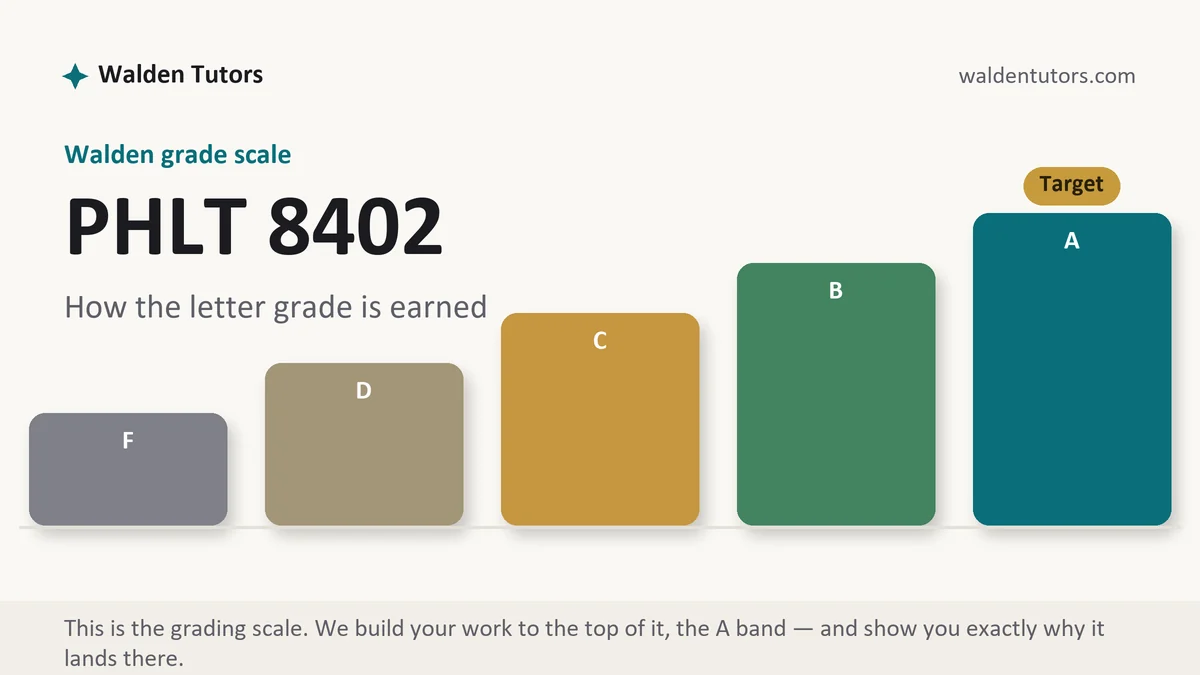
PHLT 8402 grading scale at Walden, how the work is graded, from Walden Tutors
How Walden grades PHLT 8402, visualized by Walden Tutors.

What PHLT 8402 actually grades

The written products fall into three families. Analytical papers, where theories and models of leadership get compared on their strengths and limits rather than summarized one after another. Reflective papers, where the same analytical tools are turned on yourself and you report what they find. And applied design work, where a theory has to produce a decision about a real system and the people inside it.

Rubrics in this course are alert to the difference between claiming a quality and evidencing it. Writing that you value collaboration cannot be scored. Describing a moment when collaboration cost you speed, saying what you traded and why, then naming the model that explains the choice, gives a grader something to mark. The same rule governs the cultural proficiency rows: a statement of respect for diversity earns less than an account of a decision you made differently because of who it landed on.

Leadership and management are treated as separate objects here rather than as two words for seniority, and a paper using them interchangeably bleeds rows across the whole document.

How we help in this course

Give us the assignment, the scoring guide and whatever you are willing to share about your own working history, including the situation you would rather not write about. Drafts come back with the theory carrying weight: your philosophy argued instead of announced, the self assessment specific enough to be credible, and the intervention designed at the level of a system rather than a team.

Delivery sits inside 24 to 48 hours. The draft is written to the top band, marked up so the row behind each section is visible, and put through a second reader for scoring and for APA before it reaches you. Revisions stay free until the work lands where it should.

Weekly manuals for this course

PHLT 8402 has no week manuals here yet. Walden keeps its syllabi behind the classroom login, and this site refuses to publish a week grid nobody has seen, so pages appear one at a time as each gets confirmed. Bring your assignment to chat in the meantime and a scope comes back within the day.

Leadership philosophy paper due?

Send the rubric and a sentence about where you work. The first sample is free.

The distinction the rest of the course rests on

Ask what each word does rather than what it means. Management keeps an existing system running to standard: resources allocated, schedules kept, quality held, risk contained. Leadership changes what the system is for, which is why it involves persuasion, coalition and loss. Both are needed and neither is nobler, and a paper treating leadership as the admirable version of management has already missed the analytic point being made.

In public health the distinction sharpens because the controls are shared. A health department director manages a budget and a workforce, but the change she wants usually lives in a school district, a housing authority, a hospital system or a state legislature, none of which report to her. Leadership in that setting is the practice of moving things you do not control. Say so in your writing and your examples stop sounding like workplace anecdotes.

Systems thinking is the tool this course hands you for the same problem. Used properly it means naming the feedback loops holding a bad outcome in place and asking which loop your intervention interrupts. Used lazily it becomes a claim that everything is connected, which is true and useless. Draw the loop before you write the paragraph.

Reflection that scores at doctoral level

Half of this course asks you to write about yourself, which is where strong writers often produce their weakest work. The failure mode is a document of virtue: a list of qualities you possess, each illustrated by an occasion when everything worked out. Nothing in it can be wrong, so nothing in it can be assessed.

Write the opposite. Choose situations where your instinct was tested and produced a mixed result. Report the decision, the pressure you were under, what you did not know at the time, and the cost of the path you took. Then bring theory in as an explanation rather than as a compliment, and say what the theory misses about your case. A grader reading that knows they are looking at judgment.

Implicit bias sections need the same discipline and a little more care. The assignment is not a confession and it is not an acquittal. Report what an instrument or an exercise indicated, treat the result as information about a pattern rather than a verdict on your character, then do the practical part the rubric is actually after: which of your routine decisions could that pattern touch, and what specific check would catch it. Naming a check is what separates a scored reflection from a paragraph of remorse.

How the quarter shapes this workload

This degree is published on the quarter calendar. Walden's catalog page for the PhD in Public Health builds the plan of study out of blocks headed Quarter 1 onward, thirteen of them on the longer track, and the MPhil sitting inside the program is stated as a minimum of 45 quarter credits. Advice written for the university's semester degrees does not apply to you.

Terms already on Walden's calendar are Fall 2026, August 31 to November 15; Winter, November 30 to February 14; Spring, March 1 to May 16; and Summer, May 31 to August 15. Each runs 76 days. Divide it out and the result is a little under eleven weeks, which matches the eleven and twelve week label the university puts on its full quarter term, although the calendar page prints dates rather than week counts. Half terms of six weeks also exist, so confirm your own section in the student portal.

Everything closes at 10:59 p.m. Central, one hour later for Eastern students. Something graded has to be submitted in the first week for attendance. A course this reflective still produces a letter grade assembled from rubric rows, and rows are not moved by sincerity.

How to actually write PHLT 8402: where to begin

Start from the scoring guide, convert its rows into headings, then look at what each row asks you to do with a theory. Some rows want comparison, some want application, and some want you present in the text as a subject. Mixing those up produces a paper that reads well and scores in the middle.

Choose your theories early and keep the set small. Two or three models you can hold in tension will carry a whole term better than a survey of eight. What you need from each is its account of where influence comes from, what it assumes about followers, what it is good at, and the conditions under which it fails. That last item is the one most students skip and the one that limitation rows exist to catch.

Then find the setting. Every strong paper here is anchored to a real organization or a real jurisdiction, described concretely enough that a reader could picture the room. Your own workplace is usually the best choice, with identifying details stripped and no colleague or client made recognizable. Write about a national issue with no address and the leadership recommendations end up addressed to nobody.

Build the argument as a chain. This is the outcome that will not move. These are the parts of the system holding it still. This is the point where a leader can actually push. This is the model explaining why influence works there. This is what I would do, who would have to agree, and what would tell me it worked. Any link you cannot complete is the link a grader will lean on.

Synthesis means reading the leadership literature for transfer rather than for endorsement. A study of physician leaders in an academic medical center may say very little about a rural health department with four staff, and naming the conditions that do not carry over demonstrates more than assembling three sources that agree. Culture belongs to that same transfer question: a model developed in one national and organizational setting makes assumptions about hierarchy and directness that will not hold everywhere, and noticing that is exactly the multicultural competence the course title promises.

SectionWhat it doesWhere it usually fails
Context and problemNames the organization or jurisdiction and the outcome that is refusing to improve.A national issue described in general terms, with no setting anybody could act inside.
Leading versus managingSeparates what needs administering from what needs changing in this particular case.The two words used as synonyms, which collapses the analysis the row was written to score.
Theory selectionArgues why these two or three models suit this problem and these people.A survey of every model taught, with none of them applied to anything in particular.
Personal philosophyStates what you believe leadership is for, with evidence drawn from your own record.A list of admirable traits, none of which could ever be shown to be false.
Cultural proficiencyShows a decision made differently because of who was going to be affected by it.A pledge to respect diversity, unattached to any choice the writer actually made.
Conflict and negotiationDescribes an interest based approach to a specific disagreement with named parties.Advice to communicate openly, aimed at a conflict with no sides and nothing at stake.
System level interventionProposes a change to policy, structure or resourcing, with the loop it interrupts identified.A training session offered as the answer to a problem the structure keeps producing.
Development planSets goals with dates, methods and a way of knowing whether they were met.Aspirations to keep growing as a leader, with no artifact anyone could check.

Discussion posts in a leadership course

These threads are where the personal material gets tested, and the temptation is to be agreeable. A post carrying its row takes a position somebody could reasonably oppose: the model you think is wrong for public health, the tradeoff you would make between speed and inclusion, the intervention you believe would fail in your own setting. Cite something in the initial post so the position rests on more than experience.

Walden expects participation to be substantive and spread across the week, with guidance pointing toward activity on two to four days at a minimum, and the university states plainly that specific expectations shift from course to course and week to week. Read your own classroom instructions for the count and the closing day. When you answer a peer, engage the reasoning rather than the person: ask what their model assumes about the people it would be used on, or name the stakeholder their intervention needs and does not have.

Sources and APA 7 when the subject is you

Reflective writing still carries citations, and the first person is allowed wherever the assignment asks for it. The pattern that scores is simple: your experience supplies the case, the literature supplies the interpretation, and the two stay audibly different voices on the page. Where you report a self assessment instrument, cite the instrument and its author, note what it measures and what it does not, and resist treating a score as a diagnosis.

Leadership sources should come through the Walden Library rather than from popular business writing, since a row asking for scholarly support means peer reviewed work. Public health leadership has its own literature in health administration and policy journals, and using it instead of general management texts shows you understand the setting. Follow the Writing Center templates for headings and references so the mechanics rows are settled before anybody reads a sentence.

The mistakes that cost points in PHLT 8402

  • A leadership philosophy assembled from admirable adjectives, with no situation in it that could have gone another way.
  • Leadership and management used interchangeably, which erases the comparison the assignment was built to test.
  • Theory summarized in sequence rather than applied to a decision the writer actually has to make.
  • Cultural proficiency treated as a statement of values instead of a change in how something got decided.
  • An implicit bias reflection that ends in apology, with no practical check attached to any routine decision.
  • A system level intervention that turns out to be a workshop, leaving the structure causing the problem untouched.
  • A development plan with no dates, no method and nothing that would ever show progress.

PHLT 8402 questions students actually ask

How honest should the self assessment section be?

Honest about decisions, careful about people. Graders are looking for a writer who can examine their own reasoning without either flattering or punishing themselves, so the useful material is a choice you would make differently now and the thinking that produced the original one. What does not belong is identifying information about colleagues, patients or clients, or a disclosure that would create a problem for you if the document circulated. Strip names, roles and places until the situation stays true but nobody is recognizable. If a situation cannot survive that treatment, choose another one; there is always another one.

Which leadership model should I claim as my philosophy?

Choose the one that explains your actual behavior under pressure rather than the one that sounds best. Look back at two or three moments when you had to move something without formal authority and ask what you relied on: relationships, expertise, procedure, a shared goal, or an obligation you appealed to. A model that describes what you already do gives you a philosophy you can defend when a grader pushes on it. Saying that your philosophy borrows from more than one model is perfectly acceptable too, provided you state the conditions under which you switch and argue the switch instead of avoiding the choice.

What actually counts as a system level intervention?

A change to something that keeps operating after you leave the room. Policies, funding formulas, eligibility rules, referral pathways, staffing structures, data flows and contract terms all qualify, because they shape behavior without anyone needing to be persuaded again each time. Training, campaigns and one off meetings do not, however useful they may be, since the structure that produced the problem is still standing the following month. Apply this test to your own proposal: if everyone involved forgot the intervention had happened, would the outcome still be different? A no means you have written a program where the rubric wanted a system.

Keep going

Online now