PUBH 8004 help and tutoring

PUBH 8004 · 5 credits · DrPH foundation
The short answer

PUBH 8004 is the five-credit foundation course that opens Walden's Doctor of Public Health. Walden's own description has you examining the field's philosophies and values from the standpoint of becoming a scholar-practitioner, reading into emerging issues and technologies, using the doctoral resources that strengthen scholarly writing, and building the habits doctoral study runs on. One detail changes how you should treat it: the catalog states that a B or better is required here to continue in the DrPH program.

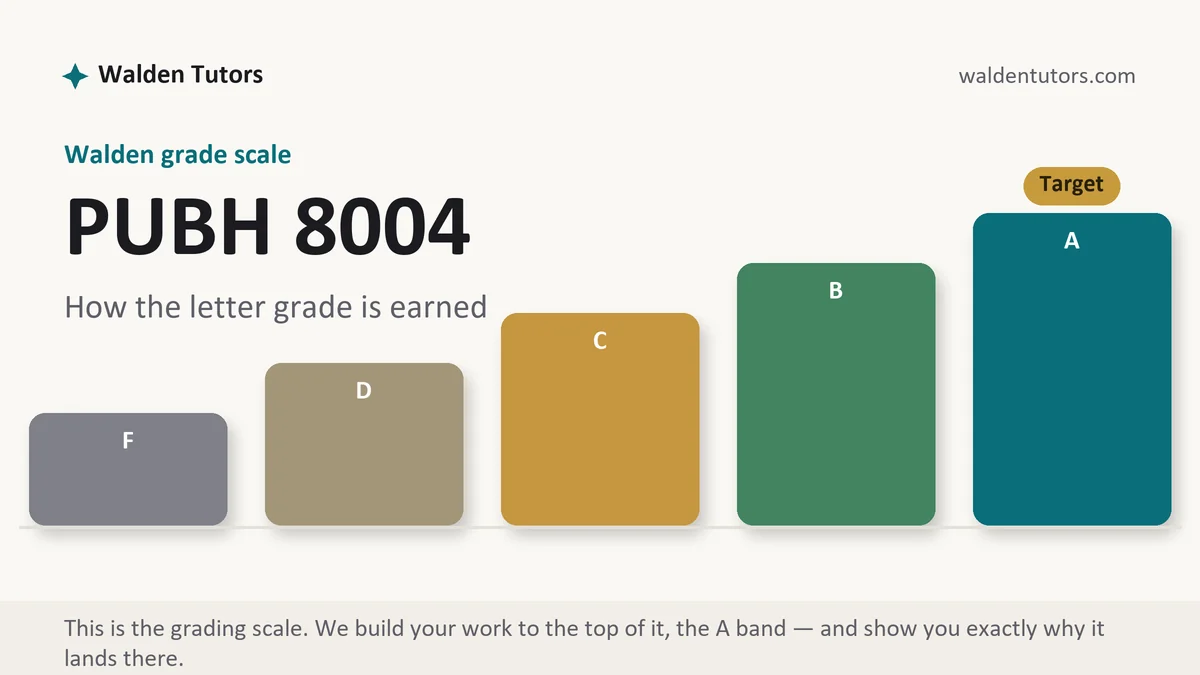
PUBH 8004 grading scale at Walden, how the work is graded, from Walden Tutors
How Walden grades PUBH 8004, visualized by Walden Tutors.

What PUBH 8004 actually grades

Your writing, mostly, and the thinking visible inside it. Deliverables tend toward short scholarly papers, literature engagement, a professional or academic development plan, integrity work, and discussion threads that are marked more strictly than the master's threads you remember. Content knowledge about public health is assumed rather than tested. What is being examined is whether you can hold a position, support it with peer-reviewed evidence, represent disagreement in the literature honestly, and write in a register that would survive a committee.

The scholar-practitioner idea is scored language, not a slogan. Walden expects you to hold two commitments at once: rigor about what the evidence supports, and seriousness about what happens in practice when the evidence is applied. Papers that read as pure literature review, and papers that read as professional opinion with a citation attached, each miss half the target. The strongest submissions move between the two on purpose and say when they are doing which.

How we help in this course

We write to the register this course is trying to teach, which means claim-first paragraphs, evidence placed underneath the claim rather than in front of it, hedging calibrated to what the study actually showed, and disagreement in the literature stated rather than smoothed away. Sources are pulled through library databases and checked for peer-reviewed status before they go in. Where a week asks for a development plan or a reflective piece, the draft stays specific to your record and your goals instead of producing the generic version every cohort submits.

Our usual arrangement applies. Turnaround runs 24 to 48 hours. The benchmark is your scoring guide. Marking happens first, an independent format and originality check second, and revision rounds carry no charge. Given what this particular course gates, we would rather see your first assignment early than your fourth one late.

Weekly manuals for this course

Per-week manuals publish only once a deliverable has been confirmed from inside a live section. Walden keeps doctoral syllabi behind the classroom login, and a fabricated week grid would be worse than none at all on a page students use to plan. Send an unlisted week to chat and it gets drafted regardless.

The DrPH runs on quarters. Walden's catalog prints the doctoral program of study in numbered quarter blocks, stretching to Quarter 12 for the longer track, and places this foundation course at the very front of the sequence. If you want a real span to plan against, Summer 2027 opens May 31 and closes August 15, a period of 76 days, which is a shade under twelve weeks by simple arithmetic rather than by anything Walden prints as a week count. Half terms of six weeks also exist inside a quarter, so check your own section dates in the student portal before building a study schedule.

First doctoral paper due?

Send the prompt and the scoring guide. The opening sample is free and shows you the register before you are graded on it.

The B that changes your pacing

Most students read the word foundations and mentally file the course under low stakes. The catalog says otherwise: continuation in the DrPH depends on earning a B or better here. That does not make the assignments harder than they look, but it does change what a poor early grade means. In a normal course, a weak first submission is recoverable through a strong finish. In a gated one, a weak first submission is information you need immediately, because the number of graded items in a single quarter is small and each one carries more weight than students expect.

Practical response: submit the first graded piece early enough that feedback arrives while there is time to use it, and ask your instructor a specific question rather than a general one. Where did my argument fail to earn this row, and what would have earned it, produces something usable. Any feedback on my paper produces a sentence of encouragement. Track your standing after every returned item rather than at the end, so that if support is needed it can be arranged in week four instead of week ten.

What we need for a doctoral assignment

The prompt and the scoring guide, the topic if you have chosen one, and any source list the week requires you to use. Two extras make a real difference in this course. Send a piece of your own prior writing, because matching your register now saves you rewriting later, and tell us what feedback you have already received, since building the next draft against a known criticism is faster than rediscovering it. What returns is the paper, the references pulled from library databases, and notes mapping sections to rows.

How to actually write PUBH 8004: where to begin

Start with the scoring guide, rebuilt as headings in an empty document with each weight beside it, then write your claim before you gather anything. Doctoral writing goes wrong at the collection stage far more often than at the drafting stage. A student reads twenty articles, feels informed, and then writes a paper organized by what those articles said, which is a report. The fix is to decide what you intend to argue first, in one sentence, and then read to test it. Reading to test a claim produces evidence with a job. Reading to become informed produces a pile.

Then get the paragraph shape right, because it is most of what separates the two registers. Open with your assertion in your own words. Follow with the evidence that supports it, cited. Then interpret: say what that evidence means for your assertion, including where it is weaker than you would like. Close by connecting forward to the next claim. A paragraph that opens with an author's name and a year has usually surrendered its argument in the first six words, and a paper made of those paragraphs reads as a summary even when every source in it is excellent.

Synthesis is the skill this course exists to install, and it is mechanical before it is intellectual. Build a matrix with one row per study and columns for population, design, finding, limitation, and the claim it serves. Fill it in, then read down each column rather than across each row. Reading down is where you notice that four studies agree about an effect but all of them used the same setting, or that two disagree and the difference lies in how the outcome was measured. Those observations are synthesis, and each one is a topic sentence waiting for its paragraph. Sources that never fit any group are sources you collected out of habit; leave them out.

Calibrate your language to your evidence. A single cross-sectional study supports the word associated, not the word causes. A pattern across several well-designed studies supports a stronger claim, and you should make it, because timid writing scores as poorly as overclaiming. Say who a finding applies to, since a result from one population is not a general truth, and say what remains unknown. Naming a gap is doctoral behavior; pretending the literature is settled is not.

Run your searching like a doctoral student rather than a browser user. Work inside the Walden Library, use the database thesaurus to find the terms the field actually indexes instead of the phrase you first thought of, combine concepts deliberately, and check whether a journal is peer-reviewed rather than assuming. Save your searches and set alerts, because the topic you choose now may follow you into later coursework and the capstone, and a saved strategy compounds. Start a reference manager in week one for the same reason. Retyping citations for three years is a tax you can decline.

On integrity, understand that the rules tighten at this level in one way that surprises people: reusing your own earlier work without disclosure counts as a problem, not a shortcut, and doctoral programs treat it seriously. If an assignment invites you to build on something you wrote in a master's course, say so and cite yourself. Paraphrase rather than quote by default, since a doctoral paper is supposed to demonstrate your understanding, and long quotations are the fastest way to signal that you have not yet developed a position of your own.

Finally, do the arithmetic on your week before the quarter starts rather than discovering it in week three. Count the hours you actually have, subtract the ones already spoken for, and see what remains for reading, drafting, and revising. Doctoral writing needs a gap between drafting and revising, so protect one day rather than planning to write and polish in a single sitting. The nightly cutoff is 10:59 p.m. Central, 11:59 p.m. Eastern, and the university requires a login plus a posted assignment or discussion during week one, so your schedule has to be functioning from the opening day.

SectionWhat goes in itWhat earns full rubric points
Introduction and claimThe question, why it matters to practice, and the position the paper will defend.A claim stated in one sentence that a reader could disagree with.
Literature engagementThe studies you are using, chosen for what they contribute rather than for their number.Peer-reviewed sources whose population and design are named, not just their conclusion.
SynthesisPatterns of agreement, points of dispute, and the gaps your reading exposed.Paragraphs organized by idea, with several studies inside each, never one study per paragraph.
Scholar-practitioner analysisWhat the evidence would mean for a real program, agency, or population you know.An application specific enough to be wrong, tied back to the evidence rather than to instinct.
Limitations and unknownsWhat your sources cannot support and what the field has not settled.Limitations you identified yourself, phrased as constraints on your own claim.
Development planWhere your skills stand now, what needs work, and how you will get it done.Named resources, dated milestones, and a self-assessment that admits an actual weakness.
Mechanics and attributionAPA 7 formatting, matched citations and references, and disclosure of any reused work.Nothing cited that is missing from the references, nothing listed that the text never used.

Discussion posts at doctoral level

The threads in this course are graded closer to short papers than to conversation, and the difference from master's discussion is visible in the first line. A doctoral post opens with a position, supports it with peer-reviewed evidence, acknowledges the strongest objection to itself, and stops. It does not restate the prompt, it does not narrate the reading, and it does not run to a thousand words to appear thorough. Length is not the currency here; defensibility is.

Responses are where cohorts either become useful to each other or waste the term. Engage the substance: identify the assumption a classmate's argument depends on, offer the study that complicates their conclusion, or ask what their position would predict in a case they did not consider. Do it in the register you would use with a colleague, because these are the people who will read your drafts for the next three years. Substance, punctuality, and presence across several days are what the participation policy names, and the published floor is two to four days. Walden also states that the specific expectation is not constant from one course to another, nor from one week to another inside a single course, so read the thread rather than assuming your master's pattern carried over. Everything is due by 10:59 p.m. Central, 11:59 p.m. Eastern.

APA 7 and the library, at the level this course expects

Mechanics carry their own rows and doctoral graders are less forgiving about them, partly because the same standards will govern your capstone. Use the title page format Walden supplies, apply heading levels consistently rather than by feel, and keep in-text citations and the reference list in exact correspondence. Learn the patterns you will actually need at this level: several works in one parenthesis, secondary citation when you genuinely cannot reach the original, tables and figures with numbers, titles, and notes, and seriation done in APA style rather than improvised bullets.

The library is a tool you are being taught to use, not a link in the syllabus. Its databases let you filter by design, population, and date in ways an open search cannot, and its guides show you how the field's controlled vocabulary is structured. The Writing Center supplies the templates and the APA guidance Walden grades against, along with paper review appointments that are worth booking before your first submission rather than after your first disappointing one.

The mistakes that cost points in PUBH 8004

  • A paper organized source by source, so each paragraph reports one study and no claim ever emerges.
  • Professional opinion presented as a finding, with a citation added afterwards to make it look sourced.
  • Language that overclaims, turning an association from one study into a causal statement.
  • Quotation used where paraphrase was expected, which hides whether you understood the material.
  • Work reused from an earlier degree without disclosure, treated by the program as an integrity matter.
  • A development plan full of generic goals with no dated milestone and no named resource.
  • Treating a gated course as a warm-up and discovering the standing problem too late to fix it.

PUBH 8004 questions students actually ask

Why does a foundations course carry a grade this heavy?

Because the catalog attaches a condition to it. Walden states that students must receive a B or better in this course in order to continue with the DrPH program, which makes it a gate rather than a warm-up. The practical consequence is about sequencing, not difficulty. Treat the first graded submission as the one that tells you where your writing currently stands against doctoral expectations, ask for specific feedback rather than reassurance, and act on it while there are still weeks left to act. Students who coast the opening assignments and then discover a scoring problem late are the ones who run out of room.

What actually makes writing doctoral?

The direction the evidence travels. Master's writing is usually organized around what the sources say, so the paper moves from source to source. Doctoral writing is organized around what you are claiming, so each paragraph opens with your assertion and the sources arrive underneath it as support, disagreement, or qualification. Three other habits follow: your claims are calibrated, meaning the strength of the wording matches the strength of the evidence behind it, you say where the literature disagrees rather than smoothing it into consensus, and you name what remains unknown. Length is not part of it. A precise five-page argument beats a padded fifteen every time.

How do I turn a pile of articles into a synthesis?

Build a matrix before you write a sentence. One row per study, and columns for the population, the design, the main finding, the limitation, and the argument it serves in your paper. Fill it in for every source, then read down the columns instead of across the rows, because reading down is where patterns appear. Sort the rows into groups of agreement, disagreement, and gaps. Each of those groups is now a paragraph with a claim already attached, and the studies inside it are your evidence. Anything that never fits a group is a source you collected out of habit, and it comes out of the paper.

Keep going

Online now