Doctor of Public Health (DrPH) program guide
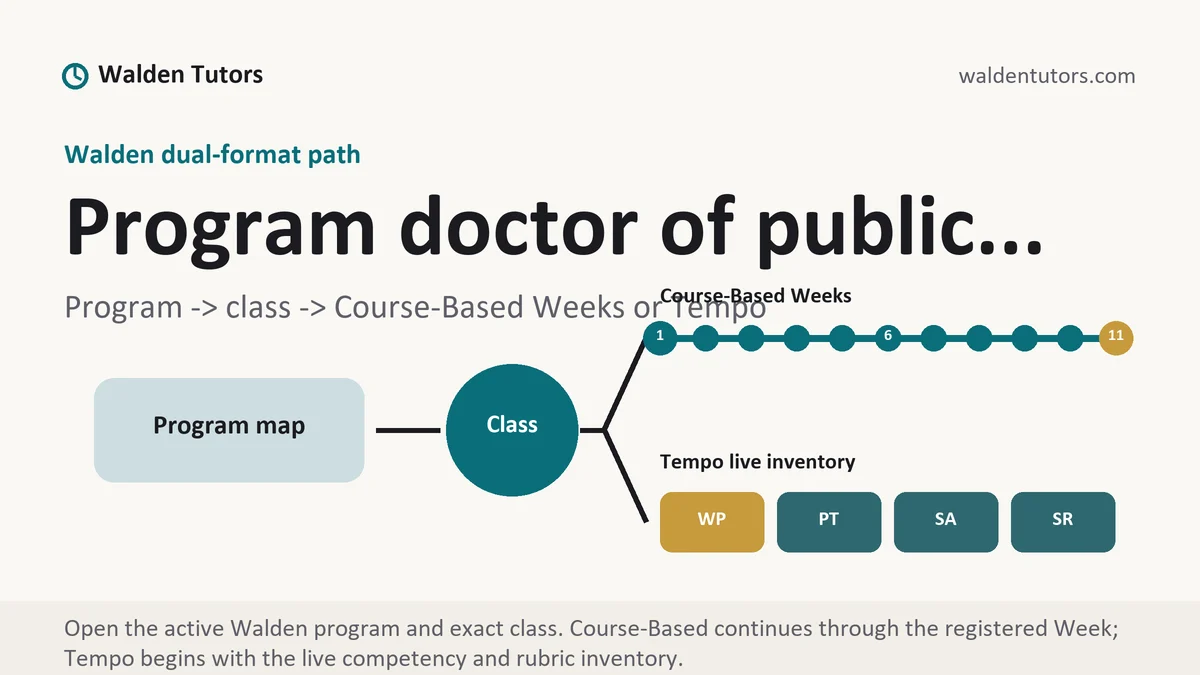
A current program-to-class map with every published requirement group wired to its canonical class page and honest native-unit support.
Walden currently publishes 23 unique course codes across 10 curriculum sections for this path. 23 appear in Course-Based contexts and 0 in Tempo or competency contexts; overlap is intentional when the catalog reuses a code.
How to read this program
The healthcare path connects organizations and populations: evidence, quality, finance, operations, policy, ethics, education, and leadership must produce defensible action rather than remain separate vocabulary.
Run coursework, research formation, residencies, approvals, and the culminating sequence as parallel clocks. A strong seminar submission does not move an approval gate; a cleared gate does not replace the scholarly work. Record both on one dated plan.
The classes, section by section
The headings below preserve Walden's published requirement groups, tracks, specializations, and modalities. Repeated codes remain visible where the catalog repeats them, while every code resolves to one canonical class page. This is a navigational transcription, not a personal degree audit or promised enrollment sequence.
Students who hold a Master of Public Health degree › Curriculum › Foundation Courses (5 credits)
| Row | Code | Official catalog title | Native next step |
|---|---|---|---|
| 1 | PUBH 8007 | Public Health Essentials | Week 1 to Week 11 |
| 2 | PUBH 8004 | Foundations of Doctoral Success in Public Health | Week 1 to Week 11 |
Students who hold a Master of Public Health degree › Curriculum › Core Courses (40 credits)
| Row | Code | Official catalog title | Native next step |
|---|---|---|---|
| 1 | PUBH 8410 | Fundamentals of Leadership, System Evaluation, and Interventions in Public Health | Week 1 to Week 11 |
| 2 | PUBH 8040 | Advanced Public Health Policy and Advocacy | Week 1 to Week 11 |
| 3 | PUBH 8211 | Research Methods for Public Health | Week 1 to Week 11 |
| 4 | PUBH 8044 | Advanced Program Evaluation | Week 1 to Week 11 |
| 5 | PUBH 8048 | Research Applications of Theories, Models, and Conceptual Frameworks in Public Health | Week 1 to Week 11 |
| 6 | PUBH 8317 | Financing Public Health Systems | Week 1 to Week 11 |
| 7 | PUBH 8546 | Advanced Analysis of Community Health Data and Surveillance in Public Health | Week 1 to Week 11 |
| 8 | PUBH 8132 | Communication and Social Marketing Strategies for Public Health Leaders | Week 1 to Week 11 |
Students who hold a Master of Public Health degree › Curriculum › Inquiry courses (3 credits)
| Row | Code | Official catalog title | Native next step |
|---|---|---|---|
| 1 | PUBH 8501 | Scholar-Practitioner Inquiry I | Week 1 to Week 11 |
| 2 | PUBH 8502 | Scholar-Practitioner Inquiry II | Week 1 to Week 11 |
| 3 | PUBH 8503 | Scholar-Practitioner Inquiry III | Week 1 to Week 11 |
Students who hold a Master of Public Health degree › Curriculum › Applied Practice Experience (2 credits)
| Row | Code | Official catalog title | Native next step |
|---|---|---|---|
| 1 | FEHP 8990 | Field Experience Preparation | Week 1 to Week 11 |
| 2 | PUBH 8990 | DrPH Applied Practice Experience | Week 1 to Week 11 |
Students who hold a Master of Public Health degree › Curriculum › Doctoral Capstone Courses (15 credits)
| Row | Code | Official catalog title | Native next step |
|---|---|---|---|
| 1 | PUBH 9101 | Completing Doctoral Capstone I | Week 1 to Week 11 |
| 2 | PUBH 9102 | Completing Doctoral Capstone II | Week 1 to Week 11 |
| 3 | PUBH 9103 | Completing Doctoral Capstone III | Week 1 to Week 11 |
Students who have a master’s degree in an academic discipline other than public health › Curriculum › Foundation Course (5 credits)
| Row | Code | Official catalog title | Native next step |
|---|---|---|---|
| 1 | PUBH 8007 | Public Health Essentials | Week 1 to Week 11 |
| 2 | PUBH 8004 | Foundations of Doctoral Success in Public Health | Week 1 to Week 11 |
Students who have a master’s degree in an academic discipline other than public health › Curriculum › Core Courses (61 credits)
| Row | Code | Official catalog title | Native next step |
|---|---|---|---|
| 1 | PUBH 8038 | Health Behavior Theory | Week 1 to Week 11 |
| 2 | PUBH 8032 | SPSS Revealed | Week 1 to Week 11 |
| 3 | PUBH 8331 | Fundamentals of Biostatistics | Week 1 to Week 11 |
| 4 | PUBH 8035 | Epidemiology: Decoding the Science of Public Health | Week 1 to Week 11 |
| 5 | PUBH 8410 | Fundamentals of Leadership, System Evaluation, and Interventions in Public Health | Week 1 to Week 11 |
| 6 | PUBH 8034 | Environmental Health: Local to Global | Week 1 to Week 11 |
| 7 | PUBH 8040 | Advanced Public Health Policy and Advocacy | Week 1 to Week 11 |
| 8 | PUBH 8317 | Financing Public Health Systems | Week 1 to Week 11 |
| 9 | PUBH 8211 | Research Methods for Public Health | Week 1 to Week 11 |
| 10 | PUBH 8044 | Advanced Program Evaluation | Week 1 to Week 11 |
| 11 | PUBH 8048 | Research Applications of Theories, Models, and Conceptual Frameworks in Public Health | Week 1 to Week 11 |
| 12 | PUBH 8546 | Advanced Analysis of Community Health Data and Surveillance in Public Health | Week 1 to Week 11 |
| 13 | PUBH 8132 | Communication and Social Marketing Strategies for Public Health Leaders | Week 1 to Week 11 |
Students who have a master’s degree in an academic discipline other than public health › Curriculum › Inquiry courses (3 credits)
| Row | Code | Official catalog title | Native next step |
|---|---|---|---|
| 1 | PUBH 8501 | Scholar-Practitioner Inquiry I | Week 1 to Week 11 |
| 2 | PUBH 8502 | Scholar-Practitioner Inquiry II | Week 1 to Week 11 |
| 3 | PUBH 8503 | Scholar-Practitioner Inquiry III | Week 1 to Week 11 |
Students who have a master’s degree in an academic discipline other than public health › Curriculum › Applied Practice Experience (2 credits)
| Row | Code | Official catalog title | Native next step |
|---|---|---|---|
| 1 | FEHP 8990 | Field Experience Preparation | Week 1 to Week 11 |
| 2 | PUBH 8990 | DrPH Applied Practice Experience | Week 1 to Week 11 |
Students who have a master’s degree in an academic discipline other than public health › Curriculum › Doctoral Capstone Courses (15 credits)
| Row | Code | Official catalog title | Native next step |
|---|---|---|---|
| 1 | PUBH 9101 | Completing Doctoral Capstone I | Week 1 to Week 11 |
| 2 | PUBH 9102 | Completing Doctoral Capstone II | Week 1 to Week 11 |
| 3 | PUBH 9103 | Completing Doctoral Capstone III | Week 1 to Week 11 |
Course-Based Weeks and Tempo assessments
Course-Based classes use the fixed quarter calendar and the current syllabus assigns work inside each Week. The linked Week 1 through Week 11 pages are positions, never invented assignment titles. Tempo Learning is different: the registered competency inventory and its rubric determine how many Work Products, Performance Tasks, Short Answer Assessments, or Selected Response Assessments appear. For that reason each Tempo course has one live-inventory manual instead of a fabricated sequence.
Plan the work as dependencies
Build a dated course ledger with the code, modality, current Week or competency, exact activity, rubric version, points or performance designation, dependencies, due or target date, evidence status, feedback, and next action. Shared courses should have one evidence and feedback record even when they appear in several tracks. Keep clinical, research, residency, and approval gates on separate lanes so writing progress never masquerades as institutional clearance.
Run the enrollment and modality checkpoint
Before using any row as a personal plan, compare it with the student's degree audit, governing catalog, admission or entry track, declared specialization, transfer evaluation, and registered modality. Confirm whether a repeated code is a shared requirement, an alternative, an elective, a concentration choice, a bridge condition, or a Tempo version. Record prerequisite and sequence rules from the live advising and registration surfaces rather than deriving them from table order. If the degree audit and this public transcription disagree, stop and resolve the difference with Walden before scheduling work. That checkpoint prevents the costly mistake of completing a valid class that does not satisfy the student's current requirement.
Carry learning across class handoffs
Close each class with a reusable learning record: the strongest instructor feedback, concepts that remain uncertain, research methods practiced, source-search terms that worked, calculation or decision templates learned, professional examples the student may responsibly revisit, and any field, research, residency, or approval dependency still open. Preserve ideas and lessons, not previously submitted prose. At the next class, compare its live rubric with that record and identify what must deepen, change audience, use new evidence, or be performed under a different professional boundary. This handoff turns a catalog list into an actual learning progression and keeps recurring feedback from becoming a recurring grade problem.
Responsible tutoring boundary
Use public or properly authorized de-identified information. Fieldwork, community activity, original data collection, doctoral research, and institutional approvals stay under the student's and Walden's control.
Tutoring supports understanding, practice, planning, research method, diagnostic questions, parallel examples, and feedback on student-authored work. The student makes the decisions, performs identity-controlled activity, verifies facts, protects confidential information, authors and personalizes the response, and completes every final submission.
Source control
The program name, curriculum headings, course codes, titles, and modality labels come from Walden's active academic catalog page for this program, reached through the official healthcare topic directory and checked July 30, 2026. Listings and nested concentrations explicitly marked not currently accepting new students are excluded. The student's governing catalog and degree audit supersede this public map.
Program questions
Is this the current Doctor of Public Health (DrPH) curriculum?
It transcribes the active Walden catalog page checked July 30, 2026. A student's governing catalog, entry track, concentration, modality, transfer evaluation, and degree audit remain controlling.
Does every listed course use the same native structure?
No. Course-Based rows link to positional Weeks in the quarter calendar; Tempo or competency rows link to a live-inventory assessment workflow. The registered classroom controls the actual activities.
Can tutoring complete practicum, residency, or doctoral approvals?
No. Those activities, identities, records, attestations, reviews, and submissions remain the student's and Walden's responsibility.