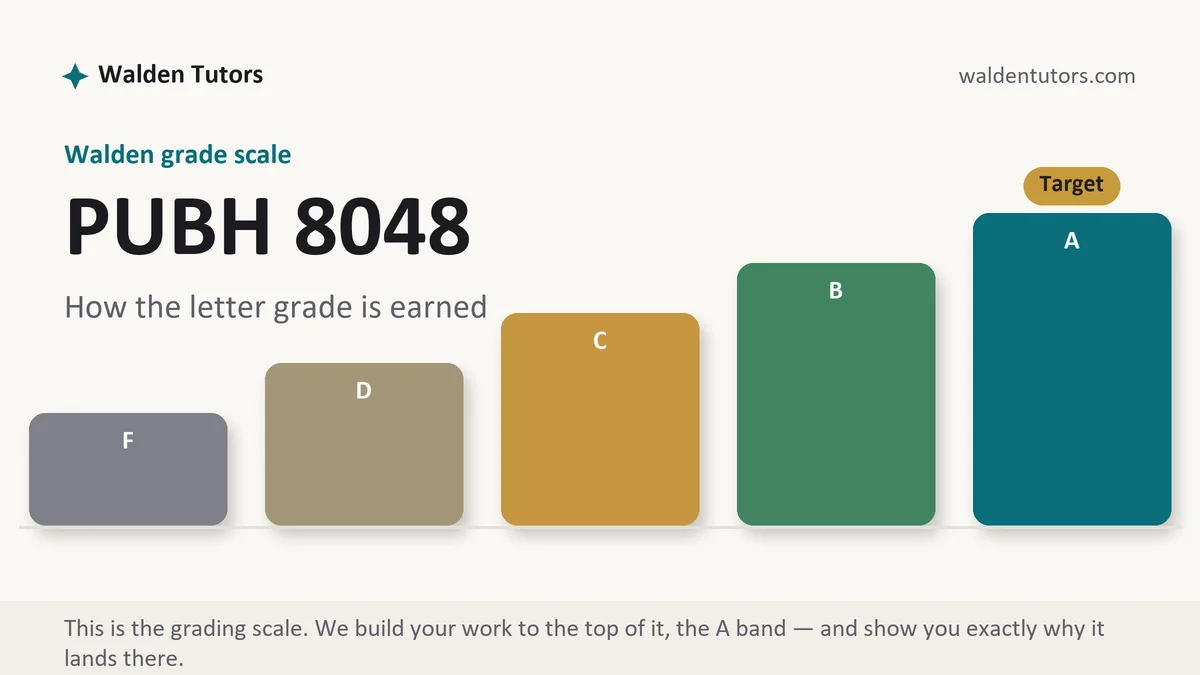
Walden lists PUBH 8048 at five credits inside the Doctor of Public Health. The catalog describes it as a wide look at the behavior change theories and conceptual models that public health research and practice actually run on, worked across individual, interpersonal, and community levels, and then applied to quantitative, qualitative, and mixed methods designs. What gets scored is fit: whether the model you picked can carry the question you asked.
What PUBH 8048 actually grades
Alignment, over and over. Deliverables here tend to be theory application papers, framework justifications, construct maps, and threads where you defend one model against a problem you selected yourself. Each of them turns on a single joint. Does the construct you named explain the determinant you are studying, and would the method you proposed be able to observe it. A doctoral grader is not counting how many frameworks you can list. That habit, surveying six models politely and committing to none, is the reliable way to underfeed the heaviest rows on the sheet.
How we help in this course
We build theory work backwards from the question. The problem gets stated first in terms of a determinant at a specific level, the candidate models are tested against that level rather than admired in the abstract, and only then does one get adopted and its constructs mapped onto the design. Where an assignment asks for comparison, the draft finds the genuine disagreement between two frameworks instead of parking two summaries beside each other. Send prior doctoral work and the register comes back close to yours.
Nothing about the commercial terms shifts between one course and another. Turnaround sits inside two days of the brief, the target is an A measured against the rows you send us, one reviewer scores the draft the way a grader would and a second checks citation mechanics and originality, and revisions stay free until that row target is reached.
Weekly manuals for this course
Individual week manuals for PUBH 8048 publish only as each deliverable is confirmed, never as a grid inferred from another doctoral course. Walden keeps syllabi inside the classroom, so anything week-specific here would be a guess wearing a number. Bring the week you are on to chat and it gets drafted whether or not a manual exists yet. On timing: the DrPH program of study is published quarter by quarter, and the longer of the two sequences Walden prints runs out to Quarter 12, so you are sitting in a quarter term rather than a semester one. Walden's own calendar prints dates rather than week counts, and the arithmetic on a published span such as Fall 2026, August 31 through November 15, comes to roughly eleven weeks. Shorter half terms of about six weeks also run inside a quarter, which is why the only trustworthy due dates are the ones in your student portal.
Sitting on a PUBH 8048 deadline?
Send the prompt, the scoring guide, and the model you are leaning toward. The opening premium sample costs nothing and arrives within two days.
What a doctoral theory rubric is really testing
Two things, and they are easy to separate once you have seen them. The first is accuracy: whether you can state what a model claims without bending it to suit your topic. The second, worth more points nearly every time, is application: whether the model then does work in your paper. A reader can spot the difference inside one paragraph. Writing that the Health Belief Model includes perceived susceptibility is a report on a textbook. Writing that men in this county postpone screening because the risk feels like something that happens to older men, which is perceived susceptibility operating exactly as the model predicts, is the model doing work. Assignments close at 10:59 p.m. Central and 11:59 p.m. Eastern, and the letter that comes back is assembled from those rows one at a time, so paragraphs that already think inside the framework earn credit everywhere downstream.
What we need to start a PUBH 8048 draft
The assignment instructions, the scoring guide, the population or problem you have chosen, and the model if the week fixed one for you. If the selection is yours and undecided, say which direction you lean and roughly what data you expect to have, because a framework that cannot be measured with your intended instrument is worth nothing to you three quarters from now. What comes back is a paper holding one frame consistently, constructs defined as their originators defined them, an alignment section a committee reader could follow, library sources rather than open web results, and notes tying each heading to its row.
Try the desk on one framework paper
Spend the free sample on a theory application assignment rather than a discussion post, because the longer piece exposes everything at once. You will see whether the model is genuinely driving the argument, whether the constructs survive into the methods section, whether the sources are current empirical work or a chain of textbook citations, and whether the APA holds up. Send the instructions with your rubric attached, read the returned draft against your own rows before any money changes hands, and decide from there. The seasonal offer then takes a cut off your first paid order.
How to actually write PUBH 8048: where to begin
Start with the scoring guide open in a second window, not the readings. Copy each row into an empty document and turn it into a heading, then write the point weight beside it. In theory application work the weight almost always sits on justification of the framework and on the application itself, while the row asking you to describe the model is comparatively light. Students invert that split constantly, producing four pages of history for the Transtheoretical Model and one page on the smokers they were supposed to explain. Describe briefly and correctly, then spend your length where the sheet is paying.
Pick your problem before you pick your model, and state it as a determinant at a named level. This matters more here than anywhere else in the sequence, because the level of the determinant decides which family of models can help you. A problem sitting inside individual beliefs and intentions belongs to the Health Belief Model, the Theory of Planned Behavior, or the stages logic of the Transtheoretical Model. A problem living in relationships, modeling, and self-efficacy points toward Social Cognitive Theory. A problem produced by clinic hours, transport, zoning, or policy is a community and structural problem, and forcing it into an individual belief model is the single most common misfit a grader in this course sees. Socio-ecological framing exists precisely so that a paper can put a determinant on the right rung. If your intervention will happen at the organizational level, an implementation framework will serve your argument better than a psychology of intention.
Then write the alignment argument as a chain the reader can walk. Problem, purpose, research question, framework, constructs, variables, instruments, analysis. Each link should follow from the one before it with a sentence saying why, and the chain should be unbreakable in both directions: a reader starting at your survey items ought to be able to walk back up to the construct, the framework, and the question without guessing. This is the part doctoral graders read most carefully, and it is where papers usually fail quietly rather than loudly. Nothing is wrong on any single page. The framework simply stops appearing after page four and returns for the conclusion, which tells the reader it was chosen after the study was designed.
Operationalize every construct you keep. For each one write a working definition in your own words, name how it has been measured in published studies, and say what you will use for it. Perceived behavioral control is not a variable until it is a set of items with a scale attached. Social support is not a variable until you have decided whether you mean instrumental, emotional, or network size, and which validated instrument captures that. When you reach for an existing measure, cite the study that developed it and the study that used it in a population resembling yours, and say what its reported reliability was. This paragraph is usually the difference between a paper that reads like doctoral work and one that reads like an essay about theories.
Synthesize the literature rather than summarizing it. Build a matrix before you write: rows for the studies you have collected, columns for the framework used, the population, the constructs measured, the design, and what was found. Patterns appear in a matrix that never appear in a stack of article summaries, and those patterns are what a synthesis paragraph says out loud. Three studies applied this model to adolescent populations and all three found self-efficacy carrying the effect, while the two conducted with older adults found the same construct doing very little. That sentence is synthesis. A paragraph beginning with an author's surname and ending with what that author concluded is a summary, and the rows in this course are written to tell them apart. Pull the studies through the Walden Library rather than a general search engine, because the subject guides and licensed databases are where the public health literature the rubric assumes actually lives, and the librarians will build a search string with you if the topic is unfamiliar.
| Section | What goes in it | What earns full rubric points |
|---|---|---|
| Problem and level | The health problem, the population, and the determinant you intend to explain, placed at an individual, interpersonal, community, or policy level. | One determinant chosen and located on a named level, rather than a broad topic restated from the prompt. |
| Framework selection | The model you adopted, its origin, and the reasoning that ruled the alternatives out. | At least one serious rival named and rejected for a stated reason connected to your determinant. |
| Construct map | Each construct you are keeping, defined as its originators defined it, with the relationships among them stated. | Definitions that match the source literature, with any adaptation flagged openly instead of slipped in. |
| Application to design | How the framework shapes your research question, your sampling, and your instruments or interview domains. | Every construct reappearing as something measurable, and nothing measured that the framework never named. |
| Evidence base | Empirical studies that have applied this model, especially in populations resembling yours. | Findings compared against each other rather than listed, with disagreements between studies discussed. |
| Limits and alternatives | What the model does not explain, whose behavior it was built from, and where a different frame would do better. | A specific boundary named and its consequence for your study stated, not a closing sentence of humility. |
Discussion posts in a doctoral theory course
Threads here usually hand you a scenario or a model and ask how it would explain a pattern. The post that scores does the explaining rather than reporting on it: name the construct, apply it to the case in two or three sentences, cite an empirical source that used it that way, then say what the model cannot see. Cut the opening paragraph summarizing the framework, since every classmate read the same chapter and the row wants your application of it. Walden expects students to log in and post something graded during the opening week, so a thread you meet on day one is easier to hold all term than one you join late.
The reply day is its own graded event, and agreeing with somebody earns none of it. Test the fit instead. Ask which construct would change if the population were rural rather than urban. Point out that the intervention proposed operates at a level the chosen model does not address. Bring a study that applied the same framework and got a different result, then say what might account for the difference. Walden's grading policy asks for participation that is substantive, timely, and spread out, and it recommends posting across at least two to four days of the week rather than emptying everything into one evening. The university also states plainly that requirements vary between courses and even between weeks of the same course, so take the count and the closing time from your own classroom rather than from a pattern you learned elsewhere.
Citations, APA 7, and the library
Theory writing attracts two citation habits that quietly cost points. The first is leaning on the course text for everything, which turns every model into one author's compression of it. The second is citing only the founding paper, which leaves your work reading as though nothing has been tested since publication. Aim for a mix: an original source when you state what a construct means, a recent empirical article when you claim the model works, and the text only for orientation. Where you are reporting one author's account of another, use secondary citation format rather than pretending you read the original.
Mechanically nothing exotic is asked. APA 7 title page in the layout Walden supplies, heading levels applied consistently, in-text citations matching a reference list with no orphans in either direction, and direct quotation kept rare because a doctoral theory paper should be argued in your own sentences. Figures matter more in this course than in most, since many assignments want a diagram of your framework, and an APA figure needs a number, a title above it, and a note beneath explaining any arrow a reader might misread. Take formatting rulings from the Writing Center rather than improvising them, and keep the reference list building as you go, because reconstructing sources at the end is how citations go missing.
The mistakes that cost points in PUBH 8048
- A model chosen for familiarity, then bent to fit a determinant that lives at a completely different level.
- Constructs renamed to suit the topic, so the paper claims an established theory it is no longer using.
- A framework that appears in the introduction and the conclusion and vanishes from everything in between.
- Literature delivered as a queue of article summaries with no comparison drawn between any two of them.
- Constructs that never become measurable, leaving a methods section that could not detect what the theory predicts.
- Limitations written as modesty about the author rather than as boundaries of the model itself.
PUBH 8048 questions students actually ask
How do I tell a theory from a conceptual framework?
A theory arrives already built. Somebody else specified its constructs, stated how they relate, and put the relationships through testing, so when you adopt one you inherit both its vocabulary and its claims. A conceptual framework is assembled by you for one study, often by borrowing constructs from two or three sources and adding variables your setting demands. The doctoral expectation is that you say which you are doing and why. Adopting an established model obliges you to use its constructs as defined rather than renaming them. Building a framework obliges you to defend each borrowed piece and to show a reader where the joins are. Trouble starts when a paper claims a named theory and then quietly redefines half of it.
Do I have to use one of the models from the course readings?
Usually not, though check the prompt, because some weeks deliberately restrict the menu so the class can compare applications side by side. Where the choice is open, the safer move is still a model with a published measurement history, since you will need instruments for the constructs later and inventing them is a separate research project. If you want something outside the reading list, justify it on fit rather than novelty, cite studies that have used it in a comparable population, and say plainly what the course models could not do for your question. Preference is not an argument. Fit is.
How many constructs should my framework actually carry?
Few enough that every one of them shows up again in your methods. A framework with nine constructs and a survey that measures four is a broken paper, and graders find that gap quickly because they read the two sections against each other. Three to five working constructs is a comfortable range for most doctoral course assignments. If a construct never reappears as a variable, an interview domain, or a measured outcome, it is decoration and it should come out. Trimming reads as discipline, not as thin work.