PUBH 8132 help and tutoring

PUBH 8132 · 5 credits · DrPH
The short answer

PUBH 8132 is a five-credit doctoral course in Walden's public health catalog. It covers communication theory, social marketing technique, health literacy, community partnership, and culturally appropriate materials, and it builds toward one named deliverable: a Public Health Communication Campaign that you develop, implement, and evaluate as your Scholar Practitioner Project, applying social marketing principles and social media technique to a health problem you choose.

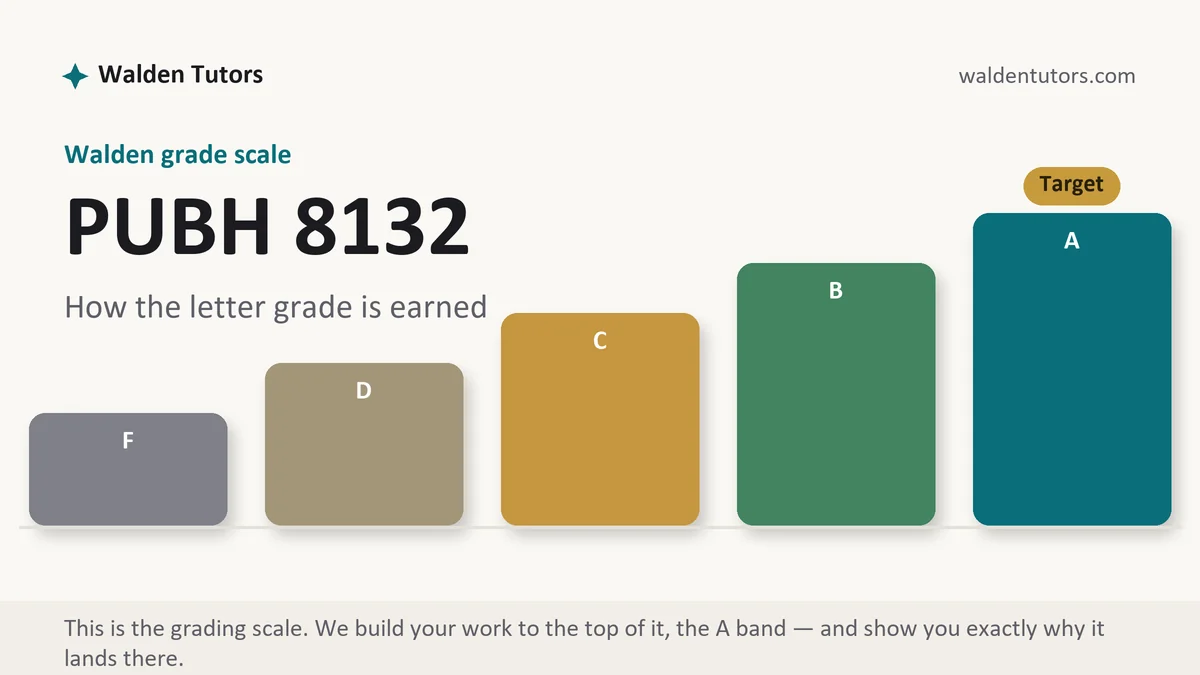
PUBH 8132 grading scale at Walden, how the work is graded, from Walden Tutors
How Walden grades PUBH 8132, visualized by Walden Tutors.

What PUBH 8132 actually grades

Whether the campaign is aimed at somebody real. The staged pieces here run to situation analyses, segmentation work, message and material drafts, channel plans, health literacy critiques, and evaluation designs, all feeding the campaign project. The rows behind them come back to one question: could a person in your named audience encounter this message, understand it, and act on it. Everything else follows from that. A campaign written for the general public is unanswerable, and the rows that ask about targeting, message fit, and channel choice all fail together when the audience was never actually defined.

How we help in this course

We build campaign work from the audience outward. The segment is defined first with a barrier and a media habit attached, the behavioral objective is written so it could be measured, the message strategy answers that specific barrier rather than announcing the health topic, and the channel plan follows where the segment actually spends attention. Materials get drafted in plain language at a defensible reading level. Health literacy and cultural fit are handled inside the creative work instead of appended as a closing paragraph.

The standing terms carry over. Drafts return in 24 to 48 hours, aimed at an A on whatever rows you hand us. Two reviewers touch every file before it goes out, one scoring it against your rubric and one auditing APA and originality. Revision is free for as long as it takes to reach the target.

Weekly manuals for this course

Week-by-week manuals for PUBH 8132 publish only once a specific deliverable has been confirmed. Walden keeps syllabi behind the classroom login, so any numbered grid on this page would be a guess, and guesses are worse than gaps when a deadline is close. Bring your week to chat and the drafting service takes it either way. As for pacing, the catalog lays the DrPH out quarter by quarter, so a quarter term is what you are in. Walden publishes the opening and closing dates without stating a week count, and counting one of them, Summer 2027 from May 31 to August 15, gives you close to eleven weeks. A six-week half term can also sit inside the quarter, which is why your own portal is the only reliable source for due dates.

Campaign project bearing down on you?

Send the assignment, the scoring guide, and the health issue you picked. The first premium sample is free and returns within 48 hours.

What a campaign rubric is really testing

Specificity and evidence, in that order. A grader reading a communication plan is checking whether each decision was made for a reason that can be stated, and whether the reason came from research rather than instinct. Choosing radio because older adults listen to radio needs a source. Choosing a fear appeal needs a defense, since the literature on fear is mixed and a doctoral paper is expected to know that. Assignments close at 10:59 p.m. Central and 11:59 p.m. Eastern, and the grade is assembled from the rows one at a time, so a well-defined audience earns credit in four or five places while a vague one loses points in the same four or five.

What we need to start a PUBH 8132 draft

The instructions, the scoring guide, the health issue and community you have chosen, and any template your classroom supplied for the campaign plan. Tell us what you already know about the audience, whether the assignment requires particular channels or a social media component, and whether the instructor has capped the length. If earlier stages of the project have been graded, send the feedback, because a campaign built in pieces has to stay consistent across them. What returns is a plan with a defined segment, a measurable behavioral objective, message strategy tied to a named barrier, a channel rationale, drafted material, an evaluation design, and notes mapping sections to rows.

Try the desk on one campaign stage

Use the free sample on the segmentation and message strategy stage rather than a discussion post. That piece is the hinge of the whole project, and it shows the most: whether the audience is a real group of people or a demographic label, whether the objective could be measured, whether the message answers a barrier, and whether the sources are formative research or general assertions. Send the instructions and your rubric, read what comes back against your own rows, and decide from there. The seasonal offer then discounts your first paid order.

How to actually write PUBH 8132: where to begin

Read the scoring guide first, then build the plan in the order the guide scores it. Campaign assignments tempt students into designing the creative work early, because writing a slogan feels like progress, and the result is a poster in search of a strategy. Rebuild the rows as headings, note their weights, and you will usually find that audience definition, objective setting, and evaluation carry more points than the materials do. Draft the material last, when you finally know who it is for and what it has to overcome.

Segment the audience until it is a person rather than a population. This is the discipline the whole course rests on. Start with a demographic boundary, then add behavioral status, since people who have never considered a behavior need something different from people who tried and quit. Add the barrier, which is the reason this behavior has not already happened, and add the media habit, which is where the person encounters information they believe. When those four pieces are on the page you can write to somebody. Formative research is what supplies them, so use published studies on your population, existing survey data, or a small set of interviews if the assignment permits, and cite them. A segment defended by evidence scores in every downstream row. A segment asserted from intuition drags on all of them.

Then write a behavioral objective rather than an awareness goal. Awareness is easy to raise and hard to bank, and public health campaigns are judged on what people do. Name the audience, the action, the size of the change, and the period, so that someone could later say whether it happened. Raising the proportion of pregnant patients at three named clinics who report a household smoking ban from a measured baseline to a stated target within twelve months is an objective; increasing understanding of secondhand smoke is not. Write the evaluation measure at the same moment you write the objective, because an objective nothing can measure will haunt the last section of the paper.

Now apply the marketing logic honestly, using its four familiar levers. Product is the behavior you are asking for, and it has to be something the audience could plausibly do; asking for a two-hour clinic visit from people with no transport is a product failure that no message will fix. Price is what the behavior costs in time, money, effort, embarrassment, or standing with family, and naming that cost is what separates a doctoral plan from a poster. Place is where the exchange happens, which means both where the message appears and where the action can be taken. Promotion is the message and the creative work, and it comes last for a reason. Two further ideas earn their keep in an assignment. Exchange means the audience must get something they value in return, so state what that is in their terms rather than yours. Competition means something is already occupying the behavior's place, whether that is convenience, a habit, a cheaper alternative, or advice from a relative, and a plan that names its competition reads far more credibly than one that pretends the field is empty.

Write the materials for the reading level and the culture of the audience you defined, and show your work. Plain language means short sentences, common words, one idea per sentence, active voice, and a specific call to action with the next step attached. Test a draft against a readability measure and report the result, since a claim that materials are accessible is worth little beside a number. Cultural fit is not translation. It runs to who appears in the imagery, which language a household actually uses at home, whether the appeal rests on individual benefit or on family and community standing, and whether the messenger is somebody the audience has reason to trust. Partnering with an organization already embedded in the community is often the strongest move available, and the plan should say what that partner contributes and what they get. Take the evidence for all of this from the Walden Library rather than an open search, since the health communication and behavioral science journals live there, and take formatting rulings from the Writing Center rather than reconstructing them from memory.

SectionWhat goes in itWhat earns full rubric points
Situation analysisThe health problem, its burden in your community, what has already been tried, and what the environment allows.Local data with sources and years, plus an honest account of a previous effort and why it fell short.
Audience segmentDemographic boundary, behavioral status, the barrier in the way, and where this group gets information.A segment described so precisely that a reader could picture one member of it.
Behavioral objectiveThe action requested, the size of the change, the population, and the deadline.An objective a spreadsheet could settle, with its measurement named in the same breath.
Message strategyThe core promise, the tone, the appeal, and the reason the audience should believe it.A message answering the named barrier, with the appeal defended from research rather than taste.
Channels and placementWhere the message runs, how often, and how the audience's habits determined that choice.Each channel justified by evidence about this segment, not by what is easiest to arrange.
MaterialsDrafted messages, visuals, and the plain language and cultural decisions behind them.A reported readability level, a stated call to action, and imagery matched to the audience.
EvaluationProcess measures, outcome measures, baseline source, timing, and who collects what.Baseline identified before launch, with reach separated clearly from behavior change.

Discussion posts about campaigns and messaging

Threads in this course often put a real campaign or a message example in front of you and ask for an assessment. Do the analysis rather than the reaction. Name the audience the campaign appears to be aimed at, identify the theory or the appeal doing the work, say what barrier it is trying to remove, and judge whether the channel choice matches the audience. Then bring one source. Walden asks students to post graded work during the first week of the term, and entering a critique thread early gives classmates something to argue with, which is the only way the exchange the rubric imagines can occur.

Responses are graded on their own and approval is not analysis. Test the plan instead. Ask what the campaign is competing against for that audience's attention and habit. Point out that the proposed channel reaches a different group than the one your classmate defined. Question whether the appeal chosen has support in the literature for this population, and bring the study that complicates it. Walden's grading policy asks for contributions that are substantive, on time, and spread across the week rather than posted in a single sitting, recommending at minimum two to four posting days, and the university notes openly that requirements differ across courses and even between weeks of one course. Your classroom sets the count and the cutoff.

APA 7 when the paper contains creative work

Campaign assignments mix scholarly prose with material a reader is meant to look at, and the mechanics of that mixing are scored. Anything visual is a figure, so it takes a number, a title above it, and a note beneath explaining what a reader could misread. Sample messages presented as exhibits belong in figures or an appendix rather than floating loose in the body. If you adapt an existing campaign's material, cite it, and if you reproduce it, say so plainly and check what the assignment permits, since reusing published creative work has both a citation dimension and a permission dimension. Data behind your situation analysis needs the source, the year, and the geography named. Government and agency reports carry group authors, so learn that reference pattern properly, and build the reference list as you draft rather than reconstructing it once the campaign is finished.

The mistakes that cost points in PUBH 8132

  • An audience defined as the community, which leaves every later decision with nothing to be justified against.
  • Awareness offered as the objective, so the evaluation section has no behavior to measure.
  • Channels picked because they are familiar to the writer rather than because the segment uses them.
  • Cultural appropriateness reduced to translating the flyer, with no change to messenger, imagery, or appeal.
  • A fear appeal chosen with no discussion of the mixed evidence behind fear-based messaging.
  • Materials written at a reading level nobody checked, then described as accessible.
  • An evaluation plan counting impressions and calling that a behavior change result.

PUBH 8132 questions students actually ask

How narrow should my audience segment be?

Narrow enough that you could describe one member of it in a paragraph and a classmate would recognize the person. Demographics alone will not get you there, because age and zip code do not tell you what somebody believes about the behavior or where they get information they trust. A usable segment combines a demographic boundary, a behavioral status, a barrier, and a media habit. Fathers of infants in two counties who intend to quit smoking but have never used a quitline, and who mostly encounter health information through short video, is a segment you can write to. Community members is not.

Is social marketing just another phrase for social media?

No, and conflating them costs points early. Social marketing is a planning discipline that borrows commercial marketing logic to encourage a voluntary behavior for a social benefit. It runs on audience research, an offer of genuine value, attention to price in time and effort and social cost, deliberate placement, and testing before launch. Social media is one channel that a campaign may or may not use. A plan can be thoroughly social marketing and never touch a platform, and a campaign can post every day while doing no social marketing at all. Your assignment may ask you to include social media techniques specifically, which is a channel requirement rather than a redefinition of the field.

How do I evaluate a campaign I never actually ran?

You write the plan for measuring it, with the same specificity you would use if the money were real. Name the process measures that would tell you the campaign was delivered, such as materials distributed and reach achieved. Name the outcome measures tied to your behavioral objective, along with the instrument and the schedule. Say where the baseline comes from and be concrete, since a campaign with no pre-launch measurement has nothing to compare against later. Then state the honest limitation, which is that reach and recall are not behavior change, and describe what you would need in order to claim your campaign caused any shift you observed.

Keep going

Online now