PUBH 8211 help and tutoring

PUBH 8211 · 5 credits · DrPH core
The short answer

Five credits, and the methods spine of the DrPH. Walden's description covers designing and running quantitative, qualitative, and mixed methods work at doctoral level, together with ecological and systems thinking across individual, group, organizational, community, and population levels. Research questions, designs, data collection, analysis and the statistical tests behind it, plus ethical conduct, all sit inside one course. The catalog also lists prerequisites: RSCH 8110, PUBH 8512, and RESI 8501.

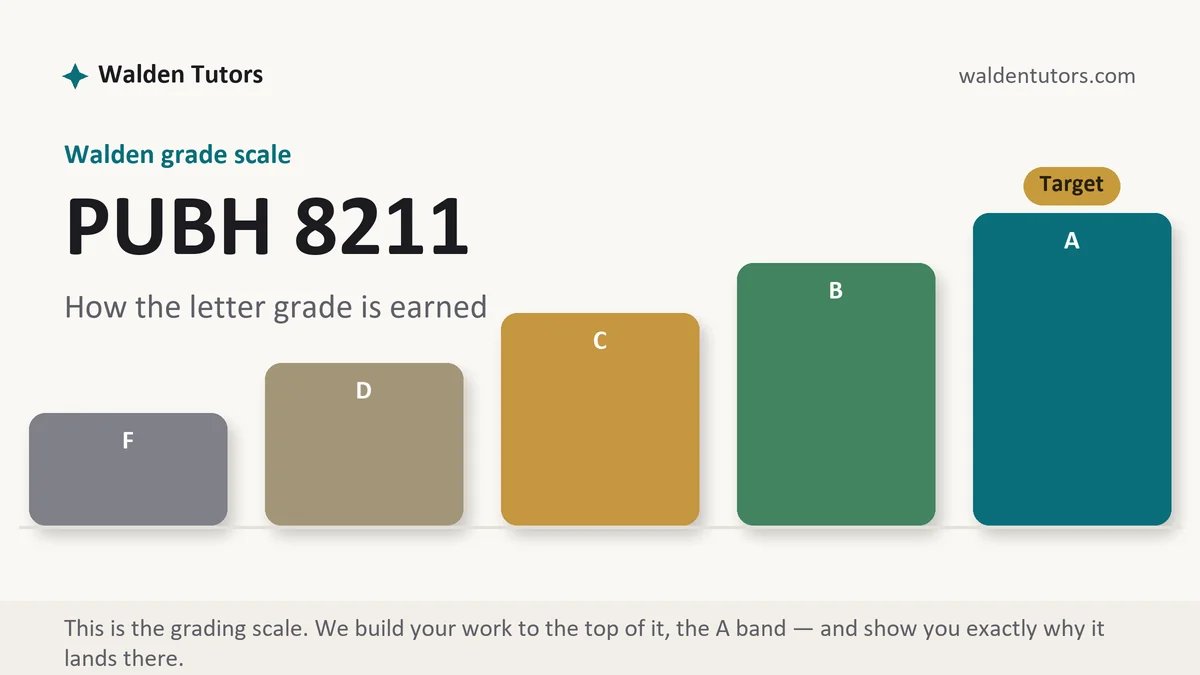
PUBH 8211 grading scale at Walden, how the work is graded, from Walden Tutors
How Walden grades PUBH 8211, visualized by Walden Tutors.

What PUBH 8211 actually grades

Coherence between the parts of a study. Almost every row in this course is checking, in some form, whether one element follows from the last: the problem justifies the purpose, the purpose produces the question, the question demands a particular design, the design permits a particular analysis, and the analysis can actually answer what you asked. A paper can be well written throughout and still land in the middle because the chain snaps somewhere in the middle of it.

The second thing under examination is whether you can defend a choice rather than describe one. Doctoral methods writing is not a summary of what qualitative research is; it is an argument for why a phenomenological approach and not a case study serves this particular question, with the rejected option named. Students coming from practice often write beautifully about the health problem and then treat the method as a label to be selected, which is precisely where the marks move.

How we help in this course

Every 8211 draft we build starts from a one-line alignment map before any prose exists: problem, purpose, question, design, sample, data, analysis, each stated in a phrase and checked against its neighbor on either side. If the chain holds there, the writing is straightforward. If it breaks, we fix it at the map stage rather than papering over it with careful sentences, because a grader reading for alignment finds the break no matter how good the paragraphs are.

Terms match the rest of the studio. Drafts come back within a day or two, aimed at an A on the rows you send across, checked once for scoring and again by a different reviewer for formatting and originality, and reworked at no extra cost until those rows are satisfied. Old coursework of yours helps the finished piece sound like you wrote it.

Weekly manuals for this course

Manuals for particular weeks appear here as each deliverable is verified, one at a time. Doctoral syllabi at Walden sit behind the classroom login, and inventing a week grid from a related methods course would be guesswork dressed up as guidance. Send the assignment you are actually holding to chat and drafting starts on it either way.

Timing works like this. The DrPH sits on Walden's quarter calendar, with the published sequence stepping through twelve numbered quarters. Take the difference between the opening and closing dates on the university calendar and a full quarter term comes to something like 11 to 12 weeks, which is arithmetic on Walden's dates rather than a duration Walden states. Anyone beginning in the Spring 2027 quarter runs from 1 March to 16 May. Nightly cutoffs land at 10:59 p.m. Central, the same moment as 11:59 p.m. Eastern, and only your classroom can tell you which items fall on which date.

Stuck on a methods assignment?

Send the prompt, the rubric, and the topic you are circling. First premium sample is free, back within 48 hours.

Why alignment decides the grade

Alignment is the reason two papers with identical reference lists can score a letter apart. A grader reads your question, forms an expectation about what design must follow, and then checks whether the document delivers it. When a question asks how survivors make sense of a diagnosis and the methods section proposes a survey with a validated scale, the mismatch is visible in seconds and it contaminates the sampling row, the instrument row, and the analysis row at once. This is also why fixing a methods paper late is so painful: a broken chain cannot be repaired by editing, only by changing the question or changing the design. Settle that pairing first and the rest of the writing becomes description rather than rescue.

What we need to start a methods draft

Send the assignment instructions and the scored rubric as posted in the classroom. Add the topic or health problem you are working with, plus any restriction your instructor placed on design, population, or setting. Tell us whether the week wants a proposal, a critique of published studies, an analysis plan, or an ethics discussion, since those four are graded on quite different rows. If your program has you building toward a dissertation topic, say so, because keeping the coursework pointed at that topic saves rewriting later. A prior submission gives us your register.

How to actually write PUBH 8211: holding the chain together

Treat the rubric as a specification rather than a summary. Its rows in this course usually correspond to the parts of a study, which means the rubric is already your outline, and the point value beside each row tells you how much room that part has earned. A design and rationale row carrying heavy weight should not be finishing in a short paragraph while the background stretches over two pages. Where the prompt emphasizes one thing and the rows pay for another, write to the rows.

Build the alignment map next, on one page, before drafting. Write the problem in a sentence that a public health practitioner would recognize as a real gap rather than as a topic. Write the purpose as what your study would do about it. Write the question so that its verb already implies a method. Then name the design, the population, the data, and the analysis, and read the chain in both directions. Downward, each item should feel inevitable given the one above. Upward, each item should be justified by the one above. Anywhere you cannot explain the jump, that is the row you were going to lose.

Pick your ecological level explicitly and state it inside the question. Walden puts individual, group, organizational, community, and population levels in this course, and the level you settle on becomes your unit of analysis. It decides who is sampled, what an instrument measures, and what you are entitled to conclude. Keeping the level constant is what stops the familiar error of reasoning from aggregate figures down to individual people, and saying the level plainly protects you from drifting across it while writing.

Then argue the design instead of announcing it. Name what you chose, say what property of the question forces that choice, and name at least one credible alternative with the reason it fits less well. Carry the same discipline into sampling: who is eligible, how they are reached, roughly how many, and why that number or that recruitment route suits the design. For qualitative work, say what would count as enough depth. For quantitative work, say what would make the sample adequate to detect the effect you care about. Precision here reads as doctoral; vagueness reads as unfinished.

Finish with the analysis plan and the ethics, and keep them concrete. State each variable and how it is measured, name the procedure, list what it assumes, and say what you would do when an assumption does not hold. Qualitative analysis needs the same specificity: which approach to coding, how themes get built, and what you do to keep the reading trustworthy. Ethics closes the paper and should name real protections rather than principles, covering consent, confidentiality, storage, and any extra care owed to participants whose circumstances make refusal difficult. Walden requires review before human subjects work begins, and our guide to the approval process covers what the committee expects to see.

SectionWhat it doesCommon failure
Problem statementEstablishes a documented gap in practice or knowledge, with evidence that it matters and to whom.A topic announced rather than a gap demonstrated, so nothing in the paper has a reason to exist.
Purpose statementSays what the study would do about the gap, in one sentence naming design and population.Purpose and problem restated in each other's words, leaving the reader without a study.
Research questionsPoses answerable questions whose verbs already imply the method and the level of analysis.Verbs pointing one direction while the design points another, breaking every row downstream.
Design and rationaleArgues for the chosen approach and names a rejected alternative with the reason it lost.The design named and then defined from a textbook, with no argument connecting it to this question.
Population and samplingDefines eligibility, recruitment, and size, matched to what the design needs.Convenience sampling described as though it were a choice rather than a limitation to be defended.
Data and analysis planTies each variable or data source to a named procedure and its assumptions.A test named with no assumptions stated, or coding promised with no method for building themes.
Ethics and limitationsSpecifies consent, confidentiality, storage, added protections, and what the design cannot show.General respect for participants in place of procedures, and limitations that quietly avoid the real weakness.

Discussion posts in a methods course

Threads here tend to hand you a published study, a design scenario, or a question to critique, and they are graded on their own rows. The strongest opening posts do one analytical thing well rather than four things briefly: test whether the article's conclusions are supported by the design it used, or take the scenario and show which of two designs the question actually licenses. Name the specific feature you are judging, quote or cite where it appears, then say what follows. Method claims need sources exactly like everything else.

Replies carry their own row and require analysis, not endorsement. Ask what a classmate's chosen design cannot show, offer the confound their sampling leaves open, or grant the design and question whether the proposed analysis fits the measurement level of their variables. Walden's grading policy asks for participation distributed through the week rather than delivered in a single sitting, recommending posts on two to four separate days at minimum. The exact number of replies and the closing day differ by classroom, so confirm yours there.

Citing methods sources and APA at doctoral level

Methods writing has a citation habit worth learning early: you cite the methodologist for the approach and the empirical study for the precedent. When you say a design is appropriate, the support is a methods authority. When you say the design has worked on a problem like yours, the support is a published study that used it. Blurring the two, and citing an empirical paper as though it were the source of the method itself, is a small tell that doctoral readers notice.

Mechanics still count. Use the Walden title page, keep heading levels consistent as the document deepens, and make sure nothing is cited that the references omit and nothing is listed that the body never uses. Pull sources through the Walden Library so you are working in the databases the rubric assumes, and prefer primary methodological texts to secondary explanations of them. Where your instructor supplies a template for a proposal or alignment table, use theirs rather than any general format, including anything you find here.

The mistakes that cost points in PUBH 8211

  • A question whose verb promises exploration paired with a design built for measurement, or the reverse, which breaks the alignment row and several others with it.
  • Design chosen first because it feels manageable, then a question reverse engineered to fit it, which readers detect from how thin the rationale is.
  • Problem and purpose statements that say the same thing twice, leaving no gap for the study to fill.
  • Statistical procedures named without their assumptions, or qualitative coding promised without saying how themes would actually be built.
  • The ecological level left unstated, so conclusions about people get drawn from data collected about places.
  • Ethics written as a paragraph of values, with no mention of consent procedure, storage, or the participants for whom saying no is hardest.

PUBH 8211 questions students actually ask

How do I tell whether my question is quantitative or qualitative?

Ask what kind of answer would satisfy it. If a satisfying answer is a number, a comparison, a rate, or a relationship between measured things, the question is quantitative. If a satisfying answer is an account of how something is experienced, why a pattern persists, or what a practice means to the people inside it, the question is qualitative. Trouble usually starts with verbs. Explore, understand, and describe point one way; predict, compare, and determine point the other, and a question carrying one verb with the other design attached will lose the alignment row no matter how carefully the rest is written.

Do I have to run real statistics for this course?

Usually you have to justify a test rather than execute one, though your classroom decides and some weeks do include applied work. What the rows consistently reward is a defensible match between your variables and your chosen procedure. Say what each variable is and at what level it is measured, name the test, state the assumptions it makes, and say what you would do if an assumption failed. A named test with no justification behind it scores like a guess, and a page of output with no interpretation scores like a printout.

What does the ecological level have to do with my design?

It sets who or what you are actually collecting data about, which then constrains everything downstream. Walden describes this course as covering ecological and systems approaches across individual, group, organizational, community, and population levels, and the level you choose determines your unit of analysis. A question about individual behavior and a question about community conditions call for different samples, different instruments, and different inferences. Mixing them creates the error where county figures are used to argue about persons, so state your level in the question itself and keep the analysis there.

Keep going

Online now