SOCW 6070, Supervision, Leadership, and Administration in Social Work Organizations, is a 5-credit advanced course in the Walden MSW. The catalog places it late, listing SOCW 6111, SOCW 6361, SOCW 6090 and an advanced practice course such as SOCW 6121 among its prerequisites. It prepares you for supervisor, leader, and administrator roles, and it ends with a strategy for your own professional growth.
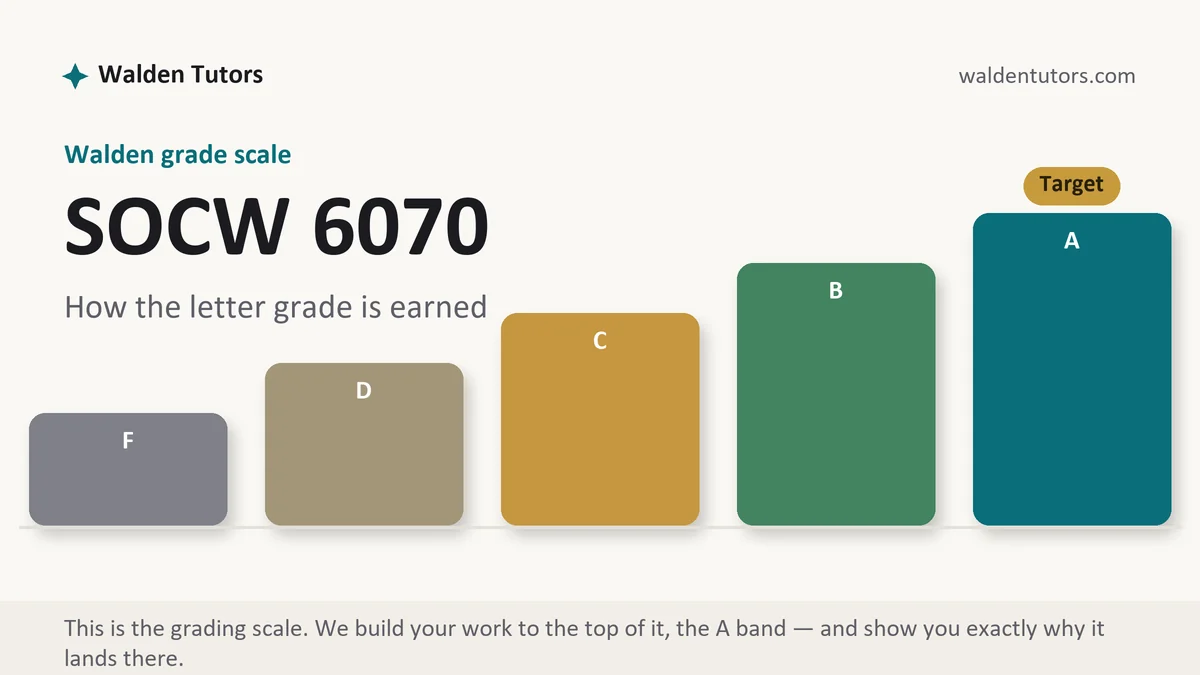
What SOCW 6070 actually grades
Walden is unusually specific about the outcome here. You are meant to finish understanding what supervisors, leaders, and administrators in this field are expected to be able to do, and to finish holding an individualized strategy for growing into those roles yourself. The assessments follow that shape: leadership theory placed against an organizational situation, ethical cases where the person deciding is a manager rather than a clinician, and a development plan written about you.
The register shifts as well. Clinical courses reward attention to one person. This one rewards attention to a system, so what you write about is caseload distribution, supervision structure, hiring and retention, funding, and internal policy. Students arriving straight from practice courses often keep writing about clients when the row asked about staff, and lose points while doing something skillful.
The third recurring demand is decision-making under pressure. Assignments build tangled situations deliberately, with no clean answer available, and the rows reward a decision with reasoning behind it rather than a tour of the options. Naming a course of action and defending it beats cataloging everything a leader might consider.
How we help in this course
Tutoring reviews your work in the organizational register this course expects, checking whether leadership theory is applied to a structure instead of summarized and whether ethical cases finish with a defensible decision. A row map shows which paragraph answers each criterion and where revision is still needed.
Orders run one path from start to finish. The rubric is broken down into what it actually demands, a writer who has worked this end of the MSW drafts it, one reviewer grades that draft against every row, another clears APA and originality, and it reaches you in 24 to 48 hours. Revisions keep running until it earns what you needed from it.
Weekly manuals for this course
Manuals for individual SOCW 6070 weeks go live once each week has been verified against a real classroom, and none are published yet. Nothing waits on that. Say which week you are in over chat and the scope answer comes back the same day.
When field hours and the final paper overlap
This course sits late in the MSW, which means most people take it while carrying a field placement at the same time. That is where a term breaks. Placement hours are fixed and immovable, field paperwork keeps its own deadlines, and the leadership deliverables land on a schedule that was already full. The dangerous stretch is not a hard reading week; it is the week your placement runs long and a major paper is owed on Sunday night.
Two moves take the pressure out. Map the course against your placement calendar before either one gets going, and mark every seven-day window holding a supervision report, an hours milestone, and a course deadline together. Then make the placement do double duty, because the organization you are already standing inside is the case study most of these assignments want, and notes on how it makes decisions turn into material rather than extra work.
The submission window shuts at 10:59 p.m. Central, 11:59 for Eastern students, on whatever day the item carries. Your program may be running on quarter terms or on semester terms, which changes how much runway sits between today and that overlap, and the authoritative calendar is the one inside your student portal.
What a leadership order needs from you
Send the prompt and the rubric. Where an assignment uses an organization, tell us what kind: rough size, funding mix, who reports to whom, and the problem sitting in front of it. Leave the agency unnamed and keep out anything that would identify a colleague. Where the deliverable concerns your own growth, a short paragraph on what you have led so far, however informally, gives the draft something true to build from. What you send stays inside the order.
Carrying SOCW 6070 alongside placement?
Send the prompt and rubric between shifts. Your opening sample is free, and it is back with you within 48 hours.
How to actually write SOCW 6070: where to begin
Rebuild the rubric as headings with the point values beside them, then check one thing before you write a sentence: whether each row is asking about a person, a team, or an organization. Getting the unit of analysis wrong is the expensive error in this course, and it stays invisible until the grade comes back. A row about supervision wants a supervisor and a supervisee in it. A row about administration wants a structure, a budget line, or a policy.
Pick an organization you can describe from inside. Your placement is usually the best choice and a former employer works too. What you need is knowledge of how decisions really get made there, not a copy of the org chart. If you have to use a published case or a hypothetical, take whichever version carries the most operational detail, because leadership analysis dies without specifics about how work flows and who signs off on it.
Choose a leadership framework the way you would choose a clinical one, by asking what it explains here. Transformational, servant, situational, distributed: each has an evidence base and each suits some problems and not others. State the problem you are solving, state why this framework speaks to that problem, then keep using its language. A model named once and never seen again fails in exactly the way it fails in the clinical sequence, just with different vocabulary.
On ethical scenarios, write toward a decision. Lay out the competing obligations plainly, name the NASW standard governing each side, say what you would do, and say what it costs. Administrative ethics nearly always involve a genuine loss somewhere, and the rows reward writing that admits the loss rather than pretending an option is free. Supervision cases add a layer, because a supervisor holds duties to the worker, to the client, and to the agency at once, and the strongest papers say which duty they are ranking first and why.
For the professional growth strategy, write against competencies rather than adjectives. Take the specific capabilities this course names for supervisors and administrators, rate yourself honestly on a handful of them, and attach one concrete development activity to each: a mentor plus the role you would ask that person to play, a training with an actual subject, a stretch assignment you could request at work. Put a horizon on each item, since a plan with no time in it is a list of hopes. Close with how you would know it worked, because self-assessment without evidence is the section graders cut hardest.
Bring evidence into organizational writing the same way you would into clinical writing. Real literature exists on supervision quality, on burnout and retention across human services, and on leadership styles inside nonprofit settings, and it lives in the Walden Library rather than in management blogs. Search Business Source Complete beside SocINDEX for this course. Then run the APA pass on the Writing Center template: heading levels consistent, citations and references matched in both directions, the NASW Code cited with its year everywhere it carried an argument.
| Section | What goes in it | Common failure |
|---|---|---|
| Organizational context | Size, funding, reporting structure, and the problem under examination. | Description that stops at what the agency does and never reaches how it decides. |
| Leadership framework | The model applied and why it suits this problem in this setting. | A tour of three leadership theories with none of them chosen and none of them used. |
| Supervision analysis | How supervision is structured, what it produces, and where it fails staff. | Supervision treated as support in general, with no frequency, format, or accountability named. |
| Ethical decision | The competing duties, the NASW standard on each side, and the call you make. | Options presented so neutrally that the paper never commits to anything. |
| Administrative implications | What changes in policy, workflow, budget, or staffing follow from the analysis. | Recommendations nobody could implement, because no owner and no sequence appear anywhere. |
| Professional growth strategy | Competencies rated, development activities attached, horizons and evidence set. | Adjectives about becoming a better leader, with no activity, no date, and no measure. |
Threads about running an organization
Discussions here tend to hand you an organizational dilemma and ask what a leader should do about it. Take a position inside the first two sentences. The pattern that scores runs decision, reasoning, a source supporting the reasoning, then an honest line about what the decision costs. Posts that catalog considerations without choosing read as avoidance to a rubric that asked for judgment.
Walden wants participation that is substantive, punctual, and repeated, and its guidance nudges you toward showing up on two to four days rather than one. It also tells students plainly that requirements vary between courses and even within one course, so check this week's instructions rather than trusting the shape of the last one.
Replies work best when you take a colleague's decision and test it. What happens under a hiring freeze, or with a unionized workforce, or if the funder objects. Stress-testing somebody's plan is a courteous form of disagreement, and it produces precisely the analysis these rows are hunting for.
The mistakes that cost points in SOCW 6070
- Writing about clients when the assignment asked about staff, supervision, or agency structure.
- A leadership theory summarized in one paragraph and then never used to explain anything that happened.
- Ethical scenarios answered by listing considerations, with no decision made and no cost acknowledged.
- Recommendations carrying no owner, no sequence, and no sense of what they would cost the organization.
- A growth plan assembled from adjectives instead of competencies, activities, horizons, and evidence.
- Consultancy pages and management blogs cited where the library carries peer reviewed human services research.
SOCW 6070 questions students actually ask
I have never supervised anyone. What do I write about?
Almost nobody in this course has, and the rubrics assume it. Use the supervision you have received rather than the supervision you have given: what a field instructor or manager did that changed your practice, where the structure helped, and where it left you alone with something you were not ready for. Analyze that against the literature and the row is satisfied. Where a prompt asks you to act as the supervisor, write it as a reasoned plan with the decisions and their rationale spelled out. Nobody expects you to claim experience you do not have.
How much can I say about my own agency?
Enough to make the analysis real, and nothing that identifies a person. Describe the agency by type, size, and funding rather than by name, and refer to people by role instead of by initials or by job titles specific enough to place them. Keep private conversations out. If the honest version of a case would expose somebody, change the identifying details and add a note saying you have done so, which is both safer and standard practice in professional writing.
Does the NASW Code apply to administrative decisions?
Yes, and the Code says so itself, carrying standards on supervision and consultation, on administration, on commitments to employers, and on obligations to the profession, all separate from direct practice duties. That is useful to you, because an ethics row in this course usually wants the administrative standards rather than the clinical ones. Cite the section that actually governs the situation, with its year, and apply it to the decision in front of you instead of quoting a general principle about service.