Marketing for Competitiveness carries the code WMBA 6060, runs for three semester credits, and expects WMBA 6000 behind you. Walden describes it as giving managers a working knowledge of marketing theory alongside the practical use of marketing tools and strategies, with the mix of product, price, place, promotion and people at its center and consumer behavior running underneath. The overload point is not where students expect it. It arrives when a written analysis needs market evidence you have not gathered yet, and gathering is the part that cannot be done at speed.
What WMBA 6060 actually grades
The catalog description sets two expectations side by side. One is theory, the models and concepts marketing has built for explaining why buyers behave as they do. The other is application, the innovative tools and strategies a manager reaches for when a market position needs defending or taking. Walden names the elements of the mix explicitly, product and price and place and promotion and people, and pairs them with insight into consumer behavior.
What faculty actually mark is an argument about a specific market. You are typically asked to take an organization, an offer or a campaign, identify who it is for, explain why that group buys, and then show how the mix either serves that group or fails to. Scoring follows the connective tissue. A paper that describes a segment in one section and a promotional plan in another, with nothing tying the plan to what the segment was shown to want, loses the rows that carry the most weight.
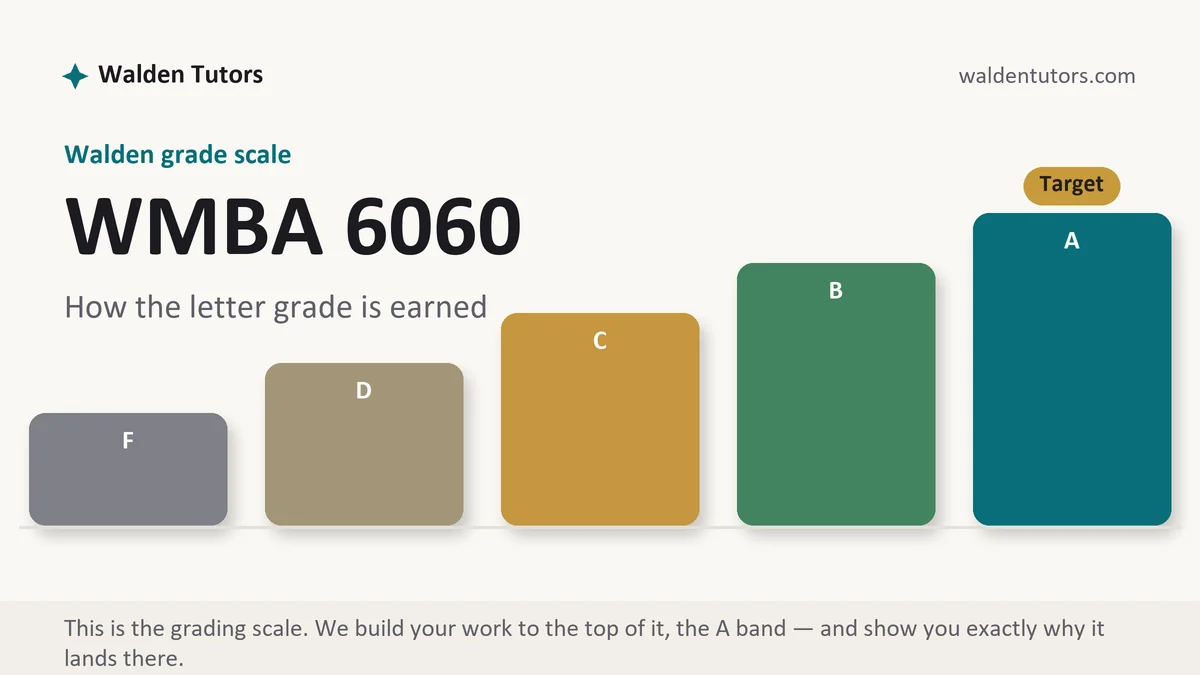
Grades come back as a letter built from those rows, and the rows are posted in the classroom alongside the item. That means the standard is not a mystery you have to infer from feedback after the fact.
How we help in this course
Hand over the assignment, the scoring rows your classroom displays, and one line naming the brand, product or market you want put under the lens. The draft that comes back argues a position rather than surveying the topic, with the framework applied to your chosen market instead of explained in the abstract.
Turnaround is 24 to 48 hours. Every draft passes a reviewer who scores it against the rows the way your instructor will, then a second reviewer who audits citations and originality on their own, and rewrites stay free until the work lands where we said it would.
Weekly manuals for this course
Manuals for individual weeks of WMBA 6060 appear only after a live classroom has confirmed what that week contains. Syllabi at Walden sit behind the student login and never reach the open web, so any week grid posted here in advance would be guesswork dressed as fact. If your week is not up yet, bring the item into chat and the desk builds from your real instructions.
Facing a WMBA 6060 marketing analysis?
Send the item and its rubric from the classroom. Your first premium sample costs nothing and returns within two days.
Where the WMBA 6060 workload spikes
Walden's MBA follows the semester calendar, which is the longer of the university's two term structures and quite separate from the quarter calendar used across nursing. Take Summer Semester 2026, which the academic calendar bounds with May 4 at one end and August 23 at the other. That is 111 days of term, a hair beneath sixteen weeks once you divide it out, and since the calendar page carries dates and no week numbers at all, the week figure is yours rather than Walden's. Your student portal is the authority on where your own term actually starts and stops.
The spike in this particular course has a cause worth naming. Marketing arguments run on evidence about other people: what a segment values, what competitors charge, how a category has moved, which channels the buyers you named actually use. None of that lives in your head, and none of it can be assembled the night before. Students who fall behind in WMBA 6060 rarely fall behind on writing. They fall behind because the writing stalls waiting for facts that take two sittings in the library databases to find.
The counter is to separate collection from composition and to do the collection early. Read every graded item the classroom exposes during the opening week, write down the specific market facts each one will require, and gather them into one file while the term is still quiet. Then keep two hard constraints in view. Your cut-off is 10:59 p.m. Central time, which an Eastern clock renders as 11:59 p.m., and it will not move to suit where you live. Walden also expects a posted assignment or discussion from every student before the first week of the term is out, so that opening quiet is relative rather than total.
How to actually write WMBA 6060
Work from the scoring sheet outward, then put it down. Read which row carries the most marks, give that row the most words, and get on to the real problem, because a marketing paper is very seldom lost on structure. It is lost on scope.
Choose your subject narrow. One product, one service line, one campaign, aimed at one buyer group. Marketing papers fail at the scoping stage more often than at the analysis stage, because a student picks a household-name corporation and then has to speak about dozens of products, markets and buyer types in eight pages. Narrow subjects produce specific sentences, and specific sentences are what the rubric can reward.
Build a positioning statement and use it as your thesis. Name the buyer group, the need or job the offer answers, the alternative that group would otherwise choose, and the reason to prefer yours. Put that in one sentence near the front of the paper. Everything afterwards either supports it, qualifies it, or gets cut. Without a statement of that kind, the sections drift into unrelated descriptions and the grader has nothing to test your evidence against.
Segment with something a reader can verify. Demographics on their own are the weakest form of segmentation, because age and income rarely explain why one person buys and another does not. Bring behavior into it: what triggers the purchase, how often it repeats, what the buyer is trying to accomplish, what makes them switch. Then cite the evidence behind your description. Behavior claims are exactly where an unsupported assertion is easiest for a marketing instructor to spot.
Make each element of the mix do a job for the same buyer. This is the discipline the course is really testing. If your segment is price sensitive and buys on convenience, then a premium price point with limited distribution needs an explanation, not a paragraph pretending both facts can sit in the same plan. Where two elements pull against each other, say so and resolve it. Naming a tension and settling it reads as judgment. Ignoring it reads as a paper assembled section by section without anyone reading it whole.
Do not quietly drop the fifth element. Walden's own description sets people beside product, price, place and promotion, and people is the one students skip, largely because it has no obvious table to sit in. It means whoever the buyer actually meets: the salesperson, the support agent, the installer, the account manager, the stranger whose review they read the night before deciding. In a service category those encounters frequently are the product. Write a real paragraph on who delivers the experience, what they need to know to deliver it, and how their behavior is measured, and you will be filling a row most of your classmates leave half empty.
Keep the register analytical. The most common tonal failure in marketing coursework is brochure voice, the sentence that promises an exciting new offering will delight customers and drive growth. Nothing in that sentence can be checked, so nothing in it can be scored. Replace every claim of that kind with something falsifiable: a number, a comparison, a source, or a stated consequence. On sourcing, marketing has more open-web material than almost any other business subject and much of it is content marketing rather than evidence. Use the Walden Library business databases for the scholarship and the framework, and treat trade press and company reporting as legitimate for market facts. APA 7 applies throughout, and a reference list that fails to reconcile with the in-text citations costs points no matter how good the analysis is.
| Section | What it does | Where it goes wrong |
|---|---|---|
| Offer and context | Identifies the product or service, its category, and the competitive situation it sits in. | A corporate profile that never narrows to one thing being sold to one group. |
| Buyer analysis | Describes the target group by behavior and need, with evidence supporting the description. | Age brackets and income bands presented as though they explain a purchase decision. |
| Positioning statement | Names the buyer, the need, the alternative, and the reason to prefer this offer. | A slogan standing in for a claim, so there is nothing the rest of the paper can prove. |
| Mix decisions | Sets out the elements in play and ties each one back to the buyer you defined. | Four tidy paragraphs that could describe any product in the category. |
| Competitive response | Anticipates what rivals do next and what your position would look like afterwards. | A plan written as though the market will stand still while it is executed. |
| Measurement | The metric that would show the position is working, and when it gets reviewed. | Awareness and engagement named with no baseline, no target, and no review date. |
Threads in a marketing course
Discussions here score on their own rubric, and they are usually where the applied thinking shows first. An initial post works best as a miniature argument: the market situation, the position you would take, the single piece of evidence that persuaded you, and a question that hands classmates something worth arguing with. Watch the length limit if the prompt sets one, since an overrun signals that the post was never edited.
Responses are marked separately. Walden wants a visible presence through the week instead of one long session at the end of it, and its participation guidance treats anything under two to four posting days as thin. Substantive in this subject means engaging with a classmate's reasoning rather than their conclusion: naming a buyer group their plan quietly excludes, pointing out that their pricing contradicts the convenience story they told, or supplying evidence that their claim about the category needs. Reply counts and closing days are set course by course and sometimes week by week, which Walden states plainly, so the only instructions with authority over you are the ones attached to your own thread.
The mistakes that cost points in WMBA 6060
- A segment defined so broadly that every recommendation afterwards would suit almost any competitor equally well.
- Consumer behavior asserted from personal experience where the rubric is asking for cited evidence.
- Promotional tactics listed as channels with no reasoning connecting them to where the named buyers already spend attention.
- Pricing set by feel, with no reference to cost, competitor levels, or what the target group has shown it will pay.
- A framework introduced with a paragraph of definition and then never applied to the actual case.
- Marketing agency blog posts carrying claims that the library's peer-reviewed sources should have been carrying.
WMBA 6060 questions students actually ask
Can I write about a brand I do not work for?
Yes, and frequently you should. A public company or a well documented consumer brand hands you published results, campaign history and third party commentary you are free to cite, where your own employer may hand you nothing you are permitted to print. The trade is access against evidence. Whichever you pick, commit to one product line instead of the whole corporation, because a paper trying to position an entire portfolio ends up saying very little about any part of it.
How many sources does a marketing paper need?
Whatever the item specifies, and where it specifies nothing, count jobs rather than citations. A positioning argument normally needs support for the buyer behavior claim underneath it, support for the framework you are applying, and something recent for any market fact you assert. Three jobs, and three well chosen sources can fill them. Ten references all agreeing pleasantly add length without adding weight, and a grader reading for evidence will see which pattern you brought.
Does the rubric want the whole marketing mix every time?
Only where the instructions say so. Some items ask you to work every element, and the risk there is a shallow paragraph apiece. Others name one element and expect real depth, and the risk there is padding the paper with the other elements to look thorough. Read what is being asked, then state early which parts of the mix you are treating and why the rest fall outside your scope. Drawing that line yourself protects you from a grader who would otherwise assume you forgot.