One habit at sentence level does most of the work between a B and an A here: the B version reports that morale improved after the appraisal cycle changed, and the A version reports that voluntary exits among first-year hires fell from nine to four across the two quarters that followed. Individual and Organizational Performance Management is 3 semester credits, it sits behind WMBA 6000 in the catalog, and it grades whether claims about performance turn up carrying their evidence.
What WMBA 6201 actually grades
Walden's published description sets the boundary of the course. Performance management is treated as the continuing work of evaluating and developing employees against goals the organization holds in both the short and the long run, examined through defined system metrics, through ethical and statutory duty, and through the way inclusion work strengthens an organization. On the page that becomes written analysis. You take a performance management system apart: what it measures, whether those measures ladder back to a goal somebody wrote down, where the law limits what a manager may do, and who the design quietly advantages.
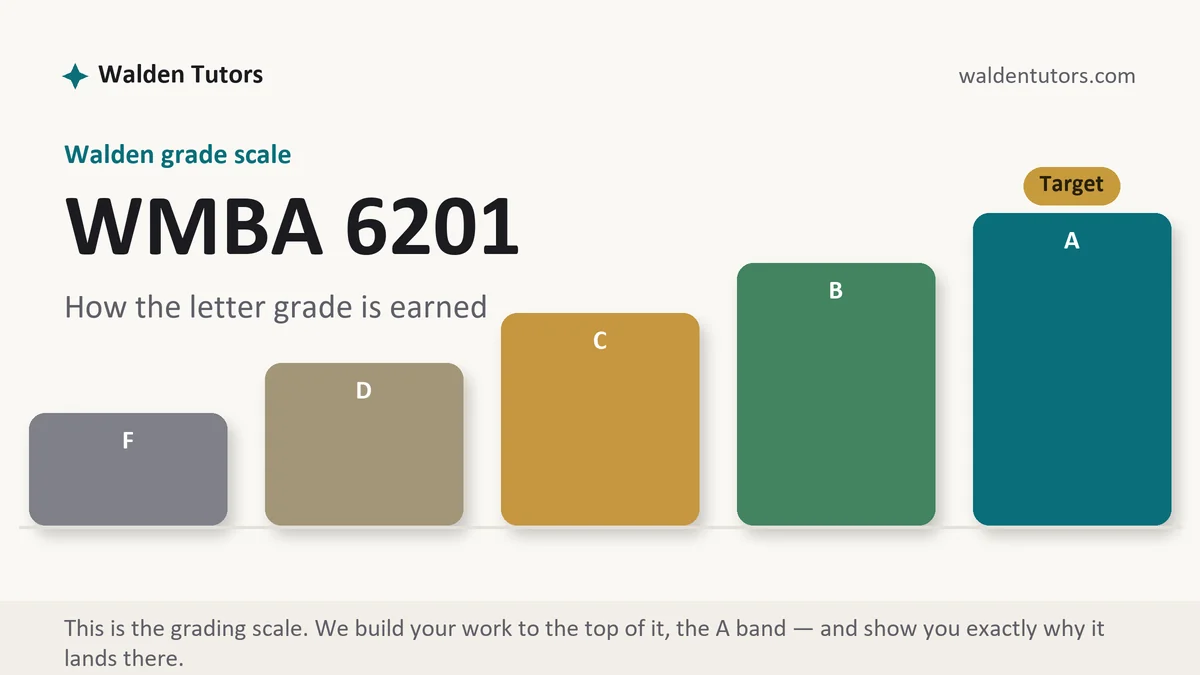
Three things get rewarded reliably in a course built this way. Alignment, meaning each metric you propose can be traced to a stated organizational objective rather than to a manager's preference. Legal grounding, meaning appraisal, documentation and adverse action are discussed against actual regulatory duty instead of a general appeal to fairness. Consequence, meaning your recommendation arrives with an owner, a date and the figure that will settle whether it worked. Grades in Course-Based work are letter grades assembled from those rubric rows, so a paper that reads well and skips a row still loses the row.
Which items are graded in your particular section, and how many of them there are, is a question only your classroom can answer. Walden states plainly that requirements shift between courses and within them, and the MBA runs on the semester calendar rather than the shorter quarter terms nursing students describe, so do not import a friend's pattern.
How we help in this course
Send us the prompt, the attached rubric, and three or four lines about the organization you want to write about, including the part you would rather not print. That last detail is usually where the analysis gets its teeth. What comes back is a performance management analysis with the measures written into the argument, the statutory points cited to a source your grader can open, and a recommendation that ends in something countable.
The terms are the same as everywhere else on this site. Delivery inside 24 to 48 hours, drafting aimed row by row at an A, one reviewer scoring the draft the way faculty will and a second reviewer auditing APA and originality, then revisions until the target is met.
Weekly manuals for this course
The MBA is a semester program. Walden's own published calendar puts the Fall 2026 semester between September 7 and December 27, which is 111 days, or close to sixteen weeks once you do the division yourself. Walden does not publish this course's syllabus, so there is no honest way for us to print a week grid for WMBA 6201, and we will not invent one. Per-week manuals appear here as each week is confirmed by students in the classroom. If the deliverable in front of you has no manual yet, send it in chat and the drafting service handles it regardless.
In WMBA 6201 right now?
Paste the assignment brief and attach the scoring rubric from your classroom. Your first premium sample is free and lands within two days.
The sentence that carries a number
Go back to the habit in the opening. Managers write in adjectives because meetings run on adjectives, and a performance course punishes that reflex harder than any other course in the MBA sequence. Improved, strengthened, more engaged, better aligned: none of those words can be graded, because none of them can be checked. The repair is small and mechanical. Every time you make a claim about performance, put the measure inside the same sentence, name the period it covers, and give the reader the comparison that makes the figure mean anything. A number with no baseline is decoration, and graders read it that way.
Do the same thing to your recommendations. A recommendation without a measure is a wish, and a wish cannot be assessed against a rubric row asking whether the proposal is actionable. Write who owns it, when it starts, and what will be counted ninety days later.
What the desk needs from you
The intake for this course is short but specific, because the quality of the draft depends almost entirely on the granularity of what you send. We want the rubric file itself, not a summary of it. We want the organization's size, sector and the goal you are measuring against. We want whatever real numbers you can share, even rough ones, and we want the constraint that makes the situation awkward, the union agreement, the two-person HR function, the appraisal form nobody has updated since 2019. Send a paragraph of your own writing too, from any course, so the register matches yours when it comes back.
Try it on one paper
The first premium sample costs nothing, and a performance management paper is a good place to spend it, because a single deliverable shows you everything at once: whether the metric spine holds, whether the citations are ones your grader will accept, whether the voice sounds like a working manager rather than a textbook. Read the returned draft against your own rubric before any money changes hands. If it fits, the rest of the term is easy to plan. If it does not, you learned that for free.
How to actually write WMBA 6201: where to begin
Start with the rubric open and the prompt closed. The rubric is the scoring instrument, and in the Walden classroom it hangs on the graded item itself, so you can read it before you write a word. Paste each row into an empty document and turn it into a heading. You are now holding the paper's outline in the order the grader will read it, with nothing forgotten. Then look at what each row is worth and match your word budget to it, because the row carrying the most points deserves the most page, and the instinct to write longest about the section you personally find interesting is what leaves the heaviest row thin.
Now choose your organization, and choose small. A performance management analysis needs specifics you can actually produce: a job family with a defined output, an appraisal cycle with dates, a manager who signs something, a number that moves. One department inside a company you know well will always outperform a famous corporation you know from press coverage, because you can describe the department completely and you can only describe the corporation vaguely. Before drafting, write down the raw facts in a scratch file. What is measured today, how often, by whom, against which goal, with what consequence attached. That list is the stock every rubric row draws from.
Your thesis in this course is a judgment about fit, not a summary of a concept. Something like: this appraisal system measures activity while the division is held accountable for retention, and the gap explains the pattern in its exit interviews. State that position in the first paragraph, because business readers and faculty graders both want to know early what the evidence is being spent on. Everything after the opening exists to test the claim, including the parts that complicate it, and admitting where the evidence is thin reads as analytical confidence rather than weakness.
Synthesis is the row that separates good papers from competent ones, and the test is simple. If your paragraphs could be reordered without damage, you have summarized. Synthesis means the sources are talking to each other inside one paragraph: this study establishes the link between goal specificity and output, this review reports the effect is weaker where supervisors change often, and your division changes supervisors every fourteen months, which is why the textbook prescription needs adjusting here. Give every source one job you can state in a short phrase. Sources with no job are padding, and padding is easy to spot from the reference list alone.
APA 7 is graded as mechanics and as behavior. Mechanics is the title page, the heading levels, author and year in the running text, and a reference list that reconciles in both directions against the body. Behavior is where the sources come from. Search inside the Walden Library rather than an open engine, because the business databases the rubric assumes are behind that login, and a librarian can rescue a search that comes back empty. The Writing Center supplies the current templates, it is included in your tuition, and copying their formatting is faster than defending your own.
| Section | What it does | Where it usually fails |
|---|---|---|
| Opening and position | Names the organization, the performance problem, and the judgment the paper will defend. | Two paragraphs of company history before the reader learns what is being argued. |
| The system as it stands | Describes what is currently measured, how often, by whom, and what happens as a result. | Describing the appraisal form instead of the behavior the form produces. |
| Alignment analysis | Traces each measure back to a stated organizational goal and marks the ones that do not connect. | Asserting alignment rather than showing the chain from metric to objective. |
| Legal and ethical review | Names the statutory duties touching appraisal, documentation and adverse action, with sources. | General language about fairness where a specific regulatory obligation was available. |
| Recommendation | Proposes the change, the owner, the start date, and the measure that will judge it. | An improvement plan made of intentions with no counting attached to any of them. |
Discussion posts that actually earn the points
Discussion is graded work in Course-Based courses, with rows of its own, and a strong paper cannot rescue a thin thread. Build the initial post like a compressed memo: your position in the first line, one piece of evidence from the assigned reading, one from a workplace you can describe, and a closing sentence that leaves classmates something to disagree with. Cite inside the post itself, since an unsourced argument reads as opinion to a row that says evidence.
Then spread your presence across the week. Walden's grading policy asks for participation that is substantive, consistent and on time, and recommends posting across at least two to four separate days rather than dropping everything at once. Replies are scored on their own row, and agreement is not a reply. Take a classmate's metric and ask what behavior it would produce if people optimized for it, or bring the employment law point their recommendation walks past. Everything in this course is due at 10:59 p.m. Central time, which is 11:59 p.m. Eastern, and Walden expects you in the classroom posting in the opening week of the term.
The mistakes that cost points in WMBA 6201
- Performance claims written entirely in adjectives, so no row on the rubric has anything countable to score.
- Metrics proposed because they are easy to collect, with no line drawn between them and any goal the organization has stated.
- A legal section that says employers should be fair and never names a statute, an agency or a documented obligation.
- Diversity and inclusion handled as a paragraph of goodwill at the end instead of as a factor in how the system rates people.
- An organization so large that describing it eats the word count the analysis needed.
- Consultant blog posts standing in for the peer reviewed HR research sitting inside the Walden Library.
WMBA 6201 questions students actually ask
What if my employer has no formal performance management system?
Then write about the absence, because an unmanaged system is still a system and the analysis is often sharper. Describe what actually happens instead: who decides raises, on what information, at what interval, and with what written record. Every rubric row still has something to grade, since alignment can be assessed against goals nobody measures and legal exposure is easier to demonstrate where documentation is thin. Ask your instructor before you commit if the prompt names a required organization type.
How much law am I expected to know for this course?
Enough to say which duty applies and where it comes from, not enough to argue a case. Appraisal, documentation and adverse action all sit inside employment law, and the graded expectation is that you name the governing statute or agency guidance and cite it properly rather than gesturing at fairness. Pull the source through the Walden Library or the agency's own publication. If your paper reaches a point where the answer depends on jurisdiction, say so in the paper instead of guessing.
Can I reuse a paper I wrote in WMBA 6000?
Not as text, and Walden's academic integrity policy covers self-plagiarism, so check it before you recycle anything. You can absolutely reuse the organization, the role and the situation, and doing so usually helps, because you already hold the detail this course needs. Build a fresh argument on the same facts, cite anything you carried over, and tell your instructor you are returning to a case from an earlier course.