WMBA 6501 is Conflict Management and Negotiation, three semester credits, with WMBA 6201 listed as its prerequisite. Walden builds the course around HR as the party who has to facilitate a resolution, working inside employment law and, where a union is present, inside a collective bargaining agreement. So the graded output is written analysis of disputes and written plans for negotiations. Theory recall earns very little here; describing behavior precisely enough to argue about earns most of it.
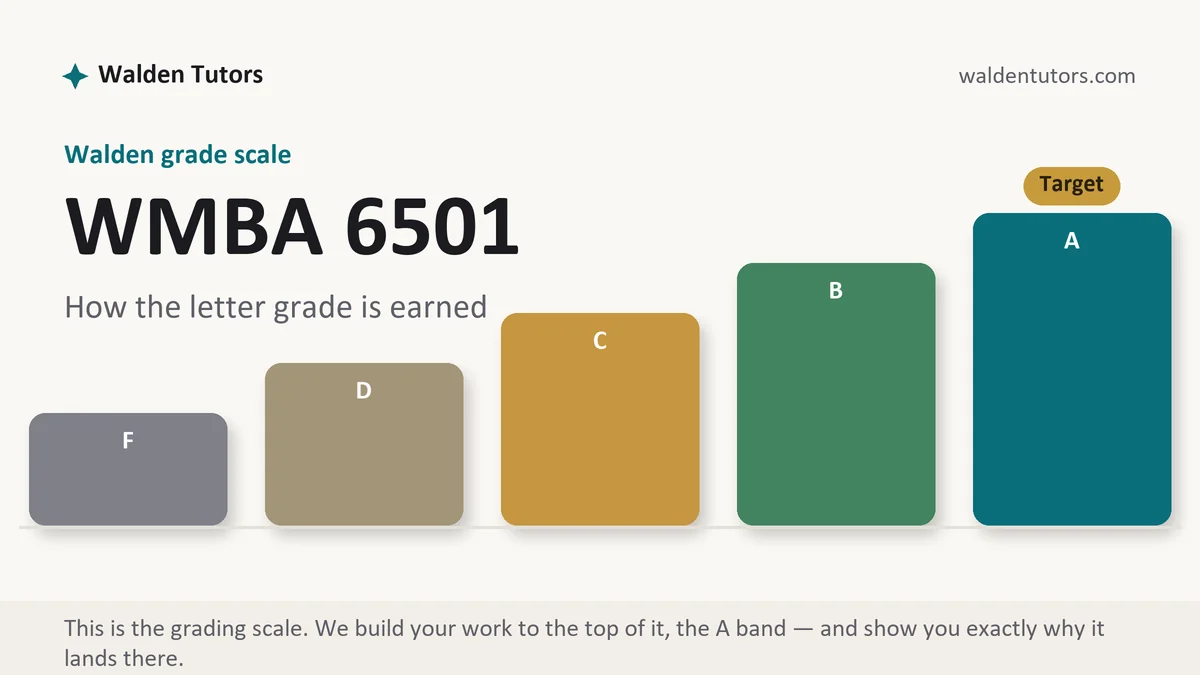
What WMBA 6501 actually grades
Walden's own description frames negotiation and dispute handling as core responsibilities of the HR function, with HR standing in the middle of the employee and employer relationship as the party who facilitates a resolution. The catalog also pushes two constraints into view: employment law and regulatory obligation on one side, and collective bargaining agreements on the other, which limit what a resolution can even look like in a unionized workplace. The course then runs practical exercises in negotiation tactics, bargaining strategy and communication approach.
What that produces as graded work is case analysis and applied planning, not theory recitals. Expect written breakdowns of a dispute, negotiation plans prepared before a simulated exchange, reflective write-ups after a role-play, style or approach self-assessments, and graded discussion threads carrying their own rubric rows. The exercise itself is rarely the thing being marked. The document you write about the exercise is.
Rubric rows in a course of this kind reward four moves fairly consistently. Describe behavior instead of assigning character. Separate what each party said they wanted from what they were actually protecting. Name the framework you are using and apply its terms consistently rather than decoratively. And keep the compliance boundary visible, because a resolution that satisfies everyone in the room and breaches an agreement or a statute is not a resolution. Your grade is a letter built from those rows, so an eloquent paper that skips the legal boundary loses that row whole.
The vocabulary that earns rows
Certain distinctions carry disproportionate weight here, and using them precisely is most of what separates a graded analysis from a story. Positions are what a party demands. Interests are what the demand protects, and they are almost never identical. Distributive bargaining treats the value on the table as fixed, while integrative bargaining looks for trades that make it larger. Your walkaway point is the worst deal you would still sign, and your best alternative is what happens if you sign nothing, which is what actually gives you bargaining power. Task conflict is a disagreement about the work, relationship conflict is a disagreement about each other, and the first often turns into the second when nobody intervenes.
Grievance procedure, mediation, arbitration and litigation form a ladder of escalation with rising cost and falling control, and knowing where a case sits on that ladder is often the whole analysis. Use these terms deliberately, define them the first time, then stay consistent. Switching vocabulary halfway through a paper is one of the more visible ways to lose an analysis row.
How we help in this course
Give us the prompt, the scoring guide exactly as your classroom shows it, and a few lines on the dispute you want to write about, including the detail that makes it awkward. That detail is usually where the analysis finds its teeth. Back comes a case write-up with behavior described rather than judged, positions and interests laid out side by side, the framework named and carried through, and a resolution that survives both the agreement and the statute.
Service terms are identical across the site. Delivery inside 24 to 48 hours, drafting aimed row by row at an A, one reviewer marking the draft as faculty would while a second audits APA and originality separately, and revisions continuing until the target lands.
Weekly manuals for this course
This course has no week-level pages here yet, and that is deliberate rather than an oversight. Walden keeps its syllabi inside the classroom and never on the public catalog, so the only honest source for what Week 4 actually asked is a student who sat Week 4. A grid assembled without one would publish faster and would be fiction. Until yours exists, paste the item into chat and the desk drafts straight from your section's own materials, which is how the work gets done regardless.
In WMBA 6501 right now?
Send the case, the prompt and the scoring guide. The first premium sample carries no charge and lands inside 48 hours.
The term you are working inside
Walden's MBA follows the semester calendar rather than the quarter terms used elsewhere in the university, and the published dates make the difference concrete. The Fall 2026 semester is listed as running September 7 to December 27. Count the days and you get 111, the same length as the Spring 2026 semester that ran January 5 to April 26 and the Summer 2026 semester that ran May 4 to August 23. Divide 111 by seven and you are near sixteen weeks, which is arithmetic done on Walden's dates rather than a figure Walden itself advertises. Confirm the span for your own term in the student portal.
Two operational facts matter more than the length. Submissions close at 10:59 p.m. Central, which is 11:59 p.m. Eastern wherever you happen to be sitting, and Walden expects a submission or a discussion post from you during the first week of the term. That opening requirement is administrative, and no amount of later brilliance repairs a missed one.
What the calendar cannot tell you is the number of graded items in your section. Walden says openly that posting and assignment requirements vary between courses and even between weeks, so count from your own classroom rather than from a classmate's memory of last term.
How to actually write WMBA 6501: where to begin
Start at the scoring guide, before you have a view on who was in the wrong. Open the rubric attached to the graded item, lift each row into a blank document, and turn the rows into your headings. That is the grader's reading order handed to you for free. Put each row's weight beside it and set your section lengths accordingly, because in a case course the narrative section swells and the analysis section starves unless you fix the budget in advance.
Write the facts before you write the argument. A neutral account of what happened, in sequence, with the parties identified by role and nothing evaluative attached, is the single most useful page in a conflict paper. Keep verdicts out of it. The manager raised his voice belongs in the facts. The manager was aggressive does not, because aggressive is your conclusion and conclusions have to be earned in a later section. A useful test: could a bystander have watched the sentence happen? If not, it belongs further down the paper.
Then split positions from interests, party by party, and put the split in a small table if the format allows. An employee demanding a transfer holds a position, and the interest underneath might be distance from one particular colleague, a shift pattern that fits childcare, or a reputation they think has been damaged. Those three interests suggest three completely different settlements, and only one of them is a transfer. Papers that stop at positions can only ever propose splitting the difference, which is why they read thin.
Diagnose the conflict before prescribing for it. Say what type it is, where it started, and what escalated it. Note whether the disagreement is about the work or about the relationship, and whether it began as one and became the other. Identify who else has entered the dispute and what each of them wants from it, since bystanders in a workplace conflict are rarely neutral. Name the structural pressures too, because conflicts that look personal frequently sit on top of an unworkable rota, an ambiguous reporting line or an incentive that pays two teams to want opposite outcomes.
Map the constraints next, and be specific. Employment law limits how an employer may respond to a complaint, particularly where a protected characteristic, a safety report or a retaliation risk is anywhere near the facts. A collective bargaining agreement, where one exists, sets a grievance path with defined steps and time limits that HR cannot simply route around. Name the constraint, say where it comes from, and cite it. General statements about wanting to be fair collect nothing from a row asking about compliance.
Build the negotiation plan as a plan somebody could actually run. State your objective, your opening, your walkaway and your alternative if no agreement is reached. Do the same for the other side as best you can infer it, and say what you would need to learn early in the conversation to test that inference. List the trades available where the parties value things differently, since that asymmetry is the entire source of integrative value. Decide on the sequence of topics and choose it deliberately, and choose your communication approach with a reason attached rather than by temperament.
Close with a resolution that has edges. Name what each party gets, what each party gives, who implements it, by when, and how anyone would know in ninety days whether it held. Papers that end by recommending open communication and mutual respect give the recommendation row nothing scoreable to hold on to.
Reading for this course comes from the Walden Library, not from whatever an open search surfaces. Negotiation and dispute resolution have a substantial peer reviewed literature, and the library holds the management and employment relations databases the rubric assumes you used. Reflective assignments still need citation: a claim about how a communication style affects escalation is an empirical claim and belongs to somebody. Give each source a single job you could state in a short phrase, and write paragraphs where the sources argue with each other and with your case rather than lining up as summaries. APA 7 governs it all, with a title page in the Walden pattern, headings at their proper levels, and a reference list that reconciles both directions against the body. The Writing Center publishes the templates being graded against, and copying them is faster than defending your own layout.
| Section | What it does | Where it usually fails |
|---|---|---|
| Case facts | Sets out the parties, the sequence and the disputed points with no evaluation attached. | Judgment words slipped into the narrative, so the conclusion arrives before the analysis. |
| Positions and interests | Separates each party's stated demand from what the demand is actually protecting. | Interests inferred for one side only, usually the side the writer sympathizes with. |
| Conflict diagnosis | Classifies the dispute, traces its origin, and names the structural pressures feeding it. | Personality treated as the cause when a rota, an incentive or a reporting line explains more. |
| Legal and contractual limits | Names the statute, regulation or agreement clause that bounds the available responses. | Compliance handled as a sentence about fairness with nothing anyone could look up. |
| Negotiation plan | Objectives, opening, walkaway, alternatives, available trades and the order of discussion. | A plan with no alternative stated, which leaves the writer unable to explain their bargaining power. |
| Resolution and follow-up | The settlement itself, its owner, its dates, and the check that tells you it held. | A closing appeal for better communication offered where a decision was requested. |
Discussion posts that survive a grading rubric
Threads in this course are marked work with rows of their own, and they usually hand you a scenario and ask what you would do about it. Build the opening post like a miniature case analysis: one sentence of facts, the interest you think is driving the dispute, the constraint that limits your options, then your recommended move. Put a source in the post. Conviction with nothing behind it is still only your view, and an evidence row cannot score a view.
Then spread yourself across the week. Walden's policy is explicit that a thread built in one sitting scores worse than the same words distributed, and it puts the minimum spread at two to four days. Replies carry their own score and agreement is not a reply. Push the argument somewhere: ask what the other party would do if a classmate's opening offer landed, name the interest their settlement leaves unmet, or point out that their proposal skips a grievance step the agreement requires. How many replies count, and when the thread shuts, are section-level settings, so take both from the week's instructions rather than from habit.
The mistakes that cost points in WMBA 6501
- Character judgments written where observable behavior was available, which makes the analysis unfalsifiable.
- Interests worked out for one party and simply assumed for the other.
- A named framework introduced in the first paragraph and never used again after it.
- A settlement proposed with no mention of the agreement clause or statute that would block it.
- No alternative to agreement stated anywhere, leaving the plan unable to say where its strength comes from.
- A real workplace dispute retold with identifying details, or internal messages reproduced verbatim.
- Reflection written as feelings about the exercise with no reference to any concept from the week.
WMBA 6501 questions students actually ask
Can I write about a dispute I was personally involved in?
Usually yes, and it often produces the sharpest paper, because you can supply the sequence and the pressure in a way an invented scenario cannot. Two conditions apply. Anonymize properly, meaning no names, no job titles specific enough to identify somebody, and no reproduction of internal documents or messages. And write yourself into the case as one party among several rather than as the narrator who was right. If the matter is still live, under investigation, or covered by a settlement, choose something else and say nothing about it.
Which negotiation framework should I use?
Whichever one your week assigned, applied properly, beats a better framework applied loosely. When the choice is yours, interest-based bargaining is the safest spine for most workplace disputes, because it forces the positions and interests split that the rubric is looking for anyway. Distributive and integrative bargaining give you useful vocabulary for saying whether the value in play was fixed or expandable. A named style model helps when the assignment is about how people behaved rather than what they traded. Pick one, name it, and use its terms consistently.
How do I write about a unionized workplace if I have never worked in one?
Research the structure rather than guessing at the atmosphere. Collective bargaining agreements set out grievance procedures with defined steps and time limits, and those steps constrain what an HR professional may do long before anyone reaches a negotiating table. Read a published agreement or a scholarly account of grievance handling through the Walden Library, then write about the process as a set of rules with deadlines attached. Say plainly which requirements would come from the agreement itself, since the specific terms differ from one employer to the next.