Finding Your Inner Leader carries the code WMBA 6605 at Walden, runs for three semester credits, and lists WMBA 6000 as its pre-requisite. Walden's own description sets the work out plainly: you examine your values, experiences, skills, capabilities, preferences and knowledge against the leadership you are aiming at, work out what strengthens or blocks your ability to influence other people, and build plans to close the distance.
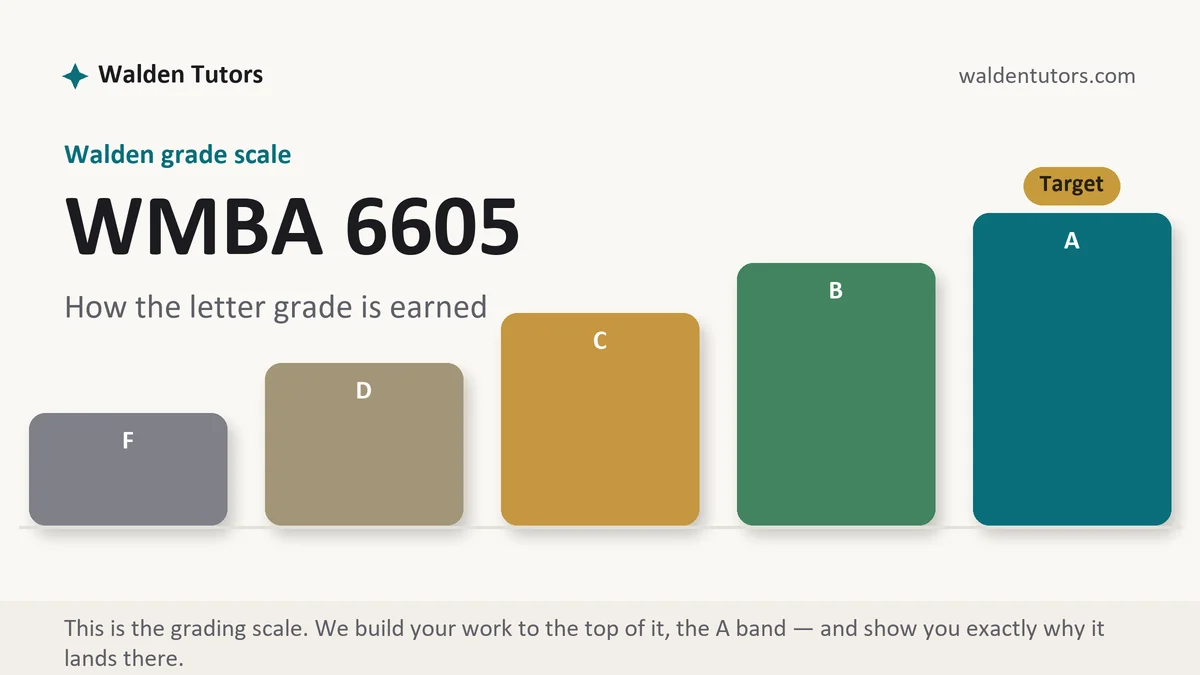
What WMBA 6605 actually grades
The graded output is reflective writing that still has to survive academic scrutiny. One caution before any list of deliverables, including the one below: Walden keeps its syllabi inside the classroom, so nobody outside your section can tell you what the assignments are. What the catalog does commit to is the material. It names self-examination across values, experiences, skills, capabilities, preferences and knowledge; the factors that lift or limit your ability to influence and inspire; plans written to strengthen whatever comes back weak; and strategies for leading through turbulence where the choices are genuinely hard.
Material like that normally reaches a grader as written self-assessments, a development plan, short papers on leading when the situation refuses to hold still, and graded discussion threads carrying rows of their own. Treat that as the shape of the work rather than a schedule, and count the actual items from the syllabus you were issued.
Scoring guides in a course shaped like this reward four moves, in order. Report the evidence about yourself accurately, including the parts that do not flatter you. Interpret it through a named leadership theory instead of through general good sense. Show that interpretation changing something you intend to do next. Then carry all of it in APA 7, on sources a business librarian would recognize.
What you receive is a letter grade assembled from those rows. Honest, warm writing with no scholarship underneath collects the reflection row and forfeits the evidence row, and that single trade is very often the whole distance between a B and an A.
Where 6605 points you next
Hardly anyone takes this course as an endpoint. Self-knowledge here is raw material that later coursework spends: work on culture asks what kind of environment a leader with your defaults tends to build, work on teams and coaching asks how those defaults actually land on other people, and capstone work asks you to make decisions under your own signature. Your program map fixes the real order, so read it rather than trusting a general pattern.
There is a practical consequence while you are still inside 6605. Keep everything. Save the raw output of every instrument, the exact wording of any feedback you receive, and flat factual notes on three or four moments when your leadership was actually tested. Half a year later, a culture paper or a coaching plan will demand a specific example, and a file already full of them beats memory doing its best at midnight.
How we help in this course
Send the assignment page, live scoring guide, permitted instrument output, and your current draft. Criterion-mapped feedback checks whether every claim about you rests on evidence and every interpretation rests on a source. You choose and defend every final revision.
The terms are the ones running everywhere else on this site: delivery in 24 to 48 hours, an A targeted row by row, one reviewer marking the draft the way faculty will while a second checks APA and originality, and revisions that continue until the target lands.
Because reflective work is personal, attach one paper you have already submitted. The draft then arrives near enough to your own register that claiming it is a short edit instead of a rewrite.
Weekly manuals for this course
No week pages exist for WMBA 6605 on this site yet. Walden keeps its syllabi inside the classroom, so a week manual can only go up after students in the course confirm what the deliverable really is. Until yours appears, paste the week into chat. The desk drafts straight from your own classroom materials and has never needed a manual to start.
In WMBA 6605 right now?
Send the assignment and its scoring guide. First premium sample is free, back inside two days.
The semester term you write inside
This is MBA coursework, which puts it on Walden's semester calendar rather than the quarter calendar the nursing programs use. Published 2026 semester spans are January 5 to April 26, May 4 to August 23, and September 7 to December 27. Every one of those measures 111 days end to end, which divides out at roughly sixteen weeks. The university prints dates and not week counts, so treat that sixteen as arithmetic done on its own calendar.
Inside the span, due times are fixed and Central. Items close at 10:59 p.m. Central, the same moment as 11:59 p.m. Eastern. There is also a rule at the front end: log in during the opening week and submit an assignment or a discussion post. That one is administrative, and strong writing later in the term does not repair it.
How many items your particular section carries is a question only the classroom answers. Walden states plainly that posting requirements are not uniform, and they can move between weeks of a single course, so count from the syllabus you were given.
How to actually write WMBA 6605: where to begin
Open the scoring guide before you have decided what you think. Copy each row into an empty file and promote it to a heading. You are now holding the grader's outline, handed over in advance. Read the weight beside every row and let those numbers set your section lengths, because a beautiful paragraph parked on a low-value row is an expensive habit.
Then gather evidence about yourself, since reflection without evidence is only mood. Three kinds work. Instrument output comes first, meaning whatever inventory the week assigned, kept raw rather than summarized from memory. Other people's words come second, which means feedback from a review, a peer or a direct report, quoted rather than paraphrased. Incidents come third: two or three occasions when you led something and it went a particular way, written down flatly, with no interpretation attached yet.
Only now write a thesis. Reflective papers still need one, and the test is whether it could turn out to be wrong. Try something like this: under time pressure I default to building consensus, which holds the team together and pushes the decision past the point where speed was the thing that mattered. That is a claim. A promise that you learned a great deal about your leadership style is not a claim, it is a closing sentence that wandered to the front of the paper.
Build every body section on the same four beats. State the incident or the result. Say what it shows. Bring in a theory that explains why it shows that. Say what changes and how you would know the change worked. Transformational and transactional models, servant leadership, authentic leadership, situational approaches, emotional intelligence frameworks: any of them can carry the interpretive weight. Committing to one and using it properly beats name-dropping four.
Synthesis is where these papers separate from each other. Summarizing gives one paragraph per author, each politely reporting what that author said. Synthesizing puts two authors in the same paragraph, over your evidence, disagreeing. If one model reads your consensus-building as relational strength while another reads it as conflict avoidance, say so out loud, then rule on which one fits the incident you described, and explain the ruling. A grader spots that difference from across the room.
Pull sources through the Walden Library rather than an open search. The management databases your tuition already covers hold the peer reviewed leadership scholarship these rubrics assume exists, and a librarian will surface a defensible article faster than a search engine will. Give each source a single job you can state in six words. Cite the publisher or manual behind any assessment instrument whose results you report, because the instrument is a source too and it is the one students forget.
APA 7 covers the rest: the Walden title page, heading levels used at their proper depth, author and year visible in the sentence doing the work, and a reference list that reconciles with the body in both directions. First person is usually welcome in reflective writing, which is not true of every course in the program, but confirm it against the week's own instructions rather than assuming.
| Section | What goes in it | The failure that costs points |
|---|---|---|
| Opening claim | The specific argument you are making about your own leadership, phrased so that it could be contradicted. | A promise to explore your leadership journey, which commits to nothing and therefore scores nothing. |
| Evidence about yourself | Instrument results, quoted feedback, and short factual accounts of episodes you actually led. | Assertions about your strengths supported by nothing except confidence. |
| Theoretical frame | One named model, explained well enough that a reader could apply it themselves. | Four theories listed in a row and not one of them turned on your evidence. |
| Analysis | The frame run over the evidence, including the places where the two refuse to fit neatly. | The incident retold at length with a theory bolted on in the final sentence. |
| Development plan | Goals carrying a measure, a first action, a date, and a way of noticing failure early. | Intentions to communicate better and grow more self aware, unmeasurable by construction. |
| Sources and APA | Peer reviewed work from the library, the instrument's own documentation, APA 7 across the whole file. | Airport leadership paperbacks and a free online quiz standing in for scholarship. |
Discussion posts that earn their row
Threads in this course are graded work, and they tend to ask you to expose something about your own practice rather than dissect a company. Write the opening post as a miniature of the paper: the claim about yourself, the evidence behind it, the source that frames it, and the thing you plan to change. Cite inside the post. A thoughtful contribution with no citation still reads as opinion to a row that asked for evidence.
The grading policy wants participation that is steady, substantial and on time, and it suggests spreading contributions across two to four days at minimum instead of dropping everything in one sitting. Replies score on their own row, which means agreement earns nothing. Do something to a classmate's post instead: offer the reading of their incident they stepped around, ask what their direct reports would say about the same event, or bring a model that reframes the conclusion they reached. The number of replies that count, and the day the thread shuts, are set by your classroom, so read the week rather than importing a rule from a course you finished last term.
Citing yourself and your sources in APA 7
Reflective writing creates a citation problem the rest of the program never raises. Your own experience needs no citation, but everything you lay over it does. Report a score from an inventory and you cite the inventory. Use a framework and you cite the person who built it, not the blog that summarized it. Personal communication, which is what an unrecorded conversation with your manager amounts to, appears in the text only and never reaches the reference list.
Everything else is ordinary Walden formatting, and the Writing Center publishes the templates the university actually grades against. Copying their title page and heading structure costs ten minutes and removes an entire class of avoidable deductions.
The mistakes that cost points in WMBA 6605
- A paper that narrates a whole career rather than arguing one claim about the way you lead.
- Instrument results reported as numbers and letters, with nothing said about what they mean for your practice.
- Theory named in the introduction and then abandoned before it ever touches a piece of evidence.
- Development goals written so loosely that nobody, you included, could later say whether they happened.
- Only the flattering evidence selected, which turns the reflection row into marketing copy.
- Confidential detail about named colleagues reproduced where a general description would have done identical work.
WMBA 6605 questions students actually ask
Does a reflective paper really need peer reviewed sources?
Yes, and it catches people out every term. One row rewards honesty about your own practice, while a separate row asks you to tie that practice to published scholarship, and the second row does not disappear because the first went well. Two or three well used articles will carry a short paper if each one has a job you could name aloud. Where the week states a source minimum, that number binds; where it does not, judge by whether your citations are doing work or decorating.
How much of my actual workplace can I put in these papers?
Enough to be specific, never enough to identify anyone. Write roles rather than names, keep the employer generic wherever the detail is not load bearing, and leave out anything a confidentiality agreement covers. A real episode with the identifiers stripped still beats an invented one, because you remember the sequence and the pressure in a way you cannot fake. If the situation is unresolved, or somebody could be harmed by it turning up in a classroom, pick another.
What if my assessment results do not match how I see myself?
Write about the gap, because it is the most useful material the course will hand you. Rubrics reward students who sit with a mismatch instead of explaining it away. State what the instrument reported, state what you believe about yourself, then hunt for evidence that settles it, which usually lives in how other people have described your behavior rather than in how you remember it. An inventory is not a verdict, and treating it as one is as weak as waving it off.