WMBA 6640 is Walden's Advanced Managerial Finance, a three semester credit course listed behind WMBA 6070. It grades judgment rather than arithmetic, across capital budgeting, cost of capital, real options, capital structure, payout policy and enterprise valuation, all of it written up for somebody who has to act on the answer. Give a grader half a minute with page one and they hunt for two things: the decision you are recommending, and the number standing behind it. A paper that opens with company history and reveals its recommendation on page six has already been filed as description, and the remaining pages spend their energy climbing out of that hole.
What WMBA 6640 actually grades
Walden aims this course at leaders who will read financial information rather than prepare it, and the published description says so directly: the point is using that information for decisions made inside the firm. Skill is built by putting alternatives side by side, weighing what each one gives up against what it returns, and being explicit about the tradeoff that gets accepted. Stakeholder analysis runs through the whole of it. The named territory is capital budgeting, cost of capital, real options, capital structure, payout policy and enterprise valuation.
What the gradebook actually holds is documents written to somebody who has to act. Expect memos and briefs addressed to a decision maker, valuation exercises, capital structure and payout arguments, case analyses, and graded threads that carry their own points. The unifying demand is commitment. Advanced finance at Walden does not reward a survey of what the models say. It rewards a position taken on a specific question, with the conditions under which the position holds written down beside it.
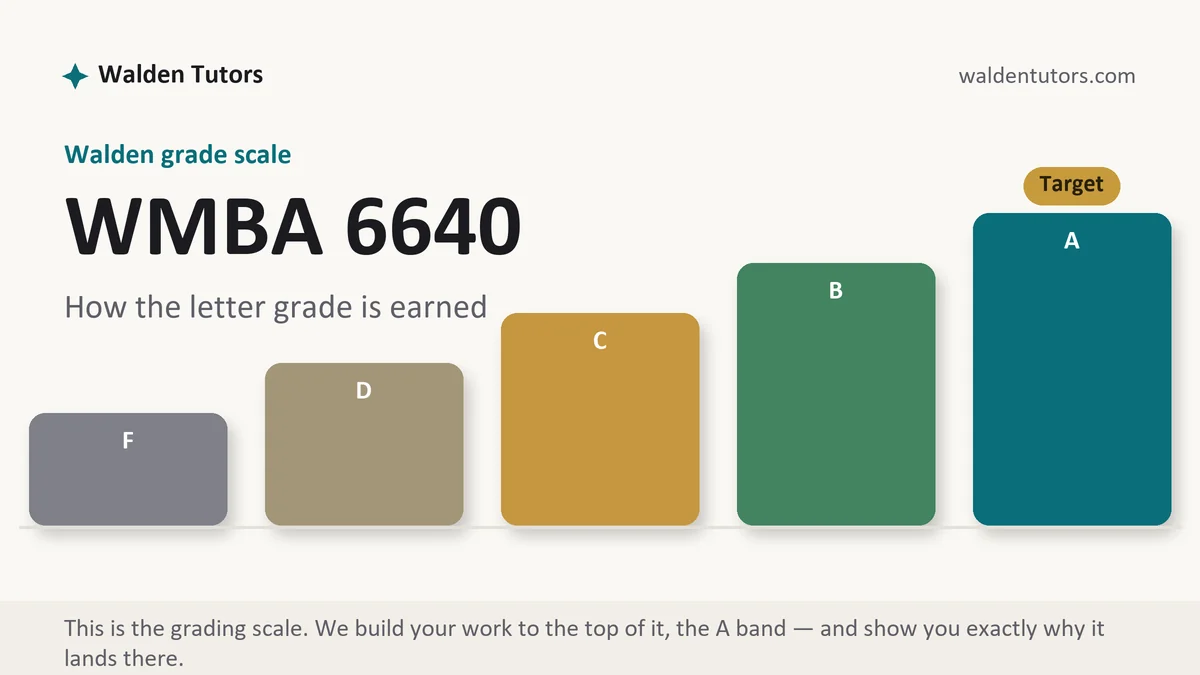
Four things reliably move the score. Alternatives have to be visible, so the reader can see what you rejected and why. The tradeoff has to be named out loud rather than implied by the fact that you chose something. Somebody has to be identified as carrying the cost of your recommendation. And the recommendation itself has to survive a question about what would change your mind. Marks are letter grades assembled from rubric rows, and the rows hang on the item in the classroom, which means the target is readable before you type a word.
The six topics that carry the term
Six areas do most of the work in an advanced managerial finance course, and it helps to know in advance which question each one answers. Capital budgeting asks whether a specific commitment of money is worth making. Cost of capital asks what return the money has to clear before it is worth committing. Real options ask what the ability to change your mind later is worth today. Capital structure asks how the money should be raised. Payout policy asks what happens to cash the firm cannot invest at an attractive return. Enterprise valuation asks what the whole operation is worth to somebody buying it.
Students who struggle usually struggle because they carry a method into a question it does not answer. Running a net present value on a question about payout produces a correct calculation attached to nothing. Before you open a spreadsheet, write the question the item is asking in one sentence, then pick the tool that answers that sentence. Where the item genuinely spans two areas, and several in this course do, handle them in sequence and say where the handoff happens rather than blending them into one long stream of figures.
How we help in this course
Start by sending the item itself, plus the scoring rows as your classroom displays them and any case, spreadsheet or template the week attached. What returns is a document with the alternatives laid out, the analysis worked and labeled, the tradeoff stated in the open, and a recommendation somebody could actually carry into a meeting.
Nothing about the terms changes by course. You see the work back within 24 to 48 hours. Each rubric row is written toward an A. Two people read it ahead of you, one grading it as your faculty member would and one auditing sources, format and originality. Revision passes keep running, at no charge, until the piece hits the standard we set with you.
Weekly manuals for this course
Week-level pages for this course have not been published here. Walden puts catalog descriptions in the open and keeps syllabi behind the student login, so a week grid posted on an outside site would be guesswork dressed as guidance, and we would rather leave the gap visible. A manual goes up once students sitting in the section confirm what the week contained. Until yours does, drop the assignment into chat and the desk builds from whatever your classroom handed you.
Sitting on a WMBA 6640 decision memo?
Give us the assignment page, the rubric and the case file if there is one. Your first premium sample costs nothing and arrives within two days.
Pacing an advanced finance term
Your MBA runs on Walden's semester calendar, not on the shorter quarter terms that govern the nursing side of the university, and the published spans put the gap at thirty-five days. Summer Semester 2026 is published with a May 4 start and an August 23 finish. Divide that span by seven yourself and you land near sixteen weeks, a figure you calculated from Walden's dates rather than one the calendar page prints, so let your own program calendar settle the term you are actually sitting in.
Advanced finance concentrates its difficulty differently from an introductory course. The early weeks revisit ground you covered in WMBA 6070 and feel comfortable, which is exactly when the term is cheapest to get ahead in. What arrives later assumes the earlier pieces are already yours: a valuation that expects you to have a defensible cost of capital, a payout argument that expects you to understand the capital structure you described three weeks ago, a real options question that expects the base case to already exist. Falling behind here is expensive because what is missing is understanding rather than hours, and understanding does not compress.
Two fixed points belong on any plan you make. The cutoff hour is 10:59 in the evening on Central time, an instant Eastern clocks show as 11:59, and it is the university's zone that counts rather than the one on your wall. Week one also carries a compulsory action: sign in, and file either an assignment or a discussion contribution before it ends.
How to actually write WMBA 6640: where to begin
Start by lifting the scoring rows out of the classroom and into an empty file. They are attached to the item itself, they are written more plainly than the prompt, and each one names something your faculty member has committed to look for. Make each row a heading, put its point weight beside it, and let those weights set section lengths. In an advanced course the temptation is to write most about whichever model you enjoy, and the weights are the cheapest cure for that.
Next, put the recommendation on page one. Business faculty read for the claim before they read for the support, and a memo that withholds its conclusion for suspense is reading against its audience. Open with what should be done, on what evidence, and under what conditions. Then spend the body earning it. This single reordering fixes more advanced managerial finance submissions than any amount of extra modeling, because it converts a report into an argument.
Show the alternatives you did not choose. The course description is explicit about examining options and weighing them, so a paper presenting one path and defending it has skipped a graded step. Name the two or three realistic alternatives, give each one a fair sentence about what it would achieve, and then say what disqualified it. A rejected option treated seriously makes the chosen one credible. A straw man does the opposite.
Put your assumptions somewhere a reader can inspect them without hunting. Cash flow estimates, the timing, the horizon, terminal value if you used one, tax treatment, and the required return all belong in a labeled block or a small numbered table before the analysis starts. Graders mark reasoning, and reasoning is only markable when the starting conditions are visible. A single final figure with no inputs behind it cannot be given partial credit, because there is no part to credit.
Defend the required return instead of borrowing it. This is where advanced students most often forfeit ground quietly. Whether the rate is handed to you in a case, drawn from a published source, or built up from components, write the sentence explaining why it matches the risk of the thing being evaluated. A venture riskier than the firm's existing business should not be measured against the firm's ordinary hurdle, and saying so demonstrates the critical reading of finance theory the course is built to test.
Treat flexibility as something with value. Real options sit in the catalog description for a reason, and the practical version is simple: ask what management can still decide after the first check clears. Can the project be staged, abandoned, expanded, or deferred until a piece of information arrives? If yes, an analysis that assumes the plan runs unchanged understates the project, and saying that in two sentences is worth more than an elaborate model you cannot explain.
On sources, cite the scholarship behind each method you use rather than describing techniques from memory, and pull market rates, industry multiples and comparable company figures through the Walden Library business databases so the numbers have a findable origin. Company filings are legitimate evidence for a company's own reported figures. Synthesis in a finance paper means putting two sources into contact and saying what your case adds, not stacking summaries. For format, APA 7 sets the title page, the heading hierarchy, the citation style and a bibliography where nothing is stranded on either side. Tables and figures fall under it as well, so give each one a number, a caption, and a call-out by that number where you discuss it.
| Section | What it does | Common failure |
|---|---|---|
| Recommendation up front | States the action, the evidence behind it, and the conditions under which it holds. | The conclusion held back until the final page, so the reader spends the paper waiting. |
| Alternatives considered | Names the realistic options and says what ruled each rejected one out. | A single path presented as though nothing else was ever on the table. |
| Inputs and assumptions | Lists the flows, the timing, the horizon, the tax treatment and the required return. | Figures entering the analysis without ever being introduced or attributed. |
| Method and result | Names the technique, ties it to the question asked, and reports what it produced. | Several models run in parallel with no reason offered for any of them. |
| Flexibility and risk | Says what management can still change and how far an input can move before the answer flips. | One scenario delivered as certainty, with estimate risk never acknowledged. |
| Stakeholder consequence | Names who gains, who pays, and through which channel each of them feels it. | A general nod at stakeholders with no party ever identified by name. |
| Closing action | Gives the owner, the date, and the signal that will tell you it worked. | A summary of the output number in place of a course of action. |
Discussion posts that carry their own weight
Threads in this course are graded against their own rows, so a strong memo will not cover a thin posting record. Build the opening post as a miniature recommendation: the question, the input you think decides it, the method you would run, one cited source, and a closing line that invites disagreement rather than agreement. Where a length is specified, treat it as a ceiling and edit to fit, because a post at twice the limit reads as undisciplined rather than thorough.
Replies are marked separately and agreement earns nothing by itself. Consistency is written into Walden's grading policy, which wants contributions that are substantial and on time, and it names two to four different days in the week as the spread to aim for. The reply that scores in an advanced finance thread usually does one of three things: changes an assumption and reports what happened to the recommendation, questions whether a classmate's required return matches the risk they described, or identifies the party their proposal quietly charges. Walden is explicit that these expectations are not uniform, so whatever your own item says about reply counts and closing days overrides any pattern you remember from earlier work.
The mistakes that cost points in WMBA 6640
- A required return applied with no sentence explaining where it came from or why it fits this risk.
- Only one course of action presented, which leaves the alternatives row with nothing to score.
- Model output reported to several decimal places when the inputs feeding it were rounded guesses.
- Textbook explanation of a technique filling the space that analysis of the actual case should occupy.
- A conclusion that restates the number without ever telling anybody what to do on Monday.
- Stakeholders mentioned in a closing paragraph with no link to any choice made earlier in the paper.
- Flexibility ignored, so a staged or abandonable project is valued as though it were locked in.
WMBA 6640 questions students actually ask
Does the memo need the full valuation model in it?
No, and burying it there usually costs you. The document should carry the inputs you chose, the rate you applied, the horizon you allowed, the answer you reached and the action you want taken. Period-by-period arithmetic belongs in a numbered table or an appendix, or in the workbook if your item ships with one. Faculty score whether the reasoning is legible, not whether you retyped a spreadsheet into prose. Check the submission instructions first, because some graded items in this course want the workbook uploaded alongside the write-up.
How do I decide between real options and a straight net present value?
Ask whether management can change course after the first commitment. Ordinary discounted cash flow assumes the plan runs as written, which fits a project that is approved once and then executed. Real options thinking fits a project where you can stage the spending, abandon it partway, expand it if early results are good, or wait for information you do not have yet. If the case gives management a genuine decision at a later date, say so and value the flexibility. If it does not, applying option language anyway reads as vocabulary rather than analysis.
What does the stakeholder row want in a finance paper?
It wants a named party and a specific consequence you can trace back to a choice in your own analysis. Saying that a decision affects shareholders, employees and the community satisfies nobody. Saying that funding the expansion through debt raises the fixed charge the operating units have to cover every quarter, which is why the plant managers will push back on the hurdle rate, is analysis. Pick the two or three parties your recommendation actually moves something for, state the mechanism, and say what you would do about the party that carries the loss.