WMBA 6650 is The Impact of Entrepreneurship, a three semester credit course with WMBA 6000 listed in front of it. It grades what an organization contributes to the society around it at local, national and international scale, what commercial activity does to environmental outcomes, and what Walden's description names glocalities, the combination of individuals, business organizations and political agencies pulling toward social progress. Half a minute on your opening page tells the marker whether you have a subject or only a theme, and what they are looking for is a named venture and a named beneficiary. A paper that opens by praising innovation and the entrepreneurial spirit has neither, so nothing in it can be checked; one that opens with a specific organization, a place it operates, and a group whose situation changed because of it has already handed the rubric something to score.
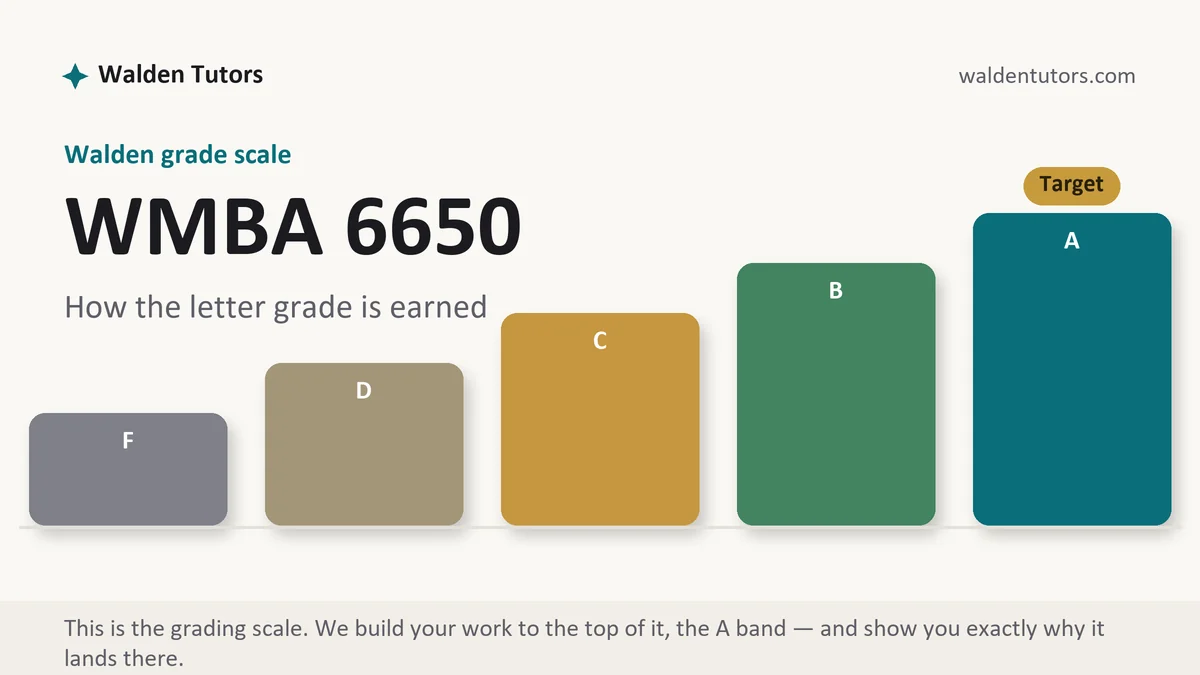
What WMBA 6650 actually grades
Walden builds this course around entrepreneurial competence developed on problems taken from actual organizations rather than invented ones. The description points at what an organization contributes to the society around it, at local, national and international scale, and it asks how entrepreneurial and commercial activity affects environmental outcomes. It also uses the term glocalities for the combination of individuals, businesses and political bodies working together toward social progress.
The graded output usually takes the form of applied analyses: venture and opportunity assessments, impact cases built around a real organization, comparisons of ventures operating at different scales, proposals with a business and a social argument running side by side, and threads scored on their own rows. What separates a strong submission is not enthusiasm for entrepreneurship, which every paper has, but the ability to attach a claim to a specific organization and support it with something a reader can verify.
Three habits reliably lift the mark. Choose one organization and stay with it, because a paper touring five examples proves nothing about any of them. Make every impact claim specific enough to be wrong, so a reader can imagine the evidence that would refute it. And handle costs as seriously as benefits, since a venture that creates jobs may also displace an existing employer, and a paper that notices this reads as judgment instead of advertising. Marks are letter grades built out of rubric rows that sit in the classroom alongside the item.
Scale, and the glocal idea
Impact behaves differently at different distances, and this course asks you to hold all three in view. Local impact is where the evidence is easiest to find and hardest to overstate: jobs in one town, a supplier chain within a county, a service that people can now reach without driving an hour. National impact usually shows up as a category rather than a place, in an industry restructured or a standard adopted. International impact adds the awkward questions, since a venture that improves conditions in one country may be doing so through a supply chain that shifts a cost somewhere else entirely.
The glocal framing Walden points at is the practical answer to that awkwardness. Progress in a place is rarely produced by a company acting alone. It comes from an entrepreneur, a set of businesses and a public body operating in the same direction: a permit that made a site viable, a training program that supplied the workforce, a purchasing decision that gave a new supplier a first contract. When your paper names all three of those actors instead of only the founder, you are describing how change actually happened rather than telling a story about one person's determination.
The environmental question sits inside the same discipline. Say which output the venture changes, in which direction, and against what baseline. A firm that reduces packaging while lengthening its shipping distances has done two things, not one, and papers that report only the flattering half lose the row that asked about consequences.
How we help in this course
Three things start the job: the prompt, the rubric rows your classroom presents, and the case, article or organization the week named. What comes back settles on one organization, ties every impact claim to evidence that can be traced, treats the costs as carefully as the benefits, and closes with a position rather than a summary.
The terms are the same here as everywhere on the site. Work comes back within a day or two, 48 hours at the outside, aimed at the top band on every row. It passes two readers first, one marking to the rubric and one auditing sources, format and originality. Free revisions continue until the piece meets what we promised.
Weekly manuals for this course
Nothing at week level has gone up for this course so far. Walden makes course descriptions public but keeps the syllabus behind the student login, which means a week-by-week grid published on an outside site would be fiction rather than information. Each manual publishes on its own, after somebody enrolled in the section has told us what the deliverable was. If yours has not been written yet, put the assignment into chat and the desk begins from the instructions you were actually handed.
Working on a WMBA 6650 venture analysis?
Send the prompt, the rubric and whichever organization you settled on. The first premium sample is free, and it lands with you in two days flat.
Pacing the research in this course
Walden runs the MBA on its semester calendar, which is the longer of the two structures the university operates and quite separate from the quarter terms used across the nursing programs. Spring Semester 2026 appears on the published calendar with a January 5 opening and an April 26 close. Counting that span into weeks lands you at roughly sixteen, though the arithmetic is yours: Walden prints the dates and leaves the division to whoever needs it. Treat your own program calendar as the authority on the term you are enrolled in.
What catches people out here is research time rather than writing time. Choosing an organization is not a five-minute decision, because you need one with enough public material behind it to support several deliverables. A private company with no filings, no coverage and no independent reporting will strand you in week nine with claims you cannot source. Pick early, test the evidence supply before committing, and keep one file of sources organized by the claim each one supports rather than by author.
Two fixed points belong in the plan you build. Anything graded shuts at 10:59 at night on Central time, an hour the Eastern seaboard reads as 11:59, and the clock in question is the university's rather than your own. Showing up in the opening week is a requirement rather than a courtesy, because Walden wants a login plus one graded contribution, assignment or thread, on the record before that week runs out.
How to actually write WMBA 6650: where to begin
Open the rubric before the readings. It is attached to the graded item inside the classroom, it is written in plainer language than the prompt, and every row is a commitment about what your faculty member intends to look for. Rewrite the rows as headings in a blank file, put each weight beside its heading, and allocate words in proportion. In an impact course the descriptive background section expands quietly until it has eaten the analysis, and matching length to weight is the cheapest way to stop it.
Pick the organization next, and pick it on evidence rather than affection. The right choice satisfies three tests: it is real, it is documented well enough that you can source claims about it, and something about it actually changed for somebody. A famous founder with a thousand admiring profiles is often a worse choice than a mid-sized regional firm with a decade of trade coverage, because admiration is not evidence. Where the item lets you propose your own venture, situate it inside a real market you can document, so the idea is yours while the supporting facts are not.
Then write a claim that could turn out to be false. This is the difference between a paper that reports and a paper that argues. Saying that entrepreneurship benefits communities is unarguable, and therefore unprovable. Saying that this company's decision to keep its production in the county sustained a supplier network that would otherwise have followed the industry offshore, at the cost of a margin its competitors do not carry, gives every later section something to establish. Put that claim in the opening paragraph, because business faculty read for the position first.
Now build the impact section so it can be inspected. Name the group affected. Give a sense of scale, even an approximate one, and say where the figure came from. Describe what changed for those people in concrete terms. State the counterfactual, meaning what would probably have happened without the venture, since impact only means anything against an alternative. Then say how the change could be observed by somebody who did not take your word for it. Four sentences built that way outscore two pages of adjectives.
Give the costs their own paragraph rather than a concession clause. Every venture with real effects has losers somewhere: an incumbent that shrank, a workforce that had to relearn, a resource consumed, a public subsidy that came out of another budget line. Naming them is not a weakness in the argument, it is the part of the argument that convinces. A paper describing only gains reads to a business faculty member as a brochure, and brochures do not get graded well.
Handle the environmental dimension with the same discipline you used on the social one. Identify the specific output or input that moves, give the baseline you are measuring against, and be honest where you are estimating rather than reporting. If the venture improves one measure while worsening another, say both, and say which one you judge to matter more and why. The row is testing whether you can hold a mixed result without flinching.
On evidence and format, run your searching through the Walden Library business databases so the peer reviewed entrepreneurship and management research is actually within reach, and use government statistical publications for market, employment and industry facts, cited with the agency as the author. Industry and trade sources establish market conditions well when attributed. Company communications and founder interviews are evidence of what an organization claims about itself, and treating them as fact is the most common sourcing error in this course. Synthesis means putting two sources into contact and adding what your case shows, not summarizing them one at a time. APA 7 handles the surface: title page, heading levels, citation form, and a bibliography with no entry left unmatched in either direction. Give every table or figure a number and a caption, then point to it by number where the text uses it.
| Section | What it does | Common failure |
|---|---|---|
| Claim up front | States a position about this organization that a reader could contest. | An opening celebration of entrepreneurship in general, which commits to nothing. |
| The organization | Introduces one real venture with enough context to make the rest legible. | Several companies sampled briefly, so no claim about any of them is ever supported. |
| Impact on people | Names the group, the scale, the change, and how it could be observed. | Value created for the community, asserted with nobody identified and nothing measured. |
| Counterfactual | Says what would likely have happened had the venture not existed. | Every good outcome in the area credited to the founder by default. |
| Costs and losers | Identifies who absorbed a loss and what it consisted of. | A benefits-only account that reads as promotion rather than analysis. |
| Environmental effect | Names the measure, the direction of movement, and the baseline used. | A sustainability paragraph with no measure, no baseline and no source attached. |
| Actors beyond the founder | Shows the public bodies, partners and buyers who made the outcome possible. | A single hero narrative that leaves out everything that made the venture viable. |
| Conclusion | Delivers the judgment asked for, with its limits stated openly. | A closing note on how inspiring the story is, offered instead of an assessment. |
Threads in an impact course
Discussions here carry their own rubric and their own marks. The prompt normally sets an organization, a trend or a claim about entrepreneurship in front of you and asks for your reading of it. Treat the first post as a small case: the position in the opening line, one piece of sourced evidence, the group it affects, and a question left genuinely open. Cite inside the post, because an unsupported paragraph looks like personal opinion to a row that was built to score evidence.
Participation is scored on its own terms in this course, and Walden's policy sets the bar at contributions that are substantive, consistent and on time, recommending that you post on at least two separate days and preferably as many as four. Replies earn nothing through agreement. The ones that score take a classmate's example and ask who paid for the outcome they admired, supply the counterfactual their argument assumed without stating, or point out that the impact figure they quoted came from the company itself. Because Walden acknowledges that these expectations are not uniform from one course to the next, the number of replies and the day they close come from your own classroom and nowhere else.
The mistakes that cost points in WMBA 6650
- A parade of well-known founders instead of one organization examined properly from beginning to end.
- Impact asserted with no group named, no scale given and no way for a reader to check it.
- Company press material and founder interviews used as proof of the outcomes they describe.
- Every improvement in the area credited to the venture, with no thought given to what else was happening.
- A sustainability section made of intentions and pledges rather than measured changes.
- The public bodies, partners and early customers left out, so the venture appears to have succeeded alone.
- An inspirational ending supplied where the prompt asked for a judgment with reasons.
WMBA 6650 questions students actually ask
Can I write about a business I want to start rather than a real one?
Read the item, because both appear in this course and they are marked differently. Where the prompt points at real-world organizations, an invented company gives you nothing to cite and the evidence rows go unfilled. Where the prompt invites a proposed venture, your own idea is welcome, but the analysis around it still has to be sourced: a real market, real customers described from research, real regulation, real competitors. A useful compromise when the choice is yours is to propose your venture inside a real market you can document, so the idea is yours and the evidence is not.
How specific does the social impact claim need to be?
Specific enough to be checked by somebody who doubts you. Name the group, say roughly how many people are in it, describe what changes for them, and say how anyone would know whether it happened. Employing thirty people in a town where the previous employer closed is a claim with edges on it. Creating value for the community is not. If the change is environmental, say which output falls and against what baseline, and be candid where you can only estimate. Graders in this course reward measurable modesty over grand and unverifiable ambition.
What counts as evidence in an entrepreneurship paper?
Peer reviewed entrepreneurship and management research is the backbone, and the Walden Library carries the business databases that hold it. Government statistical publications are strong support for facts about markets, employment and industry size, cited with the agency as author. Industry and trade sources can establish market conditions if you attribute them and do not use them where a row asked for scholarship. Company material and founder interviews are fair evidence of what a firm says about itself, which is not the same as evidence that the claim is true, and saying so in your paper is itself a mark of good judgment.