New Venture Creation and Entrepreneurship is cataloged at Walden as WMBA 6653, worth three semester credits, with WMBA 6000 listed ahead of it. Read two of its prompts back to back and a gap opens up: the assignment asks you to decide something about a venture, and the paper that gets handed in describes one.
What WMBA 6653 actually grades
Walden's own description fixes the territory. Spotting an opportunity in a market, weighing risk, managing change, building something new, taking a product from idea to shelf, raising money, protecting what you invented, and getting it commercialized. The course applies all of that twice over, once to a founder starting from nothing and once to an established firm trying to act like a startup inside its own walls.
Graded output is written rather than examined. Opportunity assessments, concept and feasibility papers, capital write-ups where you argue for one funding route against another, analyses of protection and route to market, and threads that score on rows of their own. Different shells, one underlying demand: identify the opportunity precisely, test it against evidence somebody else could check, pick, then defend the pick in APA 7.
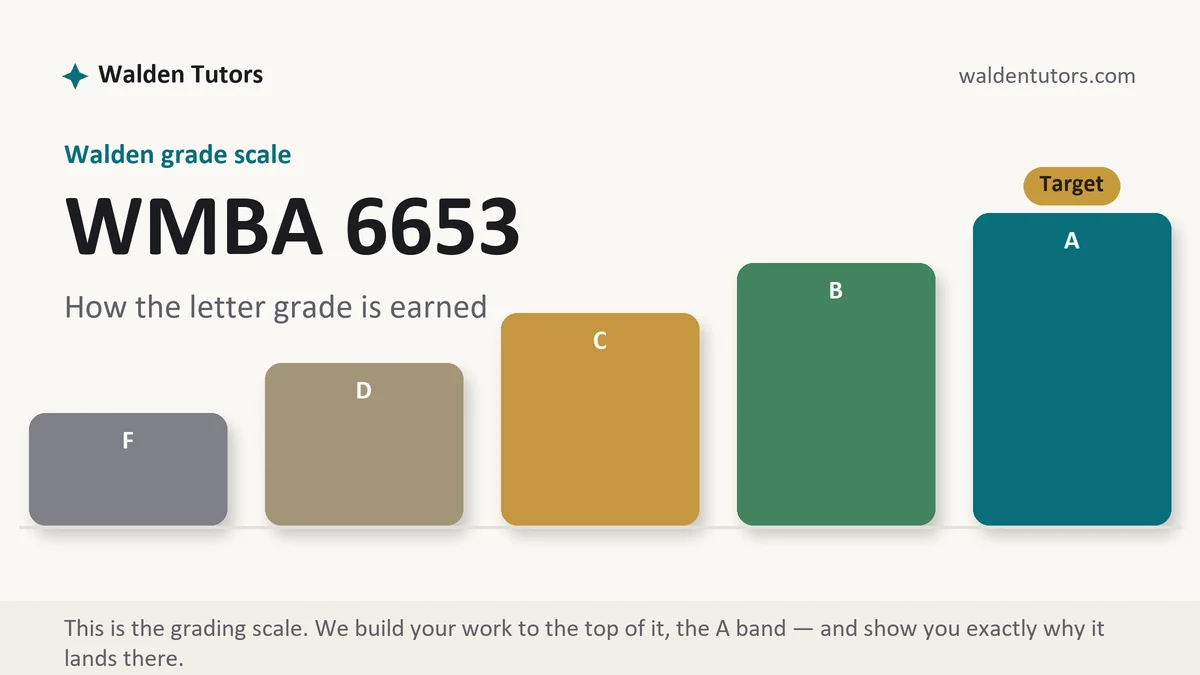
Your grade arrives as a letter built out of those rows. A paper stuffed with correct industry detail can still land mid-range if it never commits, because the row carrying the most weight is almost always the one asking what you would do and why.
Where the prompt and the paper part ways
Underline the verbs in the assignment before you type anything. Entrepreneurship prompts run on evaluate, recommend, justify, compare, assess. Each of those demands a position. What tends to arrive instead, written at eleven at night after a shift, is a report: here is the market, here is the product, here is what the founders did, here is a warm closing paragraph about the future of innovation.
The fix is structural and it is quick. Give every section one sentence that a reasonable person could argue with, then spend the rest of the section defending it. Not the smart speaker market is growing rapidly, which nobody disputes, but this venture should enter through the professional installer channel rather than direct retail, because the margin survives there and the customer acquisition cost does not sink it. The first is a fact. The second is a decision, and decisions are what the scoring guide was built to reward.
How we help in this course
Send the venture assignment, live scoring guide with row weights, permitted case material, and your current draft. Criterion-mapped feedback checks whether each section makes a clear commitment and supports it with evidence. You choose and defend every final revision.
Our service terms hold here as everywhere else on the site. Turnaround is 24 to 48 hours. Writing aims at an A on every scored row. Two people read the draft before it leaves, the first marking it the way faculty would and the second auditing citations and originality. Revision keeps running, at no extra cost, until the target is reached.
Business writing carries a voice, so attach an earlier MBA paper if you kept one. The returned draft then sits close to how you actually write, and personalizing it costs minutes.
Weekly manuals for this course
This site carries no week pages for WMBA 6653 yet. Course syllabi live behind the classroom login, which means a per-week manual only becomes publishable once students inside the course report what a deliverable actually demands. Send the week you are sitting on through chat in the meantime. Drafting never waited on a manual, because it starts from your materials rather than ours.
In WMBA 6653 right now?
Paste the venture assignment and its rubric into chat. The first premium sample costs nothing, and it is back with you inside 48 hours.
Term length, deadlines and the first week
This is business coursework, so it is priced and paced in semester credits rather than the quarter credits nursing students carry. Walden publishes three semester starts for 2026: openings on January 5, May 4 and September 7, closing on April 26, August 23 and December 27 respectively. Each of those windows measures 111 days. Divided by seven that comes to just under sixteen, so the week figure is arithmetic you performed on published dates and not a number printed on the calendar page.
Cut-off times run on Central and they do not move. Anything submitted after 10:59 p.m. Central counts as late, which for East Coast students means the hour before midnight. A second rule bites at the front of the term. Walden asks you to sign in during the opening week and put up an assignment or a discussion contribution; that requirement is administrative, and an excellent paper in week eight will not repair a miss.
The count of graded items in your own section is a question only your syllabus settles. Walden says openly that posting requirements are not uniform, and that they shift from week to week inside a single course, so take the number from the classroom rather than from habit.
How to actually write WMBA 6653: where to begin
Start with the scoring guide, not the prompt. Lift its rows into a blank file and promote every one of them to a heading. That gives you the grader's outline in advance, which is a strange gift and most students ignore it. Look next at the weight attached to each row, then size your sections to match, because a long paragraph sitting on a lightly weighted row is a cost you cannot see while you are enjoying writing it.
Then choose the venture, and choose it for tractability rather than for excitement. A workable subject has three properties: a customer you can describe in a sentence, a market whose size and growth somebody has already measured and published, and at least two named competitors doing something adjacent. Ventures failing those tests force you into vagueness, and vagueness is what unsupported papers are made of. If the week hands you a case company or a scenario, that decision is already made and your job is to work inside it rather than around it.
Build the thesis next, and build it so it could turn out wrong. Try this shape: this venture is viable in the professional segment at a subscription price, provided customer acquisition stays under the first year contribution margin, and the evidence for that condition is thin enough to name as the main risk. That sentence tells the grader where you are going, what could break it, and roughly how the paper will be organized. A promise to explore the entrepreneurial potential of the idea tells them nothing and costs you the introduction row.
Then run each body section through four moves. Make the claim. Produce the evidence, with the source named inside the sentence. Produce the evidence pointing the other way, because ventures always have some. Decide, and state what would make you decide differently. That last move is where entrepreneurship papers pull apart from one another, since a founder who can say under what condition they would walk away reads as somebody who has genuinely thought about the money.
Synthesis matters more here than summary. A summary paragraph reports one author at a time, politely, in the order you read them. A synthesis paragraph puts two sources over the same question and lets them disagree. If one body of research reads early customer concentration as validation while another reads it as fragility, put both on the page, apply them to your own venture's pipeline, and rule on which reading fits. Graders can see that difference from the first line of the paragraph.
Source the paper inside the Walden Library instead of an open browser tab. Industry data, company profiles and peer reviewed entrepreneurship scholarship all sit in business collections your tuition has already paid for, and a business librarian will surface a defensible figure faster than an hour of independent searching. Ask of each citation what one job it performs; if you cannot answer in a short phrase, it is decoration. Where a number originates in a company's own promotional material, label it as such, because a grader will spot it and the admission reads far better coming from you.
APA 7 handles the rest, and it is mostly bookkeeping. Walden's own title page, headings used at the level they belong to, the author name and the year sitting inside whichever sentence makes the claim, and no entry in the reference list that fails to appear in the body or the other way round. Financial tables and figures take APA formatting too. Number them, title them, and add a note naming where the data came from. That last detail is a scored row students lose without ever noticing it existed.
| Part of the paper | What belongs there | Where the marks leak away |
|---|---|---|
| Opportunity statement | The unmet need, the customer who has it, and the evidence that the need is real and unserved. | A product description standing in for a problem, so nothing in the paper explains why anyone would buy. |
| Market and competition | Sourced size and growth figures, named competitors, and what each already does for your customer. | Market numbers with no citation, or a claim that the venture has no competition anywhere. |
| Model and product | How value is created, how it is charged for, and what stage the product has actually reached. | An idea presented as if building it were a formality that needs no time or money. |
| Capital and financing | The amount required, the route to raising it, and the cost of that route in equity, interest or obligation. | A funding request with no use of proceeds and no comparison against the routes not chosen. |
| Risk and protection | What could break the venture, what intellectual property exists, and how either is defended. | A risk list of generic hazards that could belong to any business on earth. |
| Recommendation | The decision, the conditions attached to it, and the signal that would make you reverse it. | A summary of the preceding pages presented as though summarizing were deciding. |
Threads in an entrepreneurship course
Discussion here is graded work, and it usually pushes you toward judgment: is this opportunity real, did that founder choose well, can a large firm act entrepreneurially without breaking what already works. Write the opening post as a paper in miniature. Position first, evidence with its citation attached second, the strongest objection third, your answer to the objection fourth. An uncited post, however sensible, gets scored as opinion by a row built to reward evidence.
The university's grading policy wants posts that are substantive, regular and punctual, and it puts a floor under how they are distributed: a minimum of two to four separate days carrying contributions, rather than one long session on Sunday night. Replies carry their own row, and agreement earns nothing on it. Act on the post you answer. Supply the market figure its writer assumed, ask whether the customer segment is large enough to fund the plan described, or raise the funding route they discarded and argue that it might have survived. How many replies score, and the hour the thread closes, are decisions your classroom makes, so check this week's instructions instead of carrying last term's habit forward.
Citing evidence in an entrepreneurship paper
Business writing pulls from source types the rest of the program rarely touches, and each carries its own rule. Industry and market reports get cited as reports, with the publisher named, because the publisher is what makes the number credible. Company financials are cited to the filing or the database record rather than to a news article describing them. Interviews you conducted yourself are personal communication, appearing in the text and never in the reference list. Trade press is legitimate for what is happening now and weak for whether it works, so pair it with scholarship whenever you use it to support a claim.
Walden's Writing Center hosts the formatting templates faculty grade against. Downloading one and building inside it takes about ten minutes and quietly deletes an entire family of preventable deductions.
The mistakes that cost points in WMBA 6653
- Enthusiasm doing the work evidence should be doing, so the paper reads like a pitch deck with citations bolted on.
- Market size quoted to the nearest billion with no source, which discredits every calculation resting on it.
- Competitors dismissed in a sentence rather than analyzed, usually because taking them seriously would weaken the idea.
- A financing section that names an amount but never says what the money buys or when it returns.
- Intellectual property treated as a formality, with no thought about what is actually protectable and what is not.
- A conclusion that restates the paper instead of making the call the prompt asked for.
WMBA 6653 questions students actually ask
Can I write about a venture I actually want to start?
Usually yes, and it tends to produce sharper work, because you already know the awkward details an invented idea never has. Two cautions apply. Your own enthusiasm makes weak evidence feel strong, so hold the idea to the same tests you would apply to a stranger's pitch, and be willing to write down the finding that the numbers do not support it. Check the week as well: some assignments name the venture or hand you a scenario, and in those cases your own idea belongs in a later paper rather than this one.
How much financial detail does a concept paper need?
Enough to show the venture could be funded, not enough to pass for an accounting exercise. A startup or expansion concept generally needs a stated capital requirement, a named route to raising it, the cost that route carries in equity or interest or obligation, and a rough sense of when money starts coming back. Every figure needs a source or a stated assumption. Where the assignment attaches a template or a spreadsheet, that template sets the depth and you should not exceed it for effect.
Do I need real market data, or can I estimate?
Real data wherever it exists, clearly labeled estimates where it does not. Market size, growth rate, competitor counts and pricing bands can nearly always be sourced through the business collections in the Walden Library, and a grader who spots an unsourced market figure will discount everything built on top of it. When you genuinely have to estimate, say so in the sentence, show the arithmetic that produced the number, and name what would prove you wrong. An honest estimate with visible working scores better than a confident figure from nowhere.