At Walden this course is WMBA 6660, Communicating Using Social and Digital Media, three semester credits, sitting behind WMBA 6060. Its assignments ask for a strategy. What lands in the drop box is usually a plan for posting. Those are different documents, and only one of them satisfies the scoring guide.
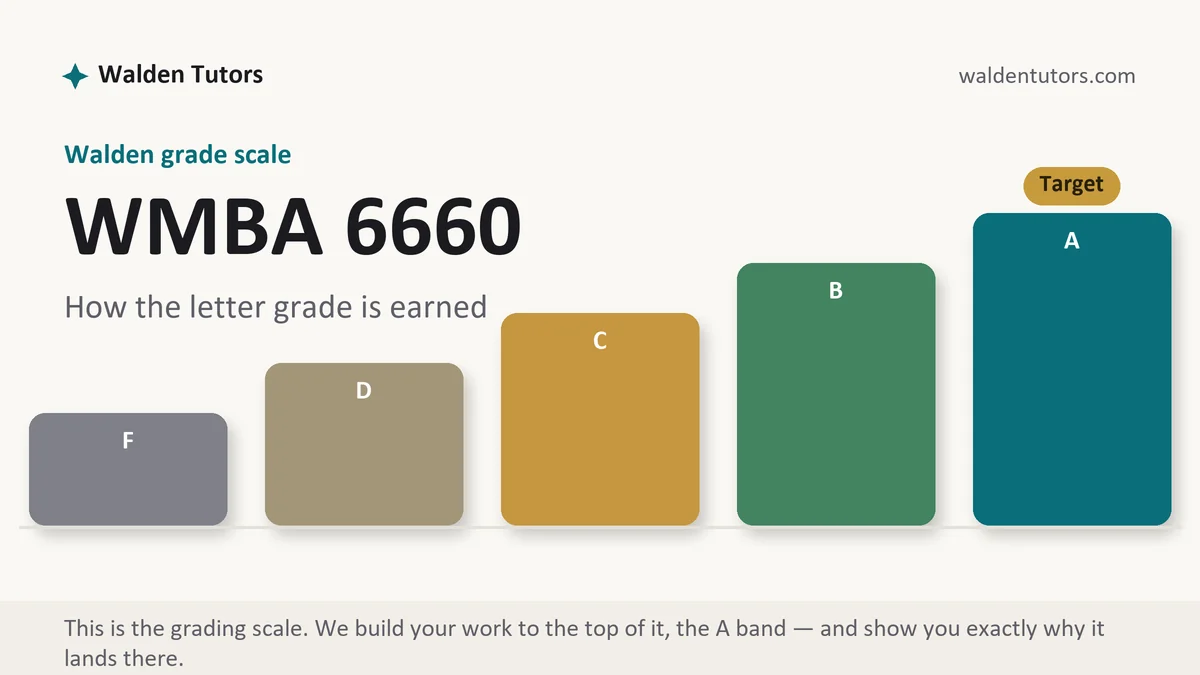
What WMBA 6660 actually grades
The course description sets three demands. Read how social channels rewired the relationship between a brand and the people who buy from it. Build a social media strategy for an organizational scenario using the elements of storytelling. Then work through the ethical, privacy and legal pressure that digital distribution puts on all of it, alongside the regulatory environment communications sits inside.
Around those sit the practical topics: which kinds of social media exist and what each is for, matching a channel to the audience actually present on it, reputation management when the conversation turns, and the methods used to judge whether any of it worked.
So the graded artifacts are strategy documents, storytelling and content pieces framed by an argument, reputation cases, ethics and law analyses, evaluation plans carrying named measures, and threads scored on rows of their own. A letter grade comes out of those rows, and the rows consistently pay for judgment rather than for coverage.
Strategy asked for, tactics delivered
This is the gap that costs most of the marks in this course. The prompt says design a strategy for the scenario organization. The submission arrives as a schedule: six platforms, three posts a week each, a hashtag, a bar chart of follower counts. Every line of it true, none of it strategic, because nothing in the document explains why this rather than something else.
A strategy answers four questions in order and refuses to skip any. Who exactly are we trying to reach, described so a stranger could recognize them. What change in their behavior or belief are we buying. What story makes that change plausible coming from this organization rather than a competitor. How will we know within a month if it is not working. A posting schedule is what falls out of the answers. Handing in the schedule alone is like submitting the last page of a proof.
How we help in this course
Three attachments do it: the assignment as your classroom renders it, the rubric showing every row and weight, and whatever scenario organization the week has handed you. A full draft returns, one that argues a strategy rather than describing activity, connects every recommendation to an audience and a measure, and cites material your grader can pull up.
Delivery is 24 to 48 hours, and every row on the scoring guide is drafted with an A in view. One reviewer marks the draft the way faculty do, a second checks sourcing and originality, and nothing ships until both have signed off. If the returned draft misses the mark, revisions carry on at no cost until it does not.
Attach a paper you wrote earlier in the MBA when you order. Your rhythm is easy to match from one sample, and matching it means the personalization you do afterwards takes minutes.
Weekly manuals for this course
No manual for any individual week of WMBA 6660 has gone live so far. Syllabi at Walden live inside the classroom, so an accurate manual has to wait until students taking the course describe what their week actually contained. Drafting is unaffected either way: paste the week into chat, attach whatever your classroom handed over, and the work starts from those materials.
In WMBA 6660 right now?
Send the strategy brief and the scoring guide through chat. Your first sample is free and moves quickly.
Term shape and the clock you write against
Because this is an MBA course, the term is a semester and not one of the shorter quarters Walden's nursing degrees use. Three starts sit on Walden's published 2026 calendar: January 5 through April 26, May 4 through August 23, and September 7 through December 27. Each of those windows runs 111 days. That is fifteen and six sevenths weeks, which nearly everybody rounds up to sixteen, and the rounding belongs to you because Walden never prints a week total on the page.
Timing inside the term runs on Central. The gate shuts at 10:59 p.m. Central, one minute short of midnight for anyone on Eastern time. Convert it into your own zone once and keep the answer somewhere visible.
Attendance in the opening week is its own separate obligation. Walden wants you signed in and posting during that week, either an assignment or a discussion entry, and no amount of later work settles a miss. What your particular section then holds by way of graded items comes only from the syllabus, since the university says outright that thread requirements are not uniform from course to course.
How to actually write WMBA 6660: where to begin
Start by reading the rubric as a specification rather than as a warning. Each row is a question the grader has committed to asking, so lay the rows down the left of a blank document and let them become your headings before you have decided anything. Note what each row is worth and let the weights allocate your words. That single habit protects you from writing three pages on channel selection while a heavily weighted evaluation row gets a paragraph.
Next, pin the audience down. Digital communication papers collapse when the audience is described as consumers or millennials or our target market, because vague audiences make every subsequent choice unfalsifiable. Write the audience with enough specificity to be wrong: a segment, where they already spend attention, what they are trying to accomplish when they open the app, and what they currently believe about this organization. Everything downstream, channel, tone, format, measure, is answerable to that description.
Then build the story. The course puts storytelling at the center for a reason, and the version that scores is structural rather than decorative. A story has somebody with a problem, an obstacle they cannot get past alone, and a change that follows. In an organizational strategy the customer is the somebody and the organization is at most the guide. Papers that cast the brand as the hero of its own narrative read as advertising, and a rubric row asking for audience relevance will not reward them.
Write the thesis as a claim that could fail. Something in this shape: this organization should concentrate on short video for one specific segment, accept slower reach elsewhere, and treat saved posts rather than followers as the signal, because the audience it needs is researching before it buys and not looking for a relationship. That takes a position, names a trade-off and states a measure, which is three rubric rows answered in one sentence.
Handle ethics, privacy and law as part of the strategy rather than as an appendix bolted on at the end. Where you propose collecting data, say what is collected and what the audience is told. Where you propose paid partnership or endorsement, address disclosure. Where you propose engaging with criticism, set the rules in advance, because reputation work invented mid-crisis is what the case studies in this field are made of. Check your week's own materials for the regulatory ground it expects you to cover, and cite the regulator or the authoritative text rather than a blog summarizing it.
Then measure. Evaluation rows are where confident papers quietly lose marks, usually by listing metrics that count activity instead of effect. Impressions and follower totals describe motion. Saves, qualified enquiries, repeat visits, sentiment shifts on a defined issue and cost per meaningful action describe result. Name the measure, name the baseline you would compare it against, name the window, and name the number that would tell you to stop.
For sources, start in the Walden Library rather than a browser tab. Marketing, communication and information systems journals sit in databases the university already pays for, and a librarian will point you at the right one faster than browsing will. Platform documentation and reputable industry research are fair for facts only they hold, and both need a date attached because this field ages in months. APA 7 then covers the rest: Walden's title page, headings kept at their proper level, author and year sitting in the sentence that carries the claim, and no entry appearing in the body or the reference list without its match in the other. One extra rule bites harder in this course than elsewhere. Platform documentation and industry dashboards are corporate-authored sources, so they take an organization as the author and a retrieval date, and a grader who cannot tell which year a benchmark came from has no reason to credit it.
| Part of the paper | What belongs there | What loses the row |
|---|---|---|
| Situation and audience | The organization's current position and a segment described precisely enough to be argued with. | An audience defined as everyone who might buy, which makes every later decision unarguable. |
| Objective | The behavior or belief you intend to move, with a starting point and a target. | Increase brand awareness, offered as a goal with no baseline and no finish line. |
| Story and message | The narrative the audience is inside, and the role the organization plays within it. | Brand voice adjectives listed with no story anyone could retell afterwards. |
| Channels | Two or three platforms, each with the audience, the format and the effort it demands stated. | Every platform included by default, with the choices never explained or defended. |
| Ethics, privacy and law | Data handling, disclosure of paid relationships, and the rules governing your communications. | A closing paragraph promising to act responsibly, attached to no specific decision in the plan. |
| Measurement | Named measures tied to the objective, with baselines, a window and a stopping rule. | A metrics list dominated by counts that rise whether or not anything worked. |
| Reputation response | What triggers a response, who approves it, how fast, and in which channel. | Monitor and respond promptly, written as though nobody would ever have to do it at 2am. |
Posting in a course about posting
Threads carry rubric rows here just as papers do, and the irony is not lost on anyone: you are being graded on written contributions in a course about written contributions. Open with a position, attach a citation to the evidence supporting it, name the strongest counter and answer it. Professional experience is welcome and it does not replace a source, so pair the anecdote from your own marketing job with something published.
On timing, the university's participation guidance asks for posts that are substantive and dependable, arriving across several days, with two to four days named as the floor rather than everything landing at once. Responses to classmates score separately and approval scores nothing. Do work in the reply: question whether the audience described can be reached on the platform proposed, offer the measure that would have tested their claim, or raise the disclosure problem their paid partnership idea creates. The reply quota and the closing day belong to your classroom, so lift both from this week's own instructions.
Law, ethics and APA in digital media writing
Sourcing in this field needs a sorting rule. Peer reviewed research carries claims about how people behave. Industry research and platform documentation carry current facts and benchmarks, always cited with a year because they will be wrong soon. Regulatory and legal material is cited to the body that issued it, never to a commentary describing it. Screenshots and posts you reproduce are quoted material and need attribution, and where you show a real person's content you should think about whether the paper needs their identity at all.
Walden's Writing Center hosts APA templates built to match faculty expectations, and a few minutes spent working inside one deletes a whole family of avoidable deductions. Any exhibit you include, a content mock-up, a funnel diagram, a channel comparison, is numbered, titled and footed with the source of what it shows.
The mistakes that cost points in WMBA 6660
- A content calendar handed in as though scheduling were the same thing as deciding.
- Platforms selected because they are large, with no line connecting any of them to the audience described earlier.
- Storytelling reduced to a tone of voice paragraph, so the paper has no narrative a reader could repeat.
- Ethics and privacy quarantined in a final section rather than shaping the recommendations they apply to.
- Vanity metrics presented as evaluation, which leaves the measurement row answered in name only.
- Vendor and platform claims cited as if they were independent findings about what works.
WMBA 6660 questions students actually ask
Do I need to run real social accounts to pass?
No. The graded artifact is the thinking, written down, not a live account with followers attached. What you do need is real material to reason about, which means looking closely at what an organization actually publishes, how its audience answers, and where the tone slips. Anyone can observe that without owning the login. If a week does ask for drafted content, treat the drafts as exhibits inside the paper, formatted and labeled, with the strategy explaining why each one exists.
How many platforms should one strategy cover?
Fewer than instinct suggests. Two or three, chosen and defended, will outscore a sweep across six that treats them as interchangeable billboards. Every platform you include should come with a reason that mentions the audience sitting there, the format that channel rewards, and the resource cost of feeding it properly. If you cannot write that reason for a channel, its presence weakens the paper, and a section explaining which platforms you deliberately left alone is one of the easiest ways to show judgment.
What counts as a scholarly source for social media work?
Peer reviewed research in marketing, communication and information systems journals is the backbone, and the Walden Library carries it. Platform documentation and industry reports are legitimate for the things only they know, such as how a feature works or what a benchmark looks like this year, and both should be cited with a date because they age within months. Popular commentary is evidence of the conversation and never evidence that a tactic works. A defensible bibliography usually mixes all three, with the scholarship carrying the claims and the industry material carrying the numbers.