WMBA 6681 is Decision-Making Tools for Today's Financial Professional, worth three semester credits, with WMBA 6050 as its prerequisite. Walden's description lists the toolkit plainly: breakeven and cost-volume-profit analysis for pricing and cost sensitivity, forecasting and cost prediction, variance analysis, relevant cost analysis, and project valuation through payback, rates of return and discounted cash flow. It is a quantitative course carrying a writing problem, because every one of those outputs has to be argued from rather than simply displayed.
What WMBA 6681 actually grades
Two things, and the students who lose points here almost always did one of them well. The first is the model: a spreadsheet or worked calculation that is correct, laid out so a reader can follow it, and resting on assumptions you stated rather than assumed. The second is the recommendation, a short piece of business writing that takes the output and tells somebody what to do about it, with the uncertainty acknowledged out loud.
Case studies carry most of the weight. A typical one hands you a company situation, some financial detail and a decision, then asks for analysis and a recommendation. The scoring guide will hold a row for the accuracy of the numbers, a row for the interpretation, a row for the quality of the argument, and a row for the writing and its sources. Getting the arithmetic right and stopping there collects one row out of four.
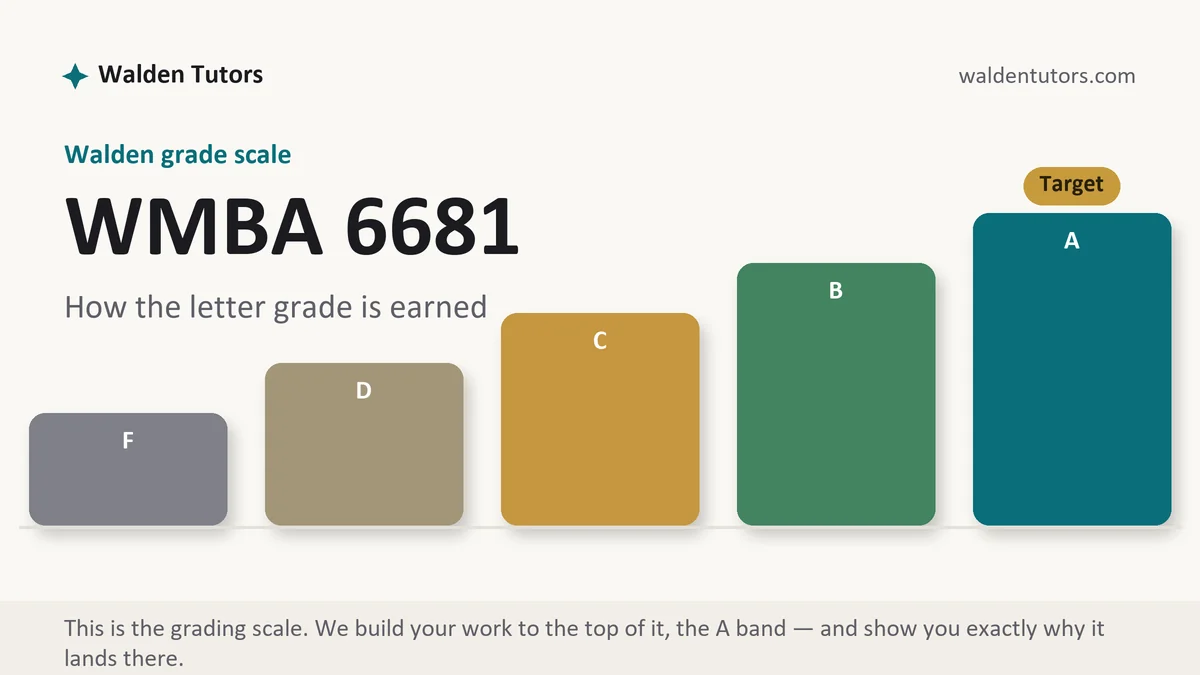
Those rows total into your letter grade, which is why an elegant model bolted to a recommendation nobody could act on lands so reliably at a B.
Read the scoring guide before you touch a formula
In a quantitative course the temptation is to start calculating, because calculating feels like progress. It is the wrong first move. Work through the scoring guide instead, write its rows down the side of an empty page, and let that column stand as the shape of the document you eventually hand in.
Do this next, and it is specific to a tools course. Beside each row, write whether it is answered by a number, by a sentence, or by both. Rows about computation get a cell reference or a worked figure. Rows about interpretation get a claim in words. Rows asking for a recommendation need both, and those are the ones people underfeed, because the analysis felt like the hard part and the recommendation ends up as four rushed lines at the bottom.
Then set the order. Analysis before conclusion is how you did the work; conclusion before analysis is how a manager reads. Most deliverables here want the second, with a short statement of what you recommend near the front and the supporting model behind it. Check the assignment for the format it expects, because a memo, a report and an essay have different fronts.
How we help in this course
Send the case, the scoring guide as displayed, and any template or workbook the week supplies. Back comes the analysis with the calculations laid out step by step, the assumptions stated in the open, and a written recommendation built on what the numbers genuinely support.
Criterion-mapped feedback on your student-authored draft can return inside two days. One pass checks the work row by row against the live rubric; another checks APA, source use, and originality. You choose each revision and submit only work you can defend. No grade is promised.
Ask for the workings and not only the answer. In a tools course, being able to reproduce a calculation matters more than having it, because the next case comes back to the same method and so does the exam question.
Weekly manuals for this course
Nothing week-specific is published here for 6681 yet. A Walden syllabus is not a public document, so any week-by-week table on this page would be invention dressed up as information, and we would rather leave the section thin than do that. Manuals go up one at a time, each after a student in the course has shown us what that week genuinely contains. None of this slows the drafting work down, since that reads your classroom materials directly: paste the case into chat and it begins.
In WMBA 6681 right now?
Send the case and its scoring guide. Your opening premium sample is on the house, back with you inside two days.
The semester term you are working inside
Because 6681 is MBA coursework it belongs to Walden's semester calendar. The university's other calendar is the quarter, which governs nursing and publishes a full term of 11 and 12 weeks with a six-week half term running inside it. Those numbers are worth knowing only so you can ignore them here.
Spring 2026 opened on 5 January and closes 26 April. Summer occupies 4 May through 23 August. Autumn takes 7 September through 27 December. Each of the three is 111 days, which divides out to 15.9 weeks and is where the familiar sixteen comes from. Treat that figure as arithmetic performed on Walden's dates, because the calendar itself carries no week numbers.
Every submission closes at 10:59 p.m. Central, which is the same instant as 11:59 p.m. Eastern, and nothing inside the term flexes for a late spreadsheet. Week one carries its own separate obligation, which is to log in and hand something in, either an assignment or a discussion contribution. Registry rules govern that one rather than your instructor, so it is not a deficit you can model your way out of afterwards.
How many cases, threads and quizzes land in your section is a syllabus question and we will not guess at it. Walden itself states that posting requirements vary between courses and between weeks of a single course, so count yours where they are actually written down.
How to actually write WMBA 6681: where to begin
Start by finding the decision. Every case in this course is asking somebody to choose: accept the project or reject it, raise the price or hold it, make the part or buy it, keep the line or close it. Write that decision at the top of your working file in one sentence. Half the analyses that go wrong here go wrong because the student answered a more interesting question than the one the case asked.
Then choose the tool that fits the decision, and be ready to say why. Breakeven and cost-volume-profit answer questions about volume, margin and the level at which a decision stops losing money, which is also why they carry price and cost sensitivity work so well. Relevant cost analysis strips a decision down to the amounts that actually differ between the alternatives, and it is the tool that quietly settles most make-or-buy and keep-or-drop cases. Variance analysis explains a gap between what was planned and what happened. Forecasting extends a pattern and quantifies how much you trust it. Payback tells you how long your money sits exposed, while a rate of return states the earning power of the commitment as a percentage you can rank against others. Discounted cash flow asks what a stream of future money is worth today, and it is the only one of these that takes the cost of capital seriously.
Ranking projects is a separate skill from valuing one. When the week asks you to prioritize, say what you are ranking on and admit what that measure hides. Payback ignores everything happening after the money comes back. A rate of return can flatter a small project against a large one. Net present value answers in dollars and says nothing about the size of the bet that produced them. Naming the tool, defending the choice and stating the blind spot is frequently a row all by itself.
State every assumption where the reader can see it, in a labeled list rather than buried inside a sentence. Which costs you treated as fixed and which as variable, the discount rate you used and where it came from, the growth rate behind a forecast, the horizon, the tax treatment, and anything you had to invent because the case stayed silent. Two students can reach different answers on the same case and both score well when the assumptions are visible and defensible. Neither scores well when the answer arrives alone.
Lay the computation out so it can be followed. Label the rows, keep one calculation per line, carry units and currency, and never present a figure whose origin is invisible. If the week wants a spreadsheet, submit one where the formulas remain live rather than typed over with values, because a grader checking method needs to see the method. Round at the end and say what you rounded to.
Interpretation is the row most people lose. Narrating means telling the reader that net present value came out at 1.4 million and payback at 3.2 years. Interpreting means saying what that combination implies for this company given its cash position, its cost of capital and the alternatives on the table, then saying what would have to be different for the answer to flip. Sensitivity work is your friend here. Move the one assumption you trust least, report what happens, and you have converted a number into an argument.
The recommendation is a short piece of business prose with four parts: what you recommend, the evidence in a line or two, the main risk of being wrong, and what you would watch to find out early. Write it so a busy reader could act on the first sentence alone. Hedged recommendations that survey both options and choose neither are the most reliable way to lose the argument row.
Case work still needs scholarship. The Walden Library carries the business and finance databases the rubric assumes you used, along with the company data and industry reports that make an assumption defensible rather than convenient. Reach for a source when you need to justify a method, a benchmark or an industry norm, and give each one a job you can state briefly. Two sources doing real work beat six decorating a reference list. Where a management article is assigned for the week, use it as an argument you are testing against your own case rather than as a paragraph to summarize.
APA and formatting for quantitative work
APA 7 governs the document even when most of it is numbers. Tables and figures take numbers, titles and notes, and any table carrying data you did not generate needs a source line. Refer to each table in the text by its number instead of leaving it to float. Spreadsheets attached as separate files usually need a summary table inside the paper as well, because a grader should not have to open an attachment to find your answer. For the document furniture, work from the Writing Center's own title page and heading files rather than reconstructing the format from memory; the templates there are the ones faculty have in front of them.
| Section | What goes in it | The failure that costs points |
|---|---|---|
| Statement of the decision | The choice the case is actually asking you to make, in one sentence. | Answering a broader question about company strategy that nobody asked. |
| Assumptions | Every input you chose, with its source or its rationale, listed openly. | Assumptions embedded silently in a formula, so the analysis cannot be checked. |
| Model or computation | The calculation itself, labeled, sequenced, and reproducible by the reader. | A final figure with no visible derivation, or values typed over live formulas. |
| Interpretation | What the output means for this company, in this position, right now. | A restatement of the numbers in words, which adds nothing the table did not say. |
| Sensitivity | The assumption you trust least, moved, with the effect on the answer reported. | A single scenario presented as though it were certainty. |
| Recommendation | The action, the evidence, the risk, and the indicator you would monitor. | Both options weighed politely and no choice made at the end. |
| Sources and APA | Library sources justifying method, benchmarks and industry figures, formatted in APA 7. | A finance paper with no references, or references never cited in the text. |
Discussion posts that earn their row
Threads in this course tend to give everyone the same short scenario, which means the difference between posts sits entirely in the reasoning. Put a number in your opening post. Even a small calculation with its assumptions attached separates a contribution from an opinion, and it hands your classmates something to argue with. State the tool you used and why it suits the question.
The participation Walden asks for is substantive, punctual and distributed, and its policy suggests a floor of two to four separate days instead of one long session on the last night. Replies carry their own row, and echoing a classmate's conclusion earns nothing on it. Recalculate their figure with a different assumption and report the difference, point out that the tool they chose answers a different question, or supply the industry benchmark that makes their result look better or worse than it first appeared. Reply quotas and closing days are set inside your own section, so lift both from this week's instructions.
The mistakes that cost points in WMBA 6681
- Reaching for a tool because it was covered this week rather than because it answers the question in the case.
- Assumptions that live inside spreadsheet cells and never reach the writing, which makes the analysis impossible to grade.
- Discount rates and growth rates chosen without a word about where they came from.
- Payback treated as a full answer when the case involves cash flows continuing well past the payback point.
- Interpretation that translates the figures into sentences instead of saying what they mean for the decision.
- A recommendation listing advantages and disadvantages that then declines to recommend anything.
- Rounding early, so the figures in the text disagree with the figures in the table.
WMBA 6681 questions students actually ask
How much spreadsheet skill does WMBA 6681 really require?
You need to be functional rather than expert. The work runs on a small set of habits: one input per cell, formulas that reference cells instead of typed numbers, an assumptions block sitting apart from the calculation, and a label on every row. Learn those and the rest of the course becomes thinking rather than software. Where the week supplies a template, use it as given, since the grader is looking at the structure they built. If your arithmetic has gone rusty, the fastest repair is redoing one solved example from the course materials by hand until the method belongs to you.
Which matters more, the right answer or the right method?
The method, by a distance, because rubric rows in this course are written about reasoning. A case with defensible assumptions, a suitable tool, visible working and an honest interpretation will score well even when a classmate reached a different figure from different assumptions. The reverse does not hold. A correct number with no derivation leaves several rows with nothing to mark. Get the arithmetic right, then spend whatever time remains on why you chose that tool and what the result means for the company in front of you.
How long should the written recommendation be?
Shorter than you expect, and denser. Most recommendations in this course fit inside a page: the action, the evidence, the main risk, and the early indicator you would watch. Length belongs to the analysis behind it, not to restating that analysis in prose. Where the assignment sets a page or word limit, that limit governs, and going past it is a formatting deduction costing the same as a content error. If something has to be cut, cut the recap of case facts, since your grader already knows them.