WMBA 6683 is Managerial Accounting for Organizational Performance, three semester credits, sitting behind WMBA 6050 in the Walden MBA. It is accounting pointed inward, meaning costing, pricing, budgets and performance measures built for the people running the business rather than for anyone outside it, and the graded work asks you to use them to argue for a decision.
What WMBA 6683 actually grades
Case studies dominate. You will cost a product line, compare an activity-based allocation against a traditional one, work a contribution margin, price something, build an operating or capital budget, or design a set of measures for a scorecard. Each one ends with somebody having to decide, and the scoring guide asks whether your accounting made that decision clearer.
Four kinds of row keep reappearing. Accuracy of the computation. Correct choice and application of the technique. Interpretation, meaning what the figures say about performance. And communication, which covers writing a manager without an accounting background could follow, in APA 7, with sources behind any claim about practice.
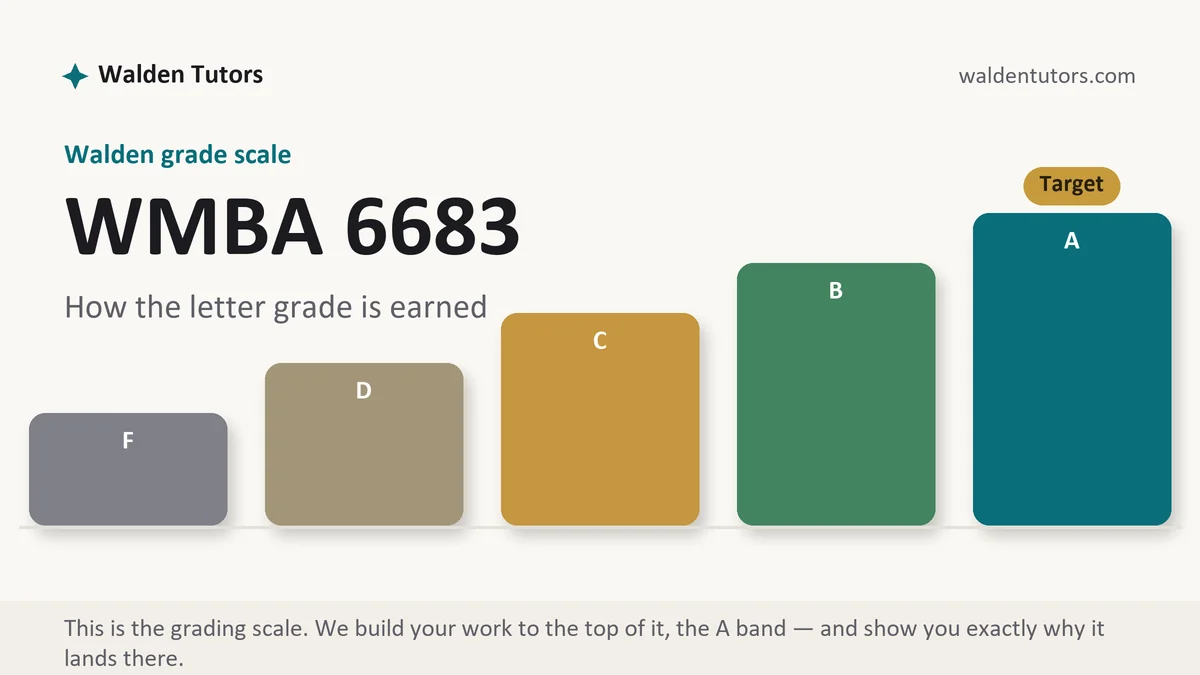
Your grade is a letter drawn from those rows. Students who arrive with an accounting background often lose ground on the last two, because the numbers come easily and the argument never gets written.
Let the scoring guide decide what each section owes
Do the outline first. Copy the scoring guide's rows into an empty file and promote each one to a heading, keeping the guide's own order, because that is the order your grader will read in.
Then annotate the outline in a way that suits an accounting deliverable. Mark each heading with what has to exist underneath it: a schedule, a table, a calculation, a paragraph of interpretation, or a cited claim. Accounting assignments fail quietly when a row wanted a supporting schedule and received a sentence, or wanted an explanation and received another table.
Finally, decide where each number will appear once. Work of this kind repeats figures across sections, and repetition is where contradictions breed. Choose the table that owns each figure, reference it everywhere else, and when a number changes late you will have one place to change rather than five to hunt through.
How we help in this course
Send the case, its scoring guide, and any workbook or template the classroom provides. What returns is the schedule or model built and labeled, the technique applied correctly, and the interpretation written for a manager rather than for an accountant.
The commercial side does not change by course. Work lands back inside two days, drafted against an A on each row, cleared by a rubric reviewer and separately by an APA and originality reviewer, and revised at no cost for as long as it takes to hit the grade.
If your section runs a term-long case that builds, say so and send whatever you have already handed in. Costing decisions made in an early week constrain the budgets and the measures that come later, and consistency across the sequence is worth real points.
Weekly manuals for this course
This course has no week pages here so far. Since Walden holds syllabi behind the classroom login, printing a week grid in advance would be a guess in a confident typeface, and a guess is worse than an empty section. Each manual publishes after someone taking 6683 has confirmed what its week really contains. The drafting service is not gated on any of that; it reads whatever your classroom gave you, so send the week through chat.
In WMBA 6683 right now?
Send the case and the scoring guide. We do not charge for the opening premium sample, and it reaches you inside two days.
The semester term this course runs in
MBA courses at Walden sit on the semester calendar. The quarter calendar serves the nursing programs, and Walden publishes its full term as 11 and 12 weeks with a six-week half term nested inside, so no single quarter figure would describe your term even if the quarter applied to you, which it does not.
On the 2026 calendar the spring semester covers 5 January through 26 April, summer covers 4 May through 23 August, and autumn covers 7 September through 27 December. Measure any of them and the answer is 111 days, fractionally under sixteen weeks. Walden prints no week numbers beside those dates, so the sixteen is our division rather than the university's claim.
Deadlines are quoted in Central time and they are firm: 10:59 p.m. Central, therefore 11:59 p.m. Eastern. Opening week carries a separate obligation to log in and hand in an assignment or a discussion post, and because that one is administrative rather than academic, no later submission repairs it.
Whatever your section wants each week is written in the syllabus you were given, and nowhere else. Walden is explicit that posting requirements are not consistent across courses or even within one, so read yours rather than carrying forward the rhythm of an earlier course.
How to actually write WMBA 6683: where to begin
Managerial accounting exists to support a decision, so identify the decision first. Whether to drop a product, what to charge, whether to make or buy, where the overhead is really going, whether a division earned its keep. Write it down before you touch a number. Every schedule you build afterwards then has one purpose, which is making that decision less blind.
Match the technique to the question. Contribution margin work answers whether a product covers its own variable costs and contributes to the fixed ones. Activity-based costing answers where overhead is actually consumed, which matters when products differ in complexity rather than in volume. Traditional allocation is quicker and defensible when the cost pools genuinely track the driver you are using. Capital budgeting handles long-lived commitments while operating budgets handle the coming year. A scorecard answers a different sort of question altogether, which is whether the organization measures the things it claims to care about. Say which you chose and why, since that sentence is often a row on its own.
Two topics in Walden's description for 6683 get skipped more often than they should, and both are easy marks. Throughput accounting treats the constraint as the thing worth measuring, so it values a product by the contribution it earns per unit of scarce capacity rather than per unit sold. If a case gives you a bottleneck, ranking products on throughput per constrained hour rather than on gross margin often reverses the obvious answer, and reversing the obvious answer with arithmetic behind it is exactly what an interpretation row rewards. Inventory sits next to it: carrying cost, ordering cost and stockout risk pull against each other, and a paragraph naming which of the three the organization is currently optimizing for, whether it means to or not, will do more than a page describing the model.
Forecasting turns up in this course as the front end of a budget rather than as an exercise on its own. Say what method you used, what history it rests on, and what it assumes stays true. Then say what happens to the budget beneath it if the forecast is ten per cent optimistic, because a budget that never gets stress tested is a wish with subtotals.
Relevance is the concept this course keeps testing. A cost is relevant to a decision when it differs between the alternatives and lies in the future. Sunk costs are neither, allocated fixed overhead usually is not, and opportunity cost almost always is even though it appears in no ledger. Building a schedule of relevant costs and stating plainly what you excluded and why is one of the highest-value paragraphs available to you here.
Write the analysis for the person who has to act on it. Lead with the answer, follow with the schedule, and translate every technical term the first time it appears. If your recommendation depends on a cost driver, explain what a cost driver is in a clause rather than assuming. A manager who cannot follow your reasoning cannot act on it, and communication rows exist precisely to catch that.
Scorecard and indicator work carries its own trap. Anyone can list measures. What the rubric wants is measures that connect: a financial outcome, the customer behavior producing it, the internal process producing the behavior, and the capability needed to run the process. Say what each measure is meant to drive, how often somebody would read it, and what they would do if it moved the wrong way. Measures with no owner and no response are decoration.
Budgets get graded on their linkages more than their totals. A sales forecast drives a production schedule, which drives materials, labor and overhead, which lands in a cash budget. Show the chain. Where a figure comes from an assumption rather than from the case, put the assumption in a labeled block and mark the worked example as illustrative rather than as anybody's published figure.
Sources for a costing paper come from the Walden Library, where the accounting and business databases sit behind your tuition. Reach for one when you make a claim about practice, when you use a benchmark, or when a technique needs authority behind its use. Summarizing is one paragraph per author; synthesis is two authors applied to your own case, disagreeing about it, with you deciding which reading the case supports. If one source argues that activity-based costing pays for itself in complex product lines while another documents implementations collapsing under their own upkeep, put both over your company and rule between them.
APA for schedules, tables and numbers
Every table gets a number, a title and a note saying where the data came from, and the text refers to it by number instead of leaving the reader to guess. Figures follow the same rules. In-text citations belong in the sentence making the claim, and the reference list has to reconcile with the body in both directions. For the shell of the document, download a Writing Center template and type into it. Deriving Walden's title page and heading levels from the APA manual yourself is slower and gets marked against the template anyway.
| Section | What goes in it | The failure that costs points |
|---|---|---|
| Decision statement | The management question the analysis exists to answer, written in one line. | An assignment that computes everything the case mentions and decides nothing. |
| Technique and rationale | The costing or budgeting method chosen, with the reason it fits this question. | A method applied because it was the week's topic, with no justification offered. |
| Cost schedule | The computation itself, labeled, with relevant costs separated from irrelevant ones. | Sunk costs and allocated overhead folded into a decision they should never touch. |
| Assumptions | Every input you supplied yourself, blocked together and marked as your own. | Invented figures presented with the same confidence as figures from the case. |
| Interpretation | What the schedule means for performance, in language a non-accountant can act on. | Technical output left to speak for itself, which no rubric row credits. |
| Measures or budget linkage | How the measures connect to outcomes, or how each budget feeds the next one. | A list of indicators with no stated purpose, or schedules that do not reconcile. |
| Recommendation and sources | The action, its risk, and library sources supporting method and benchmarks. | A conclusion restating the totals, with no reference behind any claim about practice. |
Discussion posts that earn their row
Prompts here often ask you to apply a costing idea to your own workplace, which is useful and slightly dangerous. Useful because a real example is specific in a way an invented one never manages. Dangerous because confidential figures should not appear in a classroom. Give the cost structure as percentages or bands instead of actual amounts, and refer to your employer by industry and rough size unless the name is genuinely doing analytical work. A post written that way loses nothing a rubric can see.
Get your opening post up while there is still time for somebody to answer it, then come back on separate days across the week; Walden's policy puts the floor at two to four. Replies score on their own row, so add something: question whether their chosen driver really explains the overhead, offer the relevant-cost objection their analysis skipped, or describe the same technique behaving differently in your industry. How many replies are required, and when the thread shuts, is a matter for your own classroom rather than any general rule.
The mistakes that cost points in WMBA 6683
- Allocating overhead by a driver with no causal link to how the cost is actually consumed.
- Carrying sunk costs into a decision analysis because they happened to be listed in the case.
- Leaving opportunity cost out, which quietly makes the wrong alternative look cheaper than it is.
- Contribution margin and gross margin used as though they were the same measure.
- A balanced scorecard listing financial measures four times under four different headings.
- Budget schedules that do not tie to each other, so the cash budget contradicts the production plan.
- Writing pitched at other accountants, which forfeits the communication rows even when every number is right.
WMBA 6683 questions students actually ask
How much accounting background does this course assume?
It assumes WMBA 6050 and builds directly on it. If debits and credits were never comfortable, the good news is that managerial accounting cares less about bookkeeping mechanics than about cost behavior: what changes when volume changes, what drives overhead, and what is relevant to a choice. Spending an evening on fixed and variable cost behavior before the first case will do more for your grade than reviewing journal entries. Where the workbook the classroom supplies carries practice problems, work one of them fully rather than reading three.
The case does not give me a number I need. What now?
Assume it, label it, and defend it. State the figure, say where it came from, whether that is an industry norm, an inference from another number in the case, or your own judgment, and keep every such input in one assumptions block so a grader sees the whole set at once. Then, if the decision hinges on that input, move it and report what happens. Analyses that quietly invent inputs lose the accuracy row, while analyses that declare them and test them often gain ground on interpretation.
Should I include a spreadsheet or put everything in the paper?
Follow the assignment, and when it stays silent, do both. The paper carries a summary table with the figures your argument depends on, so the reasoning stands alone. The workbook carries the full schedules with live formulas, so the method is checkable. Name the file the way your classroom asks, refer to it in the text, and never let the summary and the workbook disagree, because a grader who finds two different totals will mark the lower one.