Managing Operational and Financial Business Risks is the title behind the code WMBA 6687. Walden weights it at three semester credits and gates it behind WMBA 6050. Walden's own description sets the job: assess the tools accountants and managers use against credit, market, liquidity, reputation, technology and legal exposure, work the processes for identifying and analyzing them, then apply financial and operational controls that mitigate what you found. The risk control matrix and the COSO framework are named there too, which is why they run through nearly every deliverable.
What WMBA 6687 actually grades
Risk assessments and control designs, mostly. A typical deliverable takes an organization or a case scenario, identifies exposures across categories such as credit, market, liquidity, reputation, technology and legal compliance, assesses each one for likelihood and impact, then proposes controls with enough specificity that a reader could tell who performs them and how often.
Scoring guides reward three moves students routinely skip. Ranking, meaning the risks arrive in a defended order rather than a list. Traceability, meaning each control is tied to the specific exposure it addresses. And residual risk, meaning you say what remains once the control is working, because nothing removes an exposure completely.
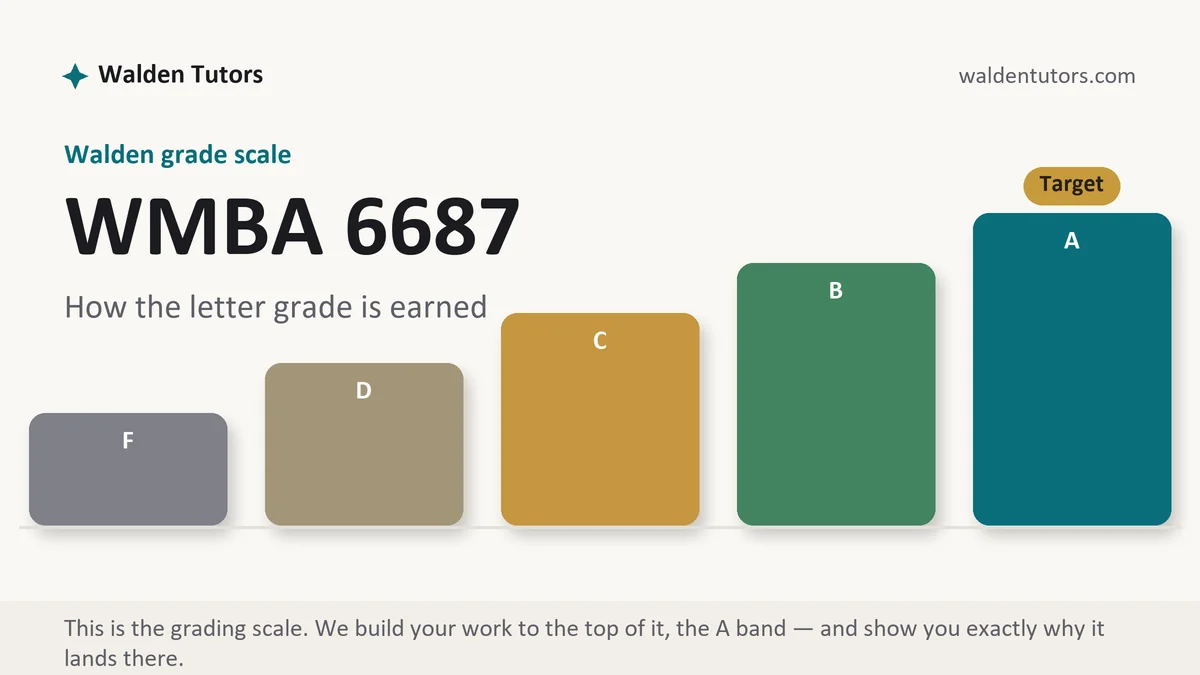
Frameworks matter here more than in most MBA courses. Using COSO properly, rather than naming it in an introduction, is usually a row of its own. All of it totals into a letter grade drawn from those rows.
Scope the paper against the scoring guide first
Risk papers sprawl. The discipline that keeps one tight is building the outline from the scoring guide before you have opened a single company filing. List the rows, make them headings, keep the order the guide uses.
Then add a second column, which is the move that suits this course specifically. Beside each heading write the artifact that will satisfy it: a matrix, a ranked table, a narrative paragraph, a control description, or a cited framework reference. Deliverables here are half document and half instrument, and a row asking for a matrix is not satisfied by prose about matrices.
Last, fix your risk universe before you write. Decide how many exposures you will carry through the whole paper and commit to them; unless your assignment sets a number, we find five to eight is enough to show range without starving any single one of analysis. Papers that identify twelve risks and then assess four have a hole a grader finds in seconds, and papers that quietly gain a new risk in the controls section have a worse one.
How we help in this course
We need the assignment itself, its scoring guide, and the organization or scenario the week hangs on. What returns is a risk assessment covering the categories, a ranking that argues for itself instead of asserting an order, controls written at the level somebody could actually perform them, and a framework doing structural work rather than appearing once for credit.
Pricing and process are the same in this course as in every other one on the site. Delivery inside two days, an A aimed at row by row, a rubric reviewer and an APA and originality reviewer both signing off before you see anything, and revisions at no charge until the target is reached.
If your paper covers a real employer, tell us what has to stay out. Work of this kind is unusually easy to over-share, and a description keeping the exposure while dropping the identifying detail scores exactly the same.
Weekly manuals for this course
There is nothing week-specific published for this course at present. Walden syllabi are not visible from outside the classroom, and a fabricated week grid would be the single most damaging thing we could put on a page like this, so the section stays empty until it can be filled honestly. Manuals arrive one week at a time, each verified by somebody sitting the course. The drafting desk needs none of them, because it works from the documents your own classroom issued: bring the assignment to chat and it starts.
In WMBA 6687 right now?
Send the assignment and its scoring guide. The first premium sample is free, delivered within 24 to 48 hours.
The semester term behind your deadlines
Your MBA courses follow Walden's semester calendar. Students sometimes arrive here having heard a shorter term length quoted somewhere on campus; that belongs to the quarter cycle serving nursing, which Walden publishes as a full term of 11 and 12 weeks alongside a six-week half term. Neither number applies to you.
Walden lists a spring semester of 5 January through 26 April for 2026, a summer semester of 4 May through 23 August, and an autumn semester of 7 September through 27 December. All three measure 111 days, a shade under sixteen weeks. Since the calendar shows dates and no week numbers, treat that sixteen as arithmetic rather than as language the university uses.
Submissions are due 10:59 p.m. Central, the same moment as 11:59 p.m. Eastern, and no weekly cutoff inside the term is negotiable. During week one the university also expects a login plus a submitted assignment or discussion post.
Deliverable and thread counts vary by section, and the syllabus you were issued is the only place they exist. Walden acknowledges that posting requirements are inconsistent between courses and inside them, which is a good reason to distrust any schedule you did not read in your own classroom.
How to actually write WMBA 6687: where to begin
Set the boundary first. A risk paper is only assessable when it says what it covers: which organization, which business unit, which processes, and over what period. An unscoped assessment drifts into every exposure a company could conceivably face, and the ranking row becomes unmarkable because nothing is comparable to anything else.
Work through the categories deliberately rather than writing down whatever comes to mind. Credit exposure sits in who owes you money and whether they can pay. Market exposure sits in prices, rates and currencies you do not control. Liquidity exposure is the gap between when cash leaves and when it arrives. Operational exposure covers process, people and systems failing at the ordinary work. Technology exposure includes both outage and breach. Reputational exposure is what happens when any of the others becomes public. Legal and regulatory exposure sits in obligations the organization carries whether or not it knows about them. Naming an exposure in each relevant category stops the paper from becoming a document about the one thing you already understood.
Assessment is where the arithmetic and the honesty meet. Score likelihood and impact on the scale the assignment specifies, or on a scale you define and explain, then say what each level means in that organization's terms. High impact should be a number or a consequence, not a color. Map the result to a grid position if the assignment wants one, and then read it critically, because an exposure scoring moderate that could nonetheless end the business belongs in your discussion regardless of where the grid put it. Say so out loud. Judgment stated openly reads as competence, while judgment hidden inside a score reads as error.
Design controls at operating detail. For each one, say what it does, whether it prevents or detects, who performs it, how often, what evidence it leaves behind, and how somebody would know it had failed. Preventive and detective controls do different jobs, and a serious exposure usually wants both. Vague controls are the most common weakness in this course, and improve oversight, strengthen the culture and enhance monitoring are intentions rather than controls.
The risk control matrix is the instrument this course keeps returning to, and it is graded as a document in its own right. One row per exposure, carried across identification, assessment, existing control, control gap, proposed control, owner and residual rating, so a reader can follow a single risk from one end of the page to the other. The COSO enterprise risk management framework earns points when it structures the work rather than decorating it: use its components to organize the analysis, cite the framework where you rely on it, and show governance, objective setting, identification, assessment, response and monitoring each doing something in your paper. Reciting component names in an introduction is the version graders see most often and credit least.
Finish honestly. State residual risk after each proposed control and say why the remainder is acceptable, or say plainly that it is not and what would have to change. Then acknowledge cost. A control consuming more than the exposure it removes is a bad control, and rubric rows about practicality exist to catch the student who designs a treasury function for a company with nine employees.
Sources belong in three places: the framework itself, the categories where published guidance defines the practice, and any benchmark or incident you use as evidence. Reach for them inside the Walden Library, not a search engine. Standards documents and peer reviewed risk scholarship live in the business and legal databases your enrollment already pays for, and the open web version of a framework is usually a consultancy summary of it rather than the thing itself. Synthesis in this course means putting two treatments of the same exposure side by side over your organization and deciding which one its circumstances support, rather than reporting each of them in turn.
APA and the documents risk work produces
Matrices and heat maps are tables and figures, so they take numbers, titles and source notes, and the text refers to each one by its number. Where a rating scale is your own construction, say so in the note under the table. Standards and framework documents have their own reference forms and are frequently cited incorrectly, so check the format before the reference list is final. Anything structural, the title page and the heading levels, should be lifted from a Writing Center file rather than assembled by hand.
| Section | What goes in it | The failure that costs points |
|---|---|---|
| Scope | The organization, the unit, the processes and the period the assessment covers. | An assessment with no stated boundary, which makes the risk list impossible to judge. |
| Risk identification | Named exposures across the relevant categories, each described as an event with a cause. | Vague hazards such as competition or economic conditions, which no control can address. |
| Assessment and ranking | Likelihood and impact scored on a defined scale, with the resulting order argued. | Ratings assigned with no scale explained, so the order looks like personal preference. |
| Existing controls | What the organization already does, honestly described, including where it does nothing. | A jump straight to recommendations, as though nothing were in place today. |
| Gaps and proposals | The distance between current practice and the exposure, and the control that closes it. | Recommendations to improve monitoring, which name no action and no owner. |
| Framework application | COSO components used to structure the analysis, cited wherever you rely on them. | A framework introduced on page one and quietly abandoned by page three. |
| Residual risk | What remains after each control works as intended, and why that remainder is tolerable. | The implication that a proposed control removes the exposure entirely. |
Discussion posts that earn their row
Prompts in this course usually put a failure in front of the class and ask what should have caught it, which produces a great deal of hindsight. Resist it. Write the opening post as an analysis rather than a verdict: the exposure, the control meant to address it, the reason it did not, and what a workable alternative looks like with an owner and a frequency attached. Cite the framework or guidance you are reasoning from.
Walden's grading policy sets a floor of two to four days for spreading your contributions, and in a risk thread there is a second reason to respect it: an assessment posted an hour before the deadline never gets challenged, and being challenged is where the marks are. Agreement does not satisfy the reply row. Ask who would perform the control your classmate proposed, point at the residual exposure their treatment leaves untouched, or name the category their assessment never visited. The required number of replies, and the hour the thread closes, are properties of your section rather than of the course.
The mistakes that cost points in WMBA 6687
- Risks written as conditions rather than as events with a cause and a consequence, leaving nothing to control.
- A likelihood and impact grid with no explanation of what its levels mean for this organization.
- Controls proposed in the language of intention: strengthen, enhance, improve, monitor more closely.
- Existing controls ignored, so the paper recommends something the company already does.
- COSO named as credentials rather than used as the structure of the analysis.
- Residual risk left out, which implies a single control eliminated the exposure.
- Recommendations that would cost more to operate than the exposure they were meant to cover.
- Sensitive internal figures pasted into a classroom paper when a band or a proportion carried the same analytical weight.
WMBA 6687 questions students actually ask
Do I have to use COSO, or can I use another framework?
Use what the assignment names, and where it names COSO, use it as the organizing structure rather than as a citation. If the week leaves the choice open, other frameworks are defensible provided you say why you chose one, apply it consistently, and cite it properly. What does not work is mixing vocabulary from several frameworks inside one paper, because the analysis stops having a shape and your grader cannot tell which set of components you are answering to. Pick one, name it early, and let it order your sections.
How specific should a proposed control be?
Specific enough that somebody could be assigned it tomorrow, which means an action, a person or role performing it, a frequency, and the record it leaves behind. Compare two versions of one idea. Strengthen approval procedures for supplier payments gives nobody anything to do. Payments above a stated threshold require a second approver from outside the requesting department, recorded in the system, with the exception report reviewed monthly, is a control. The second version also lets you write about residual risk, because you can see where it might still fail.
Can I write the assessment about the company I work for?
Often yes, and it usually produces the better paper, because you know how the processes really run rather than how the manual says they run. Keep identifying detail out of it. Describe the industry, the size band and the process without naming the employer where the name adds nothing, use proportions instead of exact figures for anything sensitive, and leave out whatever a confidentiality agreement covers. If an honest assessment would embarrass a named colleague, that is a signal to generalize the description rather than to soften the analysis.