NURS 8211 help and tutoring

NURS 8211 · 5 credits · DNP core
The short answer

Walden numbers Data Collection and Analysis for Evidence-Based Practice as NURS 8211, five credits inside the DNP core, with NURS 8002 or NURS 8006 printed as its prerequisite. The course teaches you to read a study the way a reviewer reads it and to say plainly what that study does and does not license you to change at the bedside.

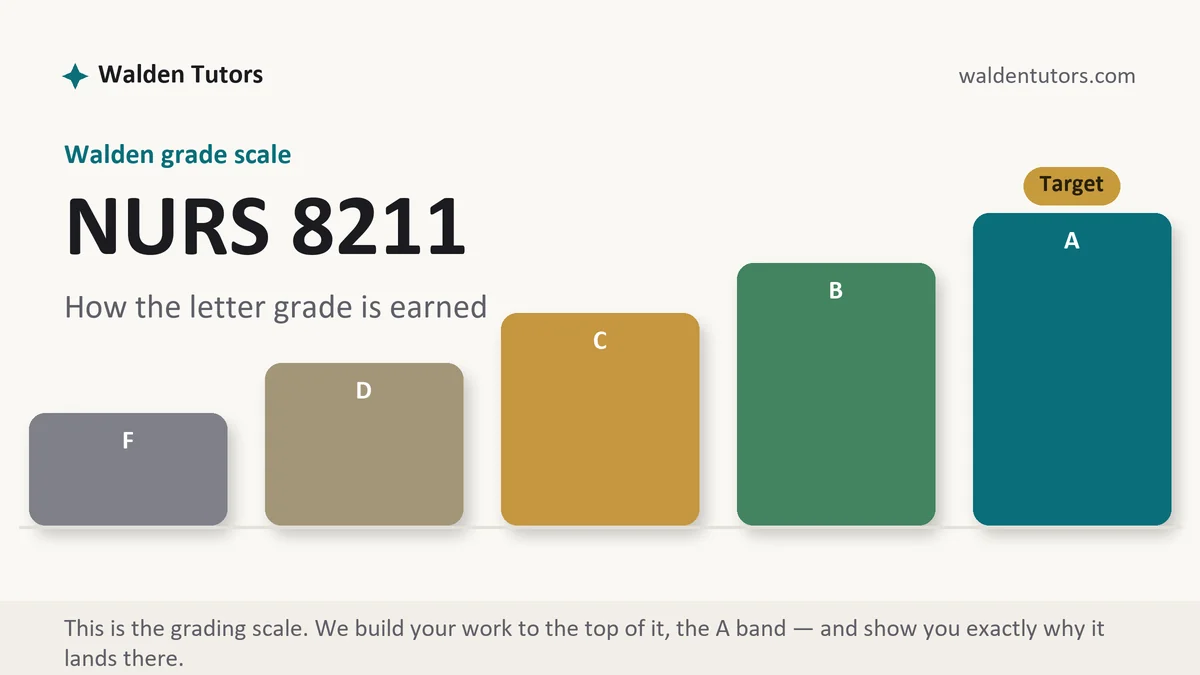
NURS 8211 grading scale at Walden, how the work is graded, from Walden Tutors
How Walden grades NURS 8211, visualized by Walden Tutors.

What NURS 8211 actually grades

Walden's own description sets the boundary of the graded work: research concepts and processes, quantitative and qualitative and mixed methods designs, data collection and analysis technique, research ethics, and a review of basic statistics that covers which procedure suits which question, what each procedure assumes, and how to read the output a package prints. Writing in a course shaped like that rewards one skill more than any other, which is taking a published study apart and stating what its design can carry.

Three verbs keep reappearing in the rows. Distinguish comes first, because Walden separates research from quality improvement and from evidence-based practice by purpose rather than by method, and mislabelling one as another is the most reliable way to lose points in this course. Appraise comes next, because naming a design earns nothing until you say what it controls for and what it leaves open. Translate comes last, since the course sits inside a practice doctorate and the closing question on most rows is what a clinician ought to do differently on Monday.

Statistics rows behave differently from the rest of the rubric. A grader is seldom checking arithmetic. The row is checking whether the test you named matches the level of measurement and the question being asked, whether you noticed the assumptions the procedure rests on, and whether a p value and a confidence interval arrive on your page as two separate pieces of information rather than one restated twice.

How we help in this course

Drafts for 8211 leave the methodological reasoning visible, so an appraisal shows its own steps rather than announcing conclusions. Send the article set your assignment names along with the scoring guide, and what comes back identifies the design, states the sampling and its consequences, reads the reported figures against the stated question, and stops where the evidence stops.

Terms here are the site's standard ones: delivery inside 24 to 48 hours, drafting aimed row by row at an A, two separate quality passes before anything reaches you, and revision at no cost until the target lands.

Weekly manuals for this course

No per-week manual for NURS 8211 has gone up yet. Each one publishes only once its contents are confirmed against something Walden actually prints, which is deliberately slow. Ask in chat for whichever week you are sitting in and the drafting desk starts immediately, with or without a manual behind it.

One thing worth knowing before you plan a term: Walden's quarter full term is published as an eleven and twelve week span, and a six-week half term also runs inside the quarter. Your own classroom decides how many graded items you owe and when, so build your schedule from the syllabus rather than from any week count you read on a tutoring site.

In NURS 8211 right now?

Attach the assignment brief and its rubric, plus the articles if your week names them. The first premium sample costs nothing.

Reading a results section without a statistics background

Most DNP students arrive at this course as expert clinicians and nervous readers of tables, and the anxiety is misplaced. You are not being asked to become a statistician. You are being asked to become a skeptical reader, and skepticism runs on four questions that need no computation at all. What was measured, and at what level. How many people, and how were they chosen. What was compared against what. How big was the difference, and how uncertain is that size.

Answer those four in order and the table stops being intimidating. Level of measurement tells you which family of tests was even available, so a means comparison sitting on top of ordinal data is a finding you can report without knowing the formula. Sample size and selection tell you how far the result can travel. The comparison tells you what the study is actually a study of, which is often narrower than its title suggests. And the effect size with its interval tells you whether a statistically significant result is also a clinically interesting one, which in nursing is very often the whole argument. A confidence interval that spans from trivial to substantial is saying something a p value never says on its own, and rubric rows about interpretation are usually written to catch exactly that.

How to actually write NURS 8211: let the question choose the design

Every appraisal in this course rests on a decision made before any writing happens, which is naming what kind of question is on the table. Whether an intervention works, what predicts an outcome, how accurately a test identifies disease, and what an experience means to the people living it are four different questions, and each has a design built to answer it. Trials speak to the first, cohort and case-control work to the second, diagnostic accuracy studies to the third, and qualitative inquiry to the fourth. Name the question type and your appraisal criteria stop being a matter of taste, because you are now asking one concrete thing: did this study use a design its own question required. Where it did not, that mismatch is your opening finding rather than a line buried in a limitations paragraph.

Read the paper out of order once you have it. Abstracts are written to persuade and they compress precisely the detail an appraisal needs, so begin in the methods, move to the tables in the results, and leave the discussion and the abstract until last, after you have formed your own view of what was found. Reading this way protects you from the commonest failure in a first appraisal, which is absorbing the authors' interpretation and then dressing it in critical vocabulary. Put your provisional verdict in one sentence before you read theirs. Where the two disagree, you have a paragraph worth writing, and the disagreement itself is the kind of judgment doctoral rows are built to reward.

Choose your study for how appraisable it is rather than for how interesting the topic sounds. A paper with a clearly stated design, a described sample, a named instrument and a reported effect gives you something to say about every criterion. A vague or heavily editorialised paper leaves half your analysis empty no matter how appealing its subject. Before drafting, fill a short grid for each source you intend to use: design, setting, sample and how it was selected, the comparison, the outcome measure and how it was captured, the result with its uncertainty, and the authors' own stated limitations. That grid is the paper in raw form, and everything after it is assembly.

Write from the question outward rather than from the article inward. Open with the practice problem and the question the evidence is supposed to answer, then let each section explain how well the study you chose is built to answer that specific question. This ordering is what separates a real appraisal from a book report, because a book report describes the study in the study's own sequence while an appraisal keeps the reader's question in view and measures the study against it the whole way down.

Synthesis, where your assignment calls for it, is a different act from summary and rubrics are written to notice the difference. Summary reports what each paper said. Synthesis reports what several papers mean together, and it needs at least one sentence that no single source could have produced. The quickest diagnostic is your paragraph openings. If a paragraph starts with an author's surname, you are summarizing. If it starts with a claim and the authors turn up inside the sentence holding it up, you are synthesizing, and the row is satisfied.

SectionWhat it doesWhere it goes wrong
Practice problem and questionNames the clinical gap and states the question the evidence has to answer, in whatever structured form your assignment accepts.A question so broad that no single study could address it, which leaves every later section vague by inheritance.
Design and methodsIdentifies the design and explains what that design is built to establish.Naming the design and stopping, with no sentence on what it controls for or what it cannot rule out.
Sample and settingReports who was studied, how they were selected, and how many were lost along the way.Copying the sample size without comment, so the reader never learns whether these patients resemble yours.
Measurement and data collectionDescribes the instrument or procedure and whether it has been shown to measure what it claims.Reliability and validity mentioned as vocabulary rather than reported as figures the study itself provides.
Analysis and resultsReads the reported statistics against the question, including size and uncertainty.Significance restated as importance, with no attention to how large the difference actually was.
Ethics and protectionsAccounts for consent, review board approval, and the safeguards used for anyone vulnerable.A single line saying approval was obtained, which satisfies nobody scoring an ethics row.
Limitations and practice implicationsStates what the evidence will support and what a clinician should do with it.Limitations borrowed wholesale from the authors, then an implication that quietly exceeds them.

Citations and APA the way Walden grades them

APA 7 is scored twice in this course, once as formatting and once as behavior. Formatting means the title page Walden expects, heading levels used consistently, and a reference list in which every entry has a matching in-text citation and every citation has an entry. Behavior means the sources arrived through the Walden Library rather than a general web search, that you opened them rather than trusting an abstract, and that the version you cite is the version you actually read.

A methods course adds one habit the others do not require. When you make a claim about what a design permits, cite the methodological source that says so rather than asserting it in your own voice. Statements about internal validity, sampling error or the assumptions behind a test are contestable claims, and a rubric row about scholarly support has something to reward when they carry a reference. Keep one master reference file running from your first deliverable so nothing drifts as material gets reused later in the sequence, and take your formatting questions to the Writing Center, whose templates are the ones Walden grades against.

Discussion posts that earn their row

Threads in this course are graded items with rubrics of their own, and they usually hand you a design, a scenario or a statistic and ask what you make of it. Build the initial post as a compact argument rather than an essay in miniature: state the position in the first sentence, name the evidence by author and finding rather than gesturing at the literature, concede the limitation you already see, and close on what a practicing nurse would do about it. Cite inside the post. A confident paragraph carrying no source reads as opinion to a row that says scholarly support.

Walden's grading policy asks for participation that is consistent, substantive and timely, and it recommends spreading your posts across at least two to four days of the week rather than stacking them. Take that literally in a methods course, because the responses worth writing depend on reading what other people posted, and there is nothing to read if everyone arrives on the last night. Walden also states plainly that posting requirements vary across courses and within them, so the count and the closing time come from your own classroom rather than from the last course you took.

Agreement is not a response. A reply that scores does something to the post it answers: it questions whether the design your colleague praised could actually detect the outcome they claim, it brings a study whose result cuts the other way, it points out that a sample drawn from one setting may not describe theirs, or it names an assumption behind the test they cited. Two or three of those, posted courteously and with citations attached, is the entire row. Everything below deadline pressure is due at 10:59 p.m. Central, which is 11:59 p.m. Eastern, so check which clock your calendar is showing you.

The mistakes that cost points in NURS 8211

  • Calling a quality improvement project research, or the reverse, because the label was chosen from the method rather than from the purpose behind it.
  • An appraisal that walks through the article in the article's own order, which produces a summary wearing an appraisal's headings.
  • Statistical significance reported as though it settled the clinical question, with no mention of effect size or interval.
  • Limitations lifted from the authors' own discussion section and then contradicted by an implication that reaches further than the study did.
  • Instruments described by name only, so nothing on the page tells the reader whether the measure was any good.
  • Sources found through a general search engine, which usually shows up as an open-access paper standing in for the trial your argument needed.

NURS 8211 questions students actually ask

How do I tell quality improvement apart from research in a paper?

By intent and by who the findings are for. Research sets out to produce knowledge that holds beyond the place it was gathered, so it carries a hypothesis or a research question, a design chosen to defend a general claim, and oversight from a review board. Quality improvement sets out to make one system work better, uses repeated small tests inside that system, and does not claim its result transfers. Evidence-based practice sits downstream of both: it takes findings that already exist and applies them locally. State the intent in your own sentence before you label anything, because the label follows the purpose rather than the method.

Do I have to run statistics myself in this course?

Read your own assignment instructions, because the balance shifts between deliverables. Some items ask only that you interpret output somebody else produced, and the graded skill there is naming the test, checking it against the level of measurement, and saying what the result licenses. Other items hand you a small dataset or a software walkthrough and expect the output as an appendix. Where computation is required, the rubric almost always weights interpretation above arithmetic, so a correct number with no reading of it still loses the row.

How many sources should an appraisal paper use?

Whatever number your instructions print, and no fewer. Where no figure is given, let the argument set it: an appraisal of one study needs that study plus the methodological sources you use to judge it, while a synthesis needs enough studies that a pattern is visible rather than asserted. Depth beats volume in this course. Six studies genuinely appraised for design, sample and effect will outscore fifteen listed with a sentence each, because the rubric rows are written to reward judgment and there is nothing to judge in a list.

Keep going

Online now