One habit sinks more submissions here than any gap in theory: writing about the person you would fix rather than the relationship you would build. Personal Leadership: Mentoring and Coaching carries the code WMBA 6633 and three semester credits, and WMBA 6000 comes first. Walden centers it on active listening, learning, empowering and enabling change, including what those look like when the other person is on the far side of a screen.
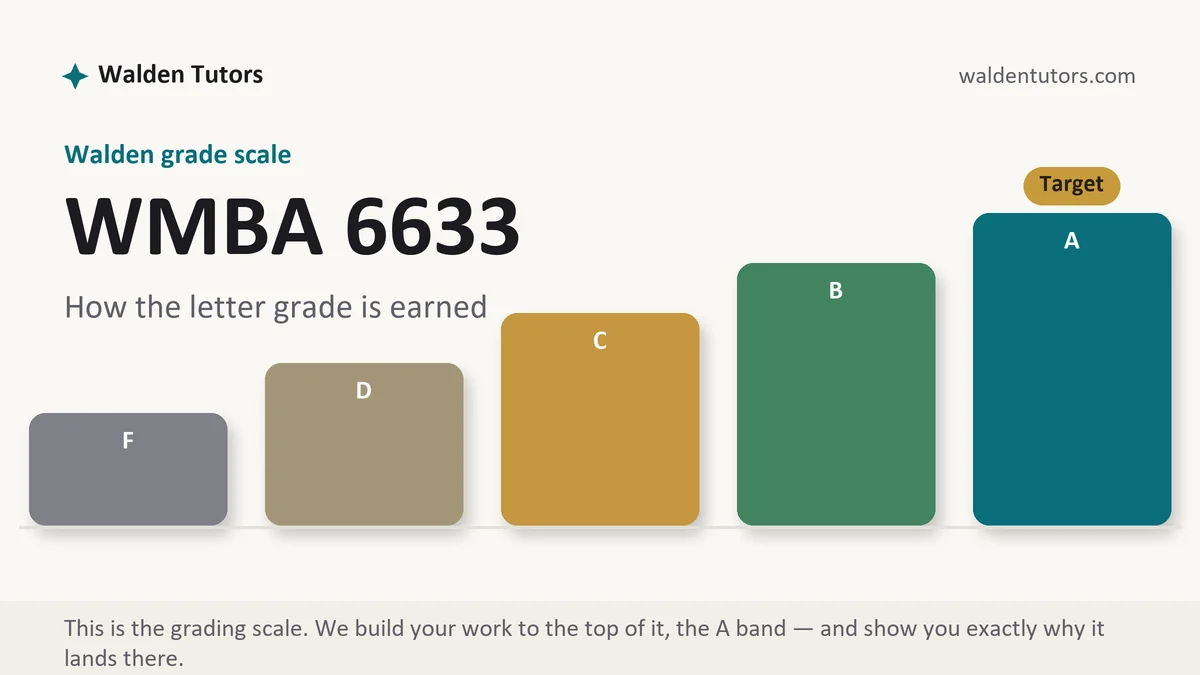
What WMBA 6633 actually grades
The deliverables lean personal and applied. Expect reflective self-assessments of your own leadership habits, developmental plans built for a named person, written or transcribed dialogue where you show a conversation rather than describe one, analyses of a feedback exchange that went well or badly, and pieces on what changes when mentoring happens across distance or inside a team. Graded discussion threads sit alongside all of it.
Walden points the course at practical exercises specifically: using feedback to create genuine two-way dialogue, and asking questions that reach a deeper understanding of what mentoring and coaching actually involve. That word "practical" sets the standard for the writing. A paragraph explaining that active listening matters earns very little. A transcript in which you paraphrase what the other person said, check whether you understood it, and leave a silence long enough for them to add the thing they were holding back, earns the row.
Reflection is graded too, and it is graded as evidence rather than confession. Naming a habit, showing where it appeared in a real exchange, and stating what you will do differently next time is reflection. A paragraph of gratitude for the learning experience is not.
Advice versus coaching
Most students arrive able to give good advice and unable to stop. That instinct produces submissions where every coaching question is really a suggestion wearing a question mark. "Have you thought about talking to your manager?" is advice. "What would have to change for that conversation to feel possible?" is a question, because you genuinely do not know the answer.
The distinction between the two roles matters as well. Mentoring is developmental and long-running, and the mentor brings experience the other person has not had yet. Coaching is focused on a goal and works by drawing capability out rather than putting knowledge in. Assignments often name one and quietly reward whichever you demonstrate accurately, so decide which you are doing before you draft and stay in that role.
How we help in this course
What we need is the prompt itself, your classroom's scoring guide, and any framework or reading the week hung off it. What comes back is a draft in the register the assignment asks for, with dialogue that behaves like dialogue, reflection anchored to specifics, and any model used rather than merely cited.
Conditions are the same site-wide. Work comes back within 24 to 48 hours, built to reach an A row by row, read twice over by two different people, one scoring it and one going through citations and originality, and revisions cost nothing until it lands.
Weekly manuals for this course
Week manuals for WMBA 6633 have not published yet. Walden does not release syllabi publicly, so each week page here waits on confirmation from someone actually enrolled. If your week is missing, describe it in chat and drafting starts from your own classroom instructions with no manual required.
Drafting a WMBA 6633 assignment?
Send the prompt and the scoring guide. Nothing is charged for the opening sample, and it is back with you in two days.
The calendar behind the course
As an MBA course this one runs on semesters, which are considerably longer than the quarters used across Walden's nursing programs. Spring Semester 2026 is published as January 5 to April 26 and Summer Semester 2026 as May 4 to August 23. Both cover 111 days, and dividing by seven puts the term just under sixteen weeks. Walden's calendar publishes dates rather than a week count, so present sixteen as your own arithmetic on their figures.
The submission clock does not move. Everything closes at 10:59 p.m. Central; shift that to Eastern and it is 11:59 p.m. Walden separately requires that the opening week of a term show both a login and a submission from you, graded work or a discussion contribution either way, and that rule is enforced for attendance rather than for academics.
The number of deliverables you personally face is a classroom question. Walden states that posting requirements are not consistent across courses or between weeks, so read the week rather than carrying over the shape of a previous one.
How to actually write WMBA 6633
Open the scoring guide first and let it structure the draft. Paste the rows in as temporary headings, size each section against its weight, and remove them before you submit. Personal writing tempts people into shape-free drafting, and shape-free drafting is where these rows get missed.
Choose a real relationship. Someone you have mentored, someone who mentored you, a colleague you would coach if the door opened. Real relationships come with texture that invented ones cannot fake: what the person is actually good at, what they avoid, what they said the last time somebody raised it. Anonymise properly, change identifying details, and if the situation is currently tense at work, pick a different one so you are not writing your way through a live problem.
Set a goal you could tell had been reached. "Grow as a leader" is not a goal, it is a mood. "Chair the weekly operations meeting without handing it back to the supervisor by the third item" is a goal, and everything else in the plan can now hang off it. Attach a horizon, name what success would look like from the outside, and say how the two of you would know.
Contract the relationship openly. Good mentoring and coaching writing includes the boring agreements: how often you meet, for how long, what stays between you, what the other person's manager will and will not hear, and what either of you can do if it stops being useful. Students skip this because it feels administrative. Graders reward it because it is the difference between a professional relationship and a series of nice chats.
Structure the conversation with a named framework and then show it working. A goal, reality, options, way forward sequence is one common approach, and it is useful because it stops you from jumping to solutions before the situation is understood. State the goal for this session, explore what is actually happening now with questions rather than assumptions, generate several options including ones you personally would not choose, and close with a commitment the other person makes rather than one you assign. If your assignment names a different model, use theirs. What matters is that the reader can see the structure operating in the dialogue, not just named in the introduction.
Write listening so it is visible on the page. Reflecting back what you heard in your own words, checking the accuracy of your reading before responding to it, summarizing a long answer down to its core, and leaving silence rather than filling it are all things a transcript can show. So is the moment you get it wrong and the other person corrects you, which is often the strongest paragraph in the piece because it demonstrates that the listening was real.
Handle feedback as three separate moves. Describe the behavior you observed without adjectives. State the effect it had, on the work, on the team, on you. Then hand the conversation over and let the other person account for it, which is the step that turns feedback into dialogue instead of a verdict delivered kindly. Keep observation apart from interpretation throughout. "You interrupted twice in the client call" is observation; "you were dismissive" is interpretation, and mixing them is what makes feedback land as an attack.
Address the virtual and team dimension, since Walden names it explicitly. Distance strips out the cues you rely on, so trust has to be built deliberately rather than accumulated by proximity. Say what you would do about it: cameras on for the harder conversations, a standing slot rather than ad hoc contact, written summaries after sessions so nothing depends on memory, and explicit permission to interrupt because the usual signals for wanting to speak do not survive a video call. Coaching a group adds another layer, since anything said in front of peers carries a social cost the same words would not carry privately.
Even reflective work is academic work. First person is usually permitted here, and where the prompt allows it, use it plainly. Claims about how people learn or how feedback functions still need sources, and those come through the Walden Library rather than a search engine. Give each source one job. APA 7 still applies from top to bottom: title page, heading levels, citations formatted where they sit, and a reference list you can read against the body in either direction without a gap opening up.
| Section | What has to be in it | How it usually goes wrong |
|---|---|---|
| Context and relationship | Who the person is in anonymised terms, how you know them, and which role you are in. | Mentoring and coaching used interchangeably, so the reader cannot tell what is being demonstrated. |
| Self-assessment | Your own tendencies as a listener and responder, with an example that shows one. | A list of strengths with no incident behind any of them. |
| Goal and agreement | An observable goal, a horizon, and the working agreements covering confidentiality and cadence. | An aspiration nobody could confirm, and no agreement about how the relationship runs. |
| Session structure | A named framework with the stages visible in the dialogue you present. | The model named in the introduction and then absent from everything that follows. |
| Questions and listening | Open questions you did not know the answer to, plus reflecting, checking and summarizing. | Advice reformatted as questions, each one steering toward the answer you had already picked. |
| Feedback | Behavior described, effect stated, then the conversation handed back for a response. | Judgment presented as observation, which reads as a verdict rather than an exchange. |
| Virtual and team setting | What distance removes and the specific adjustments you would make to compensate. | Remote treated as identical to in-person with a sentence about technology attached. |
Discussion threads in a mentoring course
Threads carry graded rows and often ask you to respond to a short scenario about a difficult conversation. Post something concrete: the question you would ask first and what you are hoping it opens up, what you would deliberately not say, and the assumption you would test before offering anything. Bring a source with you, because a claim about how people receive feedback is precisely the kind of statement the evidence row exists to check.
Walden wants contributions that are consistent, substantive and on time, spread over two to four days of the week at a minimum rather than filed all at once. Replies are scored on their own and agreement contributes nothing to that score. Extend a classmate instead: offer the question their approach never asks, point out where their phrasing would put the other person on the defensive, or ask how their plan changes if the two people have never met in person. The number of replies and the closing day come from your classroom, so check the week's instructions.
The mistakes that cost points in WMBA 6633
- Advice dressed as questions, so the dialogue only ever arrives where the writer had already decided to go.
- A development goal phrased so vaguely that nobody could say afterwards whether it was reached.
- Listening described in the abstract while the transcript shows the writer talking through every turn.
- Feedback that opens with a judgment, leaving the other person defending character rather than discussing behavior.
- Mentoring and coaching used as synonyms, which loses the row asking you to distinguish them.
- Reflection that reports feelings about the exercise instead of naming a habit and what will change.
- Identifiable details about a real colleague left in a submission that should have been anonymised.
WMBA 6633 questions students actually ask
Can I write this in first person?
Usually yes, and pretending otherwise makes reflective work worse. Check the prompt, since some items in the course are still conventional papers, but where you are analyzing your own practice the first person is the natural register and Walden's writing guidance accepts it in reflective assignments. First person does not lower the academic bar. Claims about how learning or feedback works still need citations, APA 7 still applies to the title page and the reference list, and structure still matters. Write plainly rather than casually.
What is the actual difference between mentoring and coaching here?
Mentoring is the longer relationship, usually with someone further along the same path, and it works partly by transferring experience. Coaching is tighter, aimed at a defined goal, and it works by drawing capability out of the person rather than supplying it. A mentor may say what they did in a similar situation; a coach is more likely to ask what options the person sees and what is stopping them from choosing one. Assignments in this course often specify one or the other, and staying inside that role is the fastest way to satisfy the row.
What if I have never mentored anyone?
Then write from the other chair. Almost everyone has been coached, supervised, trained or advised by somebody, and analyzing that relationship from the receiving end gives you the same material: what the other person did, what it produced in you, where it fell short. You can also build a plan for someone you would coach if the opportunity came, provided you keep it concrete about the person and the goal. What does not work is inventing a fictional protege with no texture, because the specificity the rubric rewards is exactly what fiction fails to supply.